
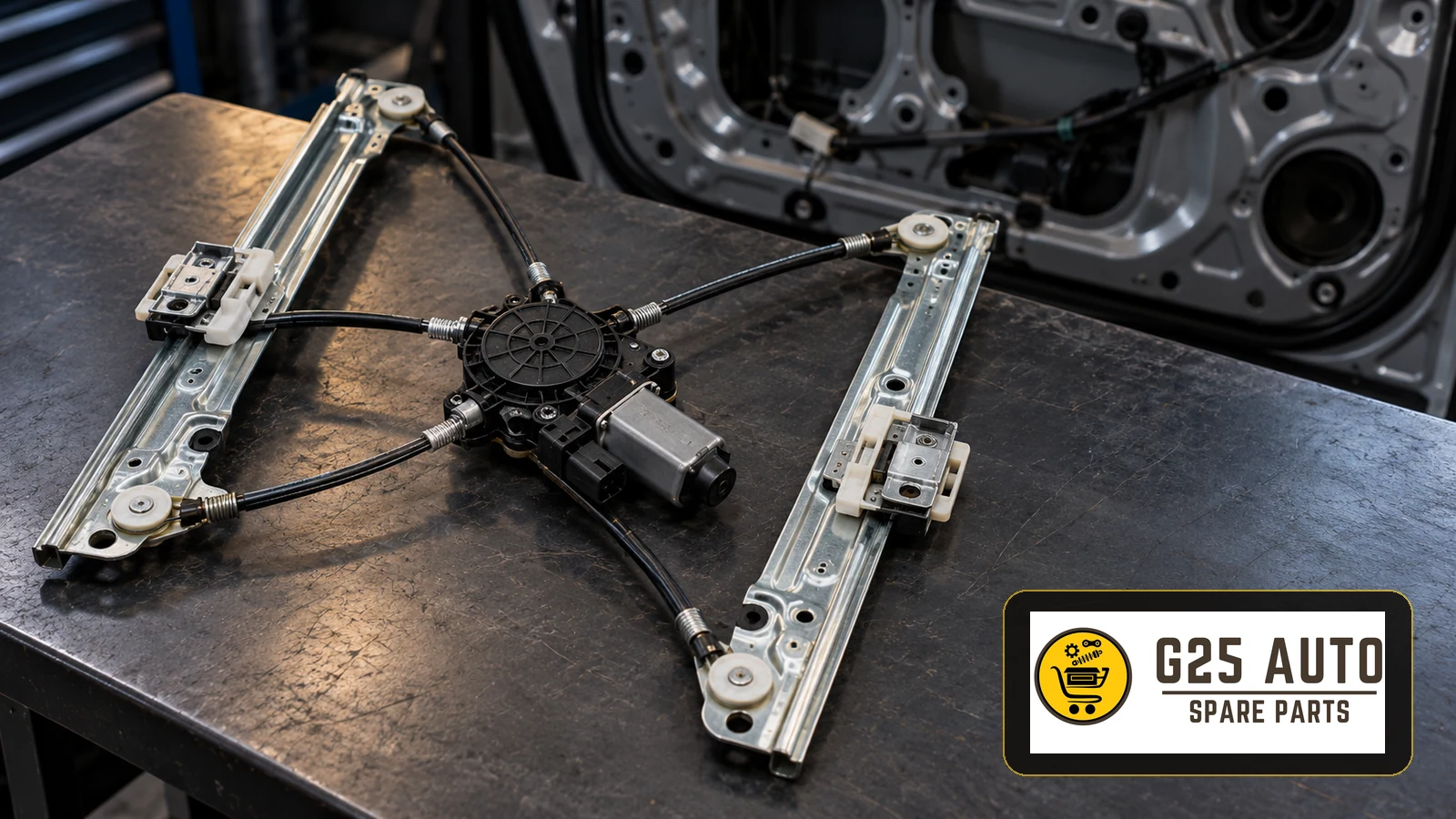
A window regulator should be selected only after the workshop has separated a mechanical lifting fault from a motor, supply or control problem. Confirm the affected door, installed mechanism and electronic functions before ordering. For European and Balkan workshops, distributors and fleet buyers, the most useful enquiry combines a recorded diagnosis with vehicle identification and a clear description of what the replacement assembly must include.
Understand the mechanism before naming the part
The regulator moves and supports the door glass. A manual system receives movement from a hand crank; a powered system uses an electric drive. Cable mechanisms transmit movement through cables and guides, while scissor mechanisms use articulated arms. These descriptions identify construction, rather than proving that one design has a longer service life or is easier to replace.
Brose’s door-system overview illustrates cable regulators with different guide arrangements, integrated carrier modules and drives with electronic functions. The practical lesson is to identify the installed system rather than treating every regulator as a stand-alone mechanical part.
Distinguish the mechanism from its drive and controls
A supplier may list a mechanism alone, an assembly with a motor or a larger carrier module. Establish the intended repair scope explicitly. One-touch operation and anti-trap functions also require attention when identifying the replacement drive and its electronics. A similar-looking connector is useful comparison evidence, but it does not establish compatibility by itself.
Turn the complaint into a diagnostic record
Record whether the glass is slow, tilted, noisy, stationary or moving in only one direction. Note which switch was used and whether the problem is repeatable. Ask about earlier door repairs, glass replacement and loss of normal window functions. Avoid repeatedly operating a mechanism that is visibly damaged or no longer supporting the glass correctly.
Inspect before replacing the motor
ELTA’s window regulator guidance explains that motor noise without glass movement can point towards the mechanism, while silence calls for further electrical diagnosis. Neither observation alone identifies the failed component. Use the applicable wiring information and service procedure to investigate the command, circuit and mechanical connection.
With safe access established, assess the glass attachment, guides, cables or arms as fitted. Record the findings rather than describing the job simply as a faulty window. Do not apply power to unidentified terminals or force the glass through an obstruction. Where the glass is loose or trapped, arrange controlled workshop handling using the manufacturer’s support and access instructions.
Make the parts enquiry specific enough to check
Provide the VIN, relevant build and equipment information, and readable identification from the installed assembly. State front or rear and left or right explicitly. In markets containing both left-hand-drive and right-hand-drive vehicles, descriptions such as driver side can be ambiguous; pair them with the physical door position.
Attach photographs of the mountings, glass attachments, motor interface and connector. Ask the supplier to confirm the application through its catalogue and clarify any replacement reference. A reference number or photograph supports that enquiry; neither should be treated as an unconditional fitment guarantee.
Confirm the supply scope in writing
Establish whether the motor is included and whether reuse of the existing drive is permitted for the proposed assembly. Confirm the required electronic functions and any separate fasteners, seals or clips. Ask for installation information and traceability, warranty and return terms. Compare those documented facts when assessing offers, without assuming equivalent construction or performance from branding alone.
Workshop and purchasing checklist
- Record the complaint, switches tested and diagnostic findings.
- Identify the exact door and installed regulator construction.
- Supply vehicle identification and relevant equipment information.
- Retain readable markings and photographs of the original interfaces.
- Confirm mechanism, motor and carrier-module supply scope.
- Check electronic functions and documented installation requirements.
- Agree traceability and commercial terms with the supplying business.
- Define final checks and retain their results with the job record.
Plan installation and initialisation for the actual vehicle
Use the manufacturer’s procedure for door access, glass support, electrical isolation, removal and fastening. Review precautions for any door-mounted restraint components before work begins. Follow the specified sequence for transport retainers and glass adjustment. Restore the required barriers, plugs and seals, and use only the specified products and settings.
Initialisation is application-specific. Tesla’s Model 3 calibration procedure, for example, uses a service-mode routine and warns that pinch detection is disabled during calibration. This is a bounded example, not a reset sequence for other vehicles. Consult current information for the vehicle being repaired and keep people and objects clear during prescribed movement.
Complete the specified travel, alignment, control and protection-function checks before handover. Use the manufacturer’s approved protection-function test method; never use a hand or another body part as an obstruction. Record unresolved noise, uneven travel or lost functions, and investigate them before releasing the repair. Recommend maintenance according to the applicable service guidance rather than promising a fixed lifespan or prescribing universal lubrication.
Frequently asked questions
Does a silent window mean the motor needs replacement?
No. Investigate the electrical command and circuit as well as the drive. Silence alone is insufficient evidence for ordering a motor.
Can the original motor be reused?
Only where it is serviceable and reuse is supported by the replacement assembly’s application and instructions. Confirm the interface and electronic functions first.
Will lubrication fix slow glass movement?
Do not assume so. Establish the cause and follow the specified cleaning or lubrication guidance. Lubricant cannot substitute for diagnosis of damaged components.
Is the same reset procedure suitable for every window?
No. Use the current vehicle-specific procedure and its precautions. Some repairs require diagnostic equipment rather than a generic switch-holding sequence.