
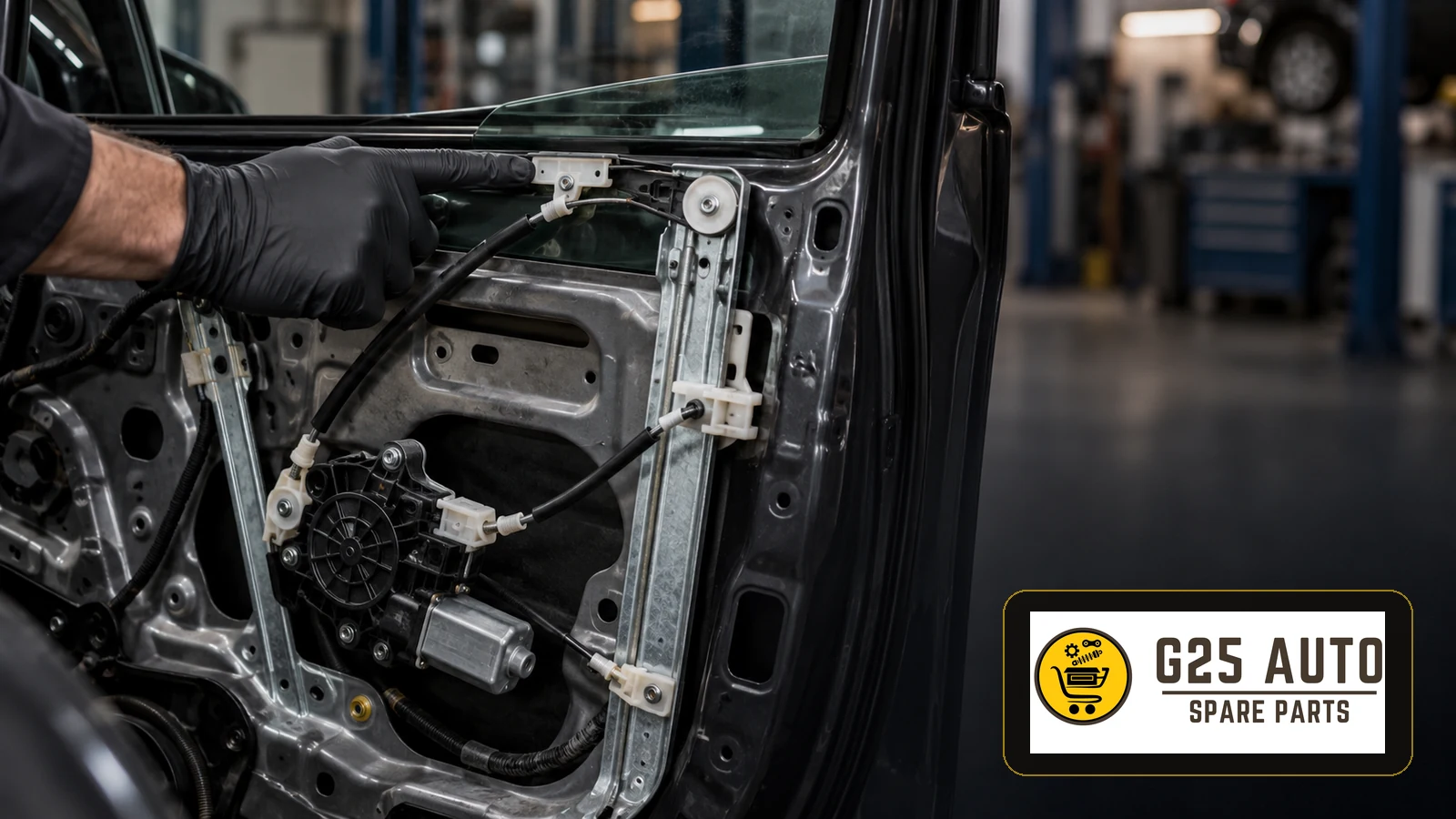
A slow, noisy or stationary window does not identify a failed regulator by itself. Separate the glass-support mechanism from the motor, electrical supply and control functions before ordering parts. For European and Balkan workshops, fleet operators and distributors, a useful repair starts with a precise symptom record and ends with a confirmed replacement specification and documented operating checks.
Describe what the window actually does
Record the affected door, movement direction, sounds and glass position. Establish whether the fault occurs consistently or intermittently, and whether normal operation returns without intervention. Ask about recent glass replacement, door repairs or electrical work. A fault that disappears still needs investigation; temporary operation does not demonstrate that a damaged mechanism has repaired itself.
Motor noise with little or no glass movement
A running motor with stationary, uneven or dropped glass directs attention towards the lifting mechanism and its connection to the glass. ELTA’s window regulator guidance distinguishes this pattern from a silent drive. Treat the observation as a diagnostic lead, then inspect the assembly using the vehicle’s access and glass-support procedure. Avoid repeated operation when the glass is loose or the mechanism is visibly damaged.
No movement and no motor sound
Silence does not prove motor failure. Establish whether the command reaches the system and investigate the applicable circuit, supply and connections using the correct wiring information. Record results from the available switches and any relevant window-lock settings. Electrical measurements need the manufacturer’s test conditions and expected values; do not apply power to unidentified connector terminals.
Slow, jerky or tilted glass
Inspect the installed guides, seals, attachments and lifting components before deciding which part to replace. Ac Rolcar’s technical FAQs identify misplaced sliding seals as a possible explanation for slow movement even with a new regulator. Follow the applicable cleaning and adjustment instructions rather than assuming that another new motor or a universal lubricant will solve the complaint.
Separate lost automatic functions from mechanical failure
A window that moves while the switch is held but has lost automatic closing deserves a different investigation from glass that has detached from its support. Check the relevant control functions and current service information before treating either complaint as proof that the lifting assembly needs replacement.
A Mercedes-Benz service bulletin describes selected models with lost automatic raising while switch-held movement remained available, and discusses door-control software and normalisation. Its model coverage and qualifications matter. This is evidence that a control issue can resemble a regulator complaint, rather than a repair prescription for other vehicles. Check the latest applicable information for the actual vehicle.
Manual systems need a separate assessment
For a hand-operated window, record stiffness, uneven travel and the relationship between handle movement and glass movement. Inspect the mechanical drive and guides under the relevant service procedure. Electrical fault-finding does not apply to the hand-operated lifting mechanism. Avoid using extra force as a substitute for identifying resistance or a failed connection.
Build a parts enquiry from the diagnosis
Give the supplier the VIN, model, build information and relevant door equipment. State front or rear and left or right explicitly; driver-side descriptions become ambiguous across markets with different steering positions. Include readable markings from the installed assembly and photographs of its mounting points, glass attachments, drive interface and connector.
Ask the supplier to verify the application in its catalogue and explain any replacement reference. Similar appearance, a matching plug or a cross-reference alone should not be treated as an unconditional fitment guarantee. Record previous modifications or an earlier replacement, since the assembly now fitted may differ from the original specification.
Confirm what the replacement includes
Distinguish a mechanism without a motor, a motor-equipped assembly and a larger carrier-panel unit. Confirm whether reuse of the existing drive is supported, and whether its condition justifies reuse. Identify required one-touch and protection functions from the vehicle specification. Agree the supply scope, installation information, traceability and commercial terms in writing instead of assuming quality, availability or warranty length from the product category.
Workshop and purchasing checklist
- Record the door position, symptom and conditions under which it occurs.
- Separate mechanical findings from electrical and control findings.
- Identify the vehicle and relevant window equipment.
- Retain assembly markings and clear interface photographs.
- Confirm the catalogue application and complete supply scope.
- Check any motor-reuse conditions and electronic functions.
- Prepare the specified fitting and initialisation information.
- Record final operating checks and unresolved findings.
Verify the repair before handover
Plan safe glass support, door access and electrical precautions from the manufacturer’s procedure, including any requirements for door-mounted restraint components. Follow the specified fastening and adjustment instructions, restore barriers and seals, and carry out initialisation where required. There is no universal switch-holding sequence suitable for every system.
Check the prescribed travel, alignment, switch operation and automatic functions. Use only the manufacturer’s approved protection-function test method; keep body parts clear of the glass path. Investigate remaining noise, hesitation or uneven movement before releasing the repair. Give fleet customers a record of the diagnosis, fitted assembly and completed checks, with any maintenance advice based on the relevant service information.
Frequently asked questions
Does a clicking or grinding noise identify the failed part?
No. Record when it occurs and inspect the mechanism and attachments. Noise guides the investigation but is insufficient for selecting a replacement.
Must every window regulator be replaced together?
Assess each reported fault and follow applicable service requirements. Do not add unaffected doors to a parts order solely because one regulator needs replacement.
Can the motor be ordered separately?
That depends on the assembly and supported replacement options. Confirm the diagnosed failure, motor interface and electronic requirements before ordering.
How long should the workshop allow for the job?
Use the applicable labour information and assessed repair scope. Door access, glass condition, diagnosis and initialisation requirements prevent a single duration from applying to every vehicle.