
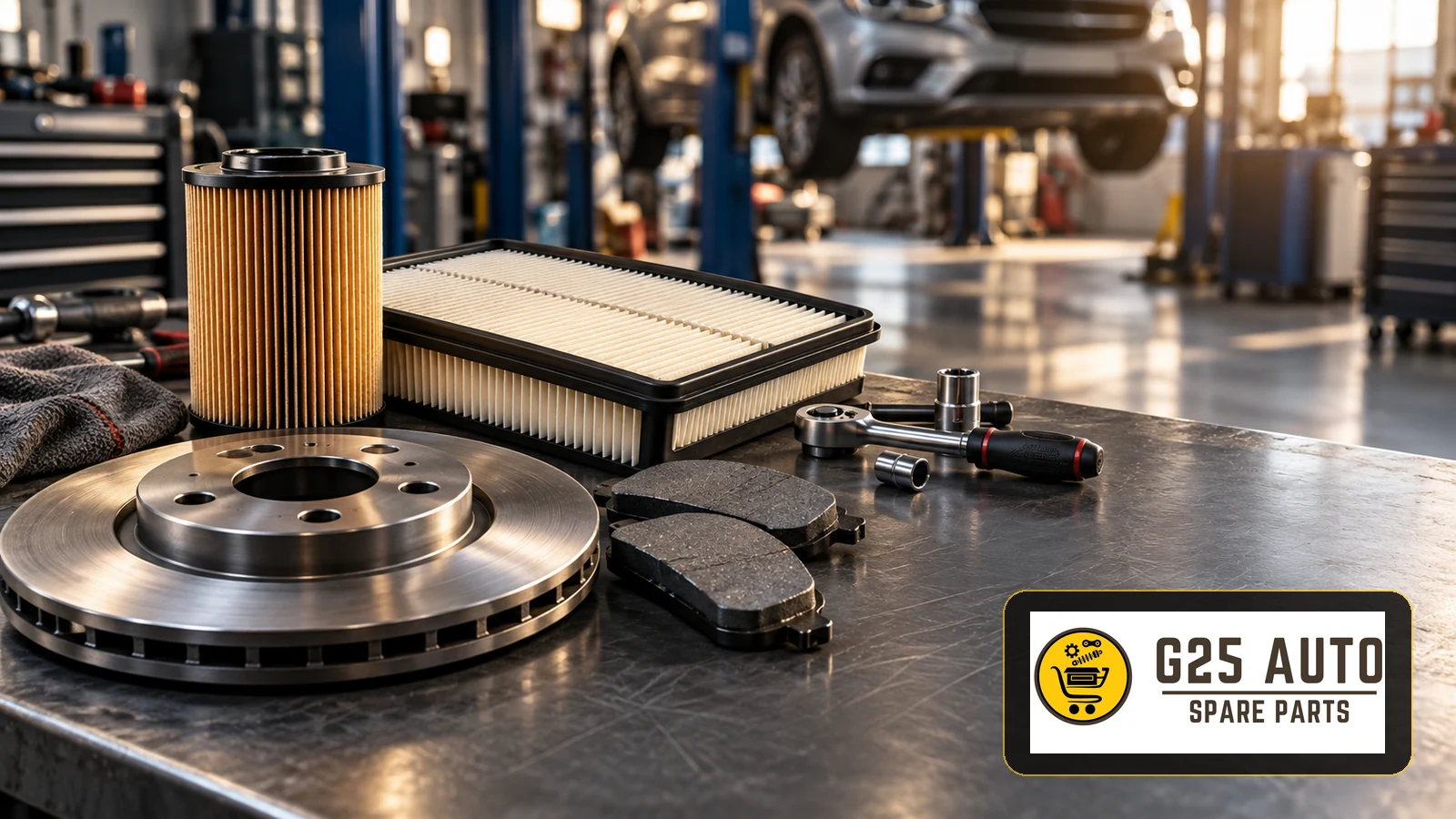
Replace service parts when the vehicle manufacturer’s schedule or a qualified inspection requires it, rather than waiting for a breakdown or applying one mileage interval to every vehicle. For European and Balkan workshops, distributors and fleet buyers, timely replacement starts with accurate vehicle identification, reliable service history and a clear distinction between scheduled maintenance and repairs prompted by condition. Those inputs should determine the parts order and the workshop booking.
Build the maintenance plan around the exact vehicle
Use the applicable schedule
Record the VIN, engine and other details needed to retrieve the correct maintenance information. Establish the last documented service date and mileage, then identify the next operations due under that schedule. Follow its time, distance and service-indicator requirements as applicable. A dashboard reminder should be interpreted using the vehicle’s instructions; it does not replace the complete maintenance plan.
For example, Ford’s service-interval guidance explains that schedules vary by model and engine and that operating conditions can affect oil-change requirements. This illustrates why a mixed fleet needs vehicle-specific planning. Short journeys, urban use and heavy loads should be recorded and checked against the relevant manufacturer’s guidance.
Separate scheduled work from condition findings
A scheduled replacement is due because the applicable maintenance requirement has been reached. A condition-based repair follows inspection, testing or diagnosis. A vehicle can need both at the same visit. Keep these reasons separate on the job card so the buyer can understand why each item is requested.
Where history is missing, mark it as unknown and arrange a workshop assessment. Do not invent a previous replacement date or assume that an apparently normal-running vehicle has completed its required maintenance.
Review the main service-part groups
Engine oil, oil filters and air filters
For combustion-engine vehicles, obtain the oil specification and oil-filter application from current vehicle information. A broad viscosity description or similar-looking filter is insufficient for an order. Confirm the applicable oil and filter service requirements together.
Treat the engine air filter and cabin filter as separate items with different functions and catalogue references. Apply their respective service and inspection instructions. Do not turn a generic filter mileage range into a fleet-wide rule or assume that every cabin-filter design fits the same housing.
Brake pads and discs
Specify brake work from inspection findings and the relevant service limits. Noise or vibration calls for diagnosis; it does not identify a worn pad by itself. Bosch’s brake-pad troubleshooting guidance describes several possible causes, including caliper and disc issues. Replacing pads without investigating the cause can leave the underlying problem unresolved.
Record the installed brake configuration and the components required by the repair procedure. Do not select pads or discs solely from a model name when the catalogue lists several brake variants. Report a change in braking performance promptly and obtain qualified assessment before further operation when safety is in question.
Timing belts and auxiliary drive belts
Identify the installed engine’s timing-drive arrangement before planning replacement. A timing belt and an auxiliary drive belt perform different jobs; their requirements should not be combined into one generic interval. Ford’s timing-drive guidance likewise directs owners to vehicle-specific information.
Have the workshop define the repair scope, associated components and required fitting information before ordering. A kit label alone does not establish its contents. Document any unresolved application question rather than substituting a similar belt or assuming that every related component is included.
Tyres and starter batteries
Tyre review should include wear, damage and age, with professional assessment where required. Michelin’s tyre-life guidance considers inspection and age alongside tread condition. Seasonal changeovers are a useful opportunity to record findings, but they do not replace ongoing checks or applicable local requirements.
For starter batteries, record test findings and confirm the specified technology and vehicle application before authorising replacement. Do not treat a general age estimate as proof of failure. VARTA’s start-stop replacement guidance distinguishes AGM and EFB requirements. Ask the workshop to confirm any battery-management procedure required for the particular vehicle.
Turn the findings into a B2B parts order
Group work by vehicle and planned workshop visit, while retaining the reason for every replacement. For a distributor supplying several workshops, keep each application enquiry attached to its quotation. Separate confirmed requirements from items awaiting inspection; avoid buying speculative components merely because they share a product category.
Compare quotations using exact references, package contents and documented application notes. Obtain order-specific availability and commercial terms from the supplier. A maintenance plan cannot establish stock, a delivery commitment or the performance of an unspecified substitute.
Maintenance and purchasing checklist
- Identify: record the VIN and catalogue-required vehicle details.
- Review: check documented service dates, mileage and unresolved history.
- Schedule: confirm the applicable maintenance requirements and operating conditions.
- Inspect: attach findings and distinguish scheduled work from diagnosed repairs.
- Specify: confirm product references, variants, quantities and kit contents.
- Order: obtain written confirmation of application and quotation-specific terms.
- Complete: record fitted parts, work performed and required completion checks.
- Resume planning: enter the next due work using the applicable schedule.
Frequently asked questions
Is there one replacement mileage for all service parts?
No. Requirements depend on the vehicle, component, schedule and inspection findings. Use current information for the exact application.
Can a vehicle wait for symptoms before scheduled maintenance?
Normal operation does not demonstrate that scheduled work is unnecessary. Follow the applicable maintenance requirements even when no symptom is reported.
Should every inspected part be replaced?
No. Inspection and replacement are distinct operations. Record the findings and apply the relevant criteria before approving the repair scope.
What if two supplier catalogues disagree?
Hold the uncertain item and resolve the application with the supplier and workshop. Keep the confirmed reference and supporting information with the order.