
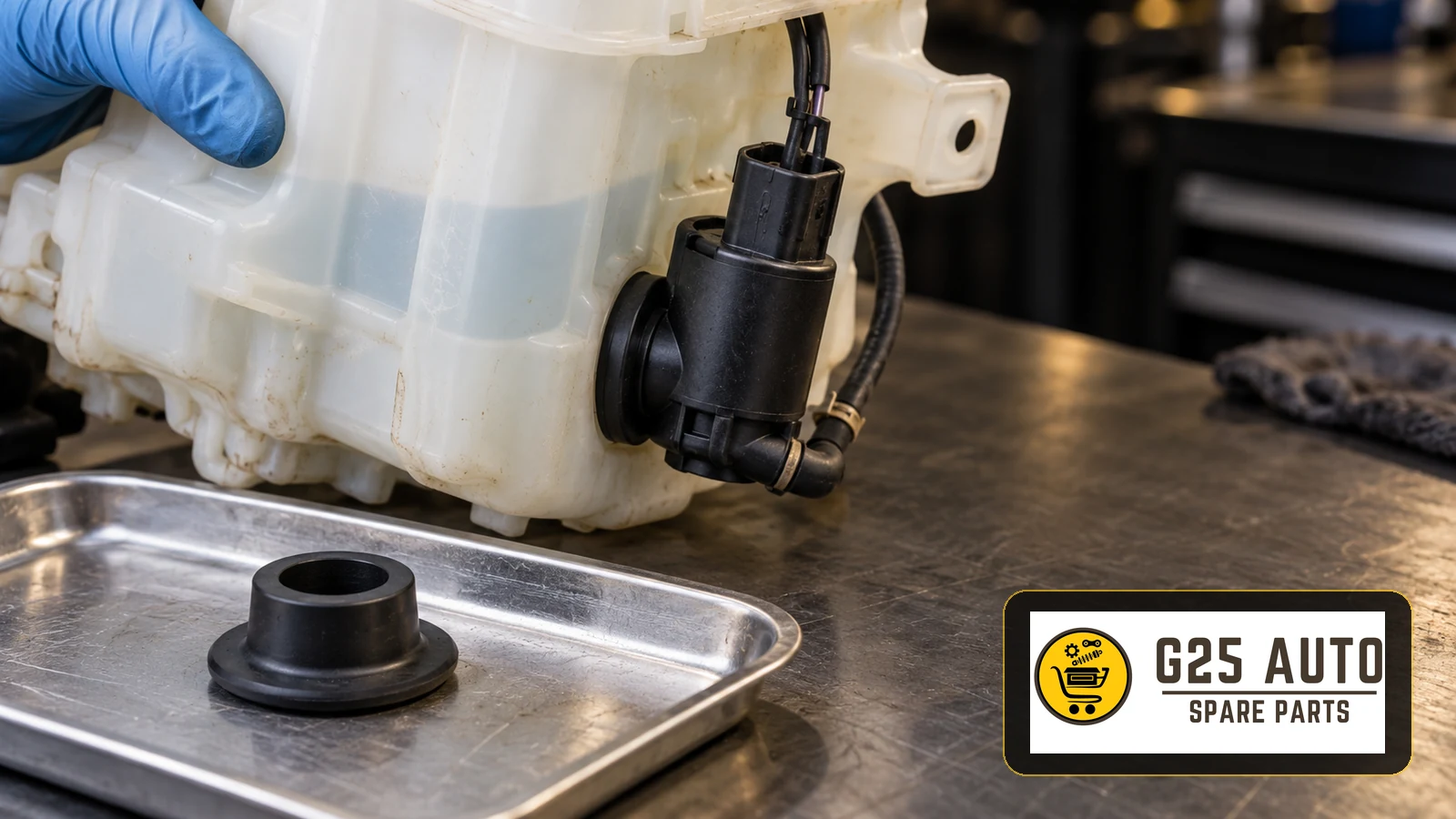
A washer pump reservoir grommet seals the joint where the pump enters the washer-fluid tank. Replace it when inspection confirms a damaged or leaking seal, after checking the surrounding reservoir, pump and hose connections. A falling fluid level or weak spray does not identify the failed component on its own. For workshops and parts buyers, the correct approach is to establish the leak location, confirm the vehicle application and order the documented repair components.
Identify the seal before specifying a repair
Parts descriptions may refer to a pump seal, mounting rubber, reservoir grommet or grommet/filter. Check the illustrated parts catalogue to establish which component the description covers. Do not confuse this joint with a filler-neck seal, reservoir-cap seal or level-sensor seal elsewhere on the tank.
Some applications combine the pump mounting seal with a filter. This is a construction detail to verify, rather than a reason to substitute a plain rubber ring. The correct profile, seating arrangement and any integrated filter must match the documented application; appearance alone is insufficient.
Separate fluid leakage from poor washer performance
Record when and where the complaint occurs
Ask whether fluid disappears while the vehicle is parked, after filling or during washer operation. Record which washer functions are affected and whether work has recently been carried out near the reservoir. Photographs of the initial wet area can help a technician and parts desk discuss the same fault.
A puddle below the vehicle does not establish the origin of a leak. Inspect the accessible tank, pump joint and connections using the vehicle repair information. Establish where fresh leakage starts before approving replacement parts. If access requires additional dismantling, plan that work from the relevant procedure.
Keep the diagnostic scope wider than the grommet
HELLA’s washer-pump technical overview identifies several possible causes of washer malfunction, including electrical faults, motor or housing damage, damaged or contaminated hoses and tanks, a defective pump-to-tank seal, and nozzle or valve problems. It also describes single- and dual-outlet pump arrangements. Check the actual system rather than inferring its layout from the vehicle’s body style.
A pump that can be heard operating has not thereby passed a full functional assessment. Equally, a leak near the pump does not prove that its motor needs replacement. Record the leak finding and washer-performance finding separately so that an unresolved fault is not hidden by a new seal.
Decide whether the seal can be replaced separately
Use the current catalogue and repair information to determine the serviceable components. A useful historical example is Volvo Trucks’ September 2022 washer-reservoir bulletin: for the specified VN trucks, it describes leakage at the pump mounting grommet/filter and a revised component replaceable separately from the pump. This example applies to the vehicles defined in that bulletin; it does not establish a repair or fitment rule for other vehicles.
For the job in front of you, assess the seal and the surfaces it mates with. If the pump housing or reservoir seating area is damaged, review the repair scope before assuming that a fresh grommet will resolve the complaint. Authorise additional components on the basis of documented findings.
Build a clear parts request for European and Balkan supply chains
Use one written specification across the workshop, distributor and purchasing desk. Include the vehicle identification details, relevant build information and washer equipment, together with a photograph or catalogue illustration identifying the joint. Where available, record the existing component identification and the catalogue reference used for the proposed replacement.
Confirm application notes, supersessions and package contents with the supplier. Ask whether the offered item is the seal alone, a seal with an integrated filter, or part of an assembly. A reference cross-check supports identification but should not be treated as a guarantee that every similarly named item fits.
Compare genuine and independent aftermarket offers using documented application and product information. Avoid assumptions about service life, rubber grade or fluid resistance based on colour, price or a generic material description. Request clarification when the supplier’s specification does not resolve the application.
Workshop replacement and handover checklist
- Record the confirmed leak location and any separate washer-performance fault.
- Identify the applicable access, electrical and fluid-handling precautions in the repair information.
- Confirm the replacement seal, any integrated filter and the required accompanying components.
- Inspect the replacement for damage and examine the accessible mating surfaces.
- Follow the specified removal and seating method; do not improvise a universal twisting or levering technique.
- Use only the assembly aid, if any, specified for the application; do not assume a universal lubricant or sealant.
- Refill with the specified washer fluid and complete the prescribed leak and functional checks.
- Record the repair, checks performed and any unresolved findings before returning the vehicle to service.
As an application-specific illustration, the Tesla Model 3 2024+ grommet procedure calls for inspecting the grommet for damage and links to separate pump instructions. Its sequence should not be transferred to another vehicle without checking that vehicle’s documentation.
Frequently asked questions
Does a leaking grommet mean the pump must also be replaced?
No. Confirm the serviceable repair and assess the pump and reservoir separately. A seal-only repair may be appropriate where the application permits it and inspection supports that scope.
Can a similar-looking rubber seal be substituted?
Visual similarity does not establish suitability. Confirm the application, profile, seating arrangement and filter requirement against the catalogue and supplier documentation.
Is there a universal replacement interval?
This guide does not prescribe one. Follow any applicable manufacturer requirements and investigate observed leakage or damage instead of assigning an unsupported age limit.
What should the parts desk receive before ordering?
Provide vehicle identification, relevant equipment details, the confirmed joint location and the catalogue identification. State whether the request covers a separate seal or a documented assembly.