
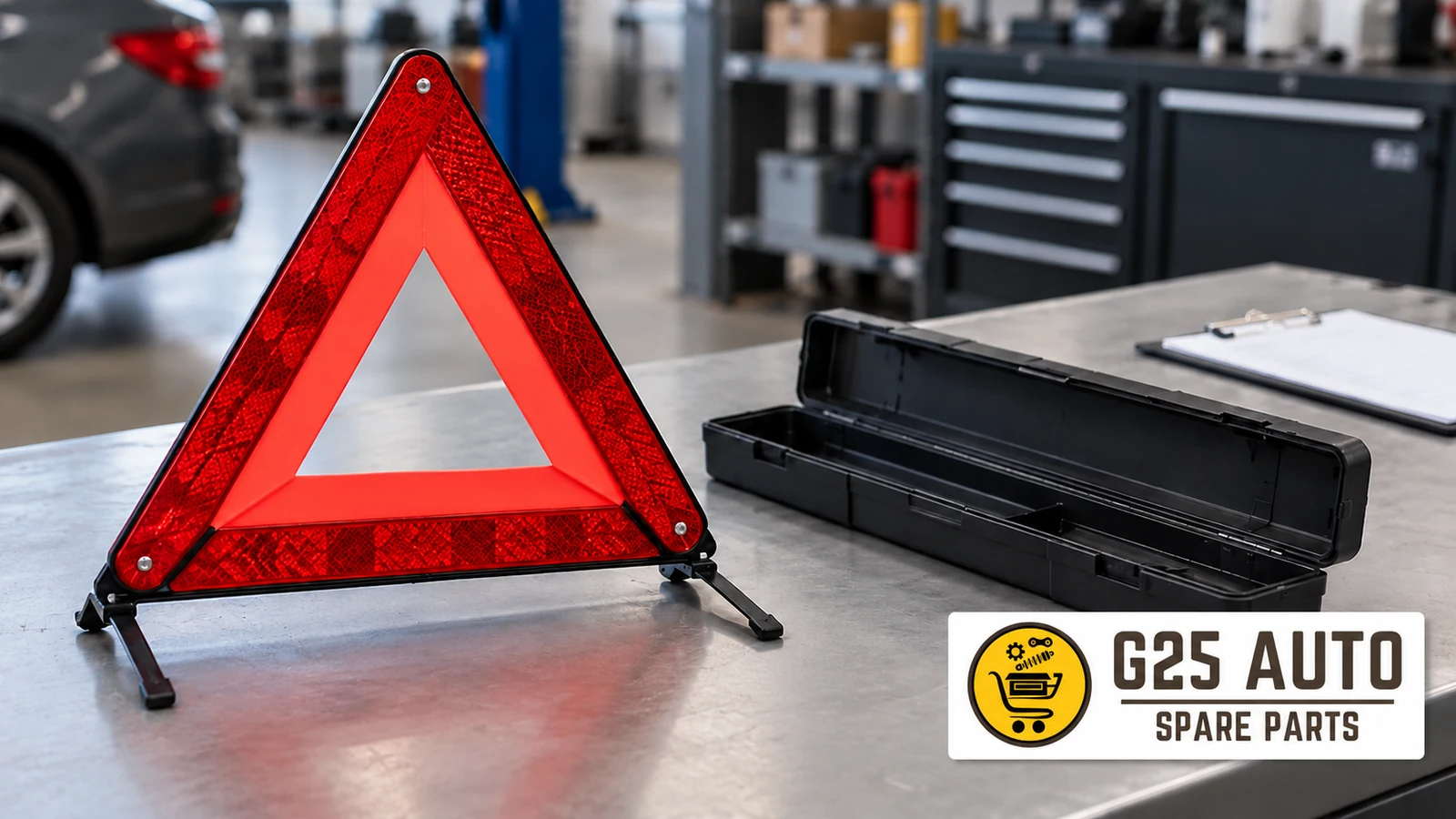
When sourcing a warning triangle and storage case, the most critical step is to clarify exactly what your purchase includes before buying. This checklist helps you organize the order scope and documentation. Determining the correct reference, recording package contents, and understanding storage requirements prevents confusion later.
Basic Sourcing and Recording Approach
Before ordering a warning triangle, check whether the product description clearly states if it includes the triangle itself or only the empty storage case. Some sellers offer only replacement cases, while others provide the complete set. Do not assume; ask the seller explicitly: “Does this offer include both the triangle and case together, or only the case?”
Verifying the vehicle reference is another fundamental step. For example, according to the 2017 Volvo XC90 manual, the warning triangle is stored in the compartment inside the tailgate; the triangle and case must be properly secured and the cover closed after use (Source verified October 31, 2026, https://www.volvocars.com/uk/support/car/xc90/16w46/article/3ddbe0c1c4422e98c0a801e80149382a_34c792e7897b3c49c0a801511ae5a473/). However, check the exact location and storage method specified in the owner’s manual for your own vehicle. A similar-looking case may not be suitable for your vehicle.
During purchase, it is important to record the seller’s markings on the product. Note any text or numerical markings that appear on labels, packaging, or product descriptions. This information creates a reference point when comparing with the receipt later or when communicating with the supplier.
Package Contents Checklist
The following checklist shows which elements you need to record when sourcing a warning triangle and case:
| Checkpoint | Notes |
|---|---|
| Is triangle included in product description? | Yes / No / Unclear (ask seller) |
| Is case/holder included? | Yes / No / Unclear (ask seller) |
| Is vehicle model reference specified? | Record model and year |
| Seller markings | Label text, package numbers |
| Number of parts actually received | Number of triangles, number of cases |
| Is product manual included? | Yes / No (request it) |
| Does receipt record match order? | Compare before use |
By using this checklist before and after purchase, you can verify whether the product you receive matches your expectations.
Choosing Between Triangle and Empty Case
In some cases, you may only need to replace the storage case because your triangle is still usable but the case is damaged. In other cases, both triangle and case are missing or need replacement. Therefore, when reviewing sellers’ offers, make this distinction:
Triangle Only: Ask in writing whether the offer covers only the triangle. Storage case and parts required for the vehicle’s own storage arrangement must be verified separately. If you plan to use the existing case, do not assume compatibility; have references in product and vehicle documents checked together.
Case Only: If you are looking for a replacement case or holder, note that sellers sometimes sell only empty cases. If the product description contains phrases like “storage case,” “holder,” or “container” but does not mention the triangle, ask the seller for clarification.
Items Offered Together: If triangle and case are listed together, request that each part be specified separately in the description. Do not extract fixed content from the word “complete”; record exactly which parts the seller is sending. Which option is needed depends on your existing parts and verified vehicle reference.
Reference Verification and Documented Vehicle Application
When sourcing a warning triangle, check whether the seller’s product description references specific vehicle models or years. If a reference is given, verify whether it matches your own vehicle. If no reference is given, this does not mean “universal fit”; confirm compatibility by informing the seller of your vehicle’s make, model, and year.
Do not infer compatibility from a similar-looking case. Even if two different vehicle models’ storage compartments are visually similar, mounting mechanisms, dimensions, or attachment points may differ. Rely only on documented, verified references.
Preserving Blank Spaces When Comparing Two Offers
When receiving offers from two different sellers, leave blank spaces for information you do not know or have not yet verified. For example:
- Offer A: Triangle included? → Yes. Case included? → Unclear (will ask seller). Vehicle reference → Not specified (will request).
- Offer B: Triangle included? → Unclear (product description not clear). Case included? → Yes. Vehicle reference → Awaiting documentation; vehicle application not yet verified.
This way, you can visually track which information is missing or unclear and determine which questions you need to prepare before asking sellers. Do not fill in missing information with assumptions; mark them as “pending” or “to be verified.”
Recording Seller Markings and Included Parts
When the product arrives, photograph or record in writing all markings on external labels before opening the package. This helps you verify whether the product the seller sent is the product you ordered.
After opening the package, list each part actually included:
- Collapsible warning triangle: how many?
- Storage case or cover: how many?
- Mounting parts (clips, screws, etc.): if any, how many?
- Product manual or assembly instructions: included?
Compare this list with the content the seller promised before purchase. If there is any inconsistency, contact the seller before using the product.
Requesting Product Manual
A product manual or usage instructions is valuable, especially for showing how to mount the storage case to your vehicle or how to store the triangle. If there is no manual in the package, request a digital copy from the seller. Some suppliers offer product manuals as PDFs on their websites; check this before purchase and save the download link.
The absence of a manual does not mean the product is counterfeit or non-standard, but it can create uncertainty about assembly or storage. Therefore, requesting a manual is good practice for record and reference.
Making Receipt Comparison Before Use
Before installing the warning triangle and case in your vehicle or placing it in the storage compartment, compare the purchase receipt or order confirmation with the received product. Points to check:
- Does the number of parts stated on the receipt match the number of parts received?
- Is the product description written on the receipt consistent with the label on the package?
- Does the vehicle compatibility stated on the receipt match the information in the product manual or on labels?
When you see an inconsistency, keep the order record, product photos, and seller’s written description together. Before using the product, clearly inform the seller which part or information is different and request an explanation. This record helps compare the product with the order scope; it does not constitute proof of compatibility by itself.
Preserving Unresolved Questions
You may not always get answers to all your questions during the sourcing process. For example, the seller may not be able to provide definitive information about compatibility with a specific vehicle model or may not provide details about case material. In this case, keep unresolved questions in a list and request written clarification from the seller or manufacturer based on vehicle and product reference.
Unresolved questions may include:
- Whether the case fits exactly in my vehicle’s tailgate compartment → Awaiting documentation based on vehicle and product reference.
- Whether the triangle’s folded dimensions are compatible with the case’s internal measurements → Awaiting manufacturer’s product information and matching explanation.
- Whether mounting parts fit my vehicle’s existing attachment points → Verify the product’s vehicle application and required mounting parts with documentation.
Accepting these questions as unanswered helps you form realistic expectations and avoid post-purchase surprises.
Frequently Asked Questions
1. When buying a warning triangle, how do I know if the case is included?
Read the product description carefully and look for phrases like “case included” or “triangle only.” If the description is unclear, ask the seller directly: “Does this product include both the triangle and storage case, or only one?” Do not assume; record the seller’s written response.
2. Will a similar-looking case fit my vehicle?
Similar appearance does not guarantee compatibility. Mounting mechanisms, dimensions, or attachment points may differ. Rely only on verified references documented by the seller or manufacturer for your specific vehicle model and year. Do not infer from a similar case.
3. What should I do if there is no product manual?
Request a digital or printed manual from the seller. If the seller cannot provide a manual, check the manufacturer’s website or contact customer service. A manual reduces uncertainty about storage and assembly; therefore, try to obtain it before use.
Source: Volvo XC90 2017 manual, verification date October 31, 2026, https://www.volvocars.com/uk/support/car/xc90/16w46/article/3ddbe0c1c4422e98c0a801e80149382a_34c792e7897b3c49c0a801511ae5a473/