
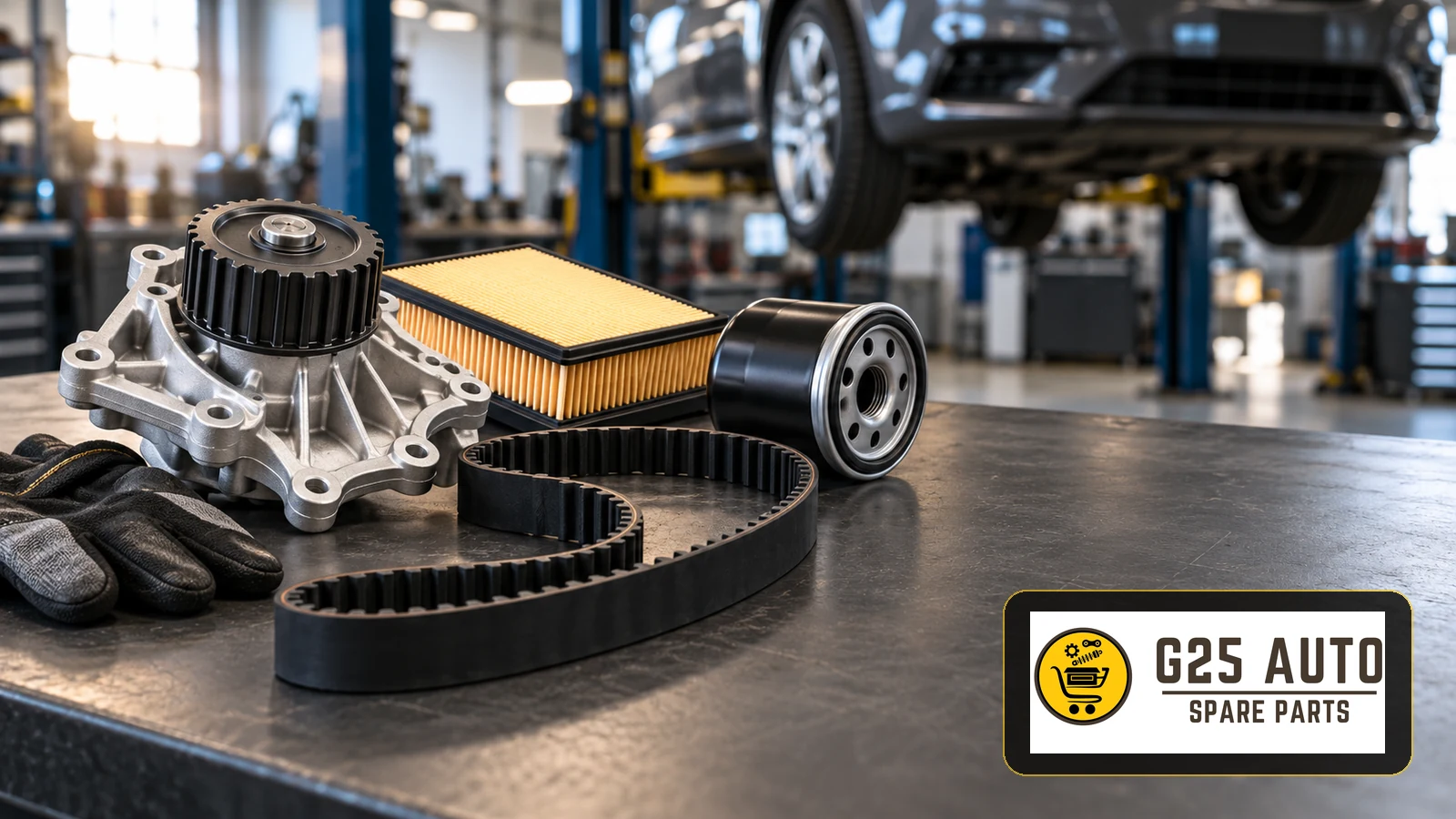
Replace scheduled service items when the exact vehicle’s maintenance requirements call for them, and replace wear or fault-related parts when inspection and diagnosis establish the need. There is no single mileage chart that can safely decide every filter, brake, battery, thermostat or water-pump replacement. For European and Balkan workshops, distributors and fleet buyers, each order should have a clear reason: a scheduled operation, a documented condition finding or an application-specific repair requirement.
Give every replacement a documented reason
Start with the VIN, engine or powertrain, model year and applicable service information. Reconcile the service history before calculating what is due. Keep the last recorded replacement separate from the last inspection: checking a component does not establish that it was renewed.
Use the manufacturer’s calendar, distance and service-indicator rules for that vehicle. Check provisions for the actual duty cycle, including urban deliveries, short journeys and heavily loaded operation. Ford’s service guidance explains that operating conditions can bring an oil change forward while mandatory maintenance intervals still apply. A reminder for one operation should not become a blanket instruction to replace unrelated parts.
Engine service parts: confirm the operation and specification
Engine oil and oil filter
For combustion-engine vehicles, confirm the required oil specification, service regime and filter application before preparing an oil-service order. Petrol or diesel alone does not define the interval. Neither does a generic description such as synthetic oil. Match the oil and filter work to the applicable instructions, including any required seals or other service items.
Air and fuel filters
Track engine-air and fuel filters separately. Confirm whether the maintenance information calls for inspection, replacement or another service operation. Have the workshop assess relevant contamination or operating conditions rather than applying an arbitrary shorter interval to every filter. Verify the filter reference and required fittings against the vehicle application; similar housings do not establish interchangeability.
Spark plugs and ignition coils
Where fitted, spark plugs need the specified type and replacement requirements for the engine. An ignition coil should not be added to every plug order simply because the vehicle has reached a round mileage. Misfiring or a warning lamp requires investigation. NGK’s ignition-coil diagnosis guidance calls for visual inspection and further diagnosis when symptoms suggest a coil fault. Record the confirmed cause and application before authorising parts.
Brakes and chassis: use findings to define the scope
Brake pads, discs and fluid
Separate friction-component assessment from brake-fluid maintenance. Follow the vehicle’s fluid requirements without assigning one universal age or distance limit. For pads and discs, retain inspection findings and the applicable wear limits. Brembo’s disc-maintenance guidance identifies minimum thickness and surface defects among replacement criteria. Mileage alone cannot establish that a disc is serviceable or worn out.
Ask the workshop to investigate abnormal wear and related faults before finalising the repair. Confirm the required axle scope, fitting hardware and installation instructions for the application. A replacement list should explain what will be renewed and why.
Dampers, steering joints and tyres
Use the scheduled inspections and qualified assessment to evaluate dampers, steering joints and associated components. A noise, vibration or handling complaint is a reason to inspect the system; it does not identify a particular failed part. Record the location and findings before choosing a replacement reference or assembly.
Tyre decisions also need more than a distance estimate. Assess wear, damage and age using the tyre and vehicle guidance, with the requirements applicable to the operating market. Michelin’s tyre-life guidance addresses abnormal wear, professional inspection and age precautions separately. Retain the assessment and arrange wheel or alignment work when the findings justify it.
Battery and cooling system: avoid automatic replacement bundles
Starter battery
Base a starter-battery order on assessment, vehicle requirements and a verified application. A generic age estimate does not confirm failure. Identify the required technology and any vehicle-specific replacement or registration procedure. Keep the starter battery distinct from a hybrid or electric vehicle’s traction battery; these are different systems and service tasks.
Coolant, thermostat and water pump
Retrieve the specified coolant and maintenance requirements. Do not choose a product solely by colour or assume that every cooling system uses the same replacement interval. A temperature complaint needs diagnosis before the thermostat or pump becomes an approved purchase.
Check the pump drive arrangement when planning belt work. Gates recommends replacing a timing-belt-driven water pump with the timing belt. Apply that guidance to the relevant system and confirm the vehicle procedure and actual kit contents. It does not establish an interval for every pump or a requirement to replace every thermostat. Record seals, fasteners and associated items specified for the confirmed job.
Parts-order checklist for workshops and fleet buyers
- Vehicle: confirm the VIN, powertrain and relevant application details.
- Evidence: attach the schedule requirement, inspection finding or diagnosis.
- History: distinguish previous checks from documented replacements.
- Reference: verify catalogue coverage and the required specification.
- Scope: confirm quantities, kit contents and associated service items.
- Supplier: request application evidence, traceability and current order terms.
- Approval: keep diagnosed repairs separate from items awaiting assessment.
- Completion: record fitted references, date, mileage and next requirements.
Evaluate aftermarket options using documented application and product information. A matching appearance, broad quality claim or advertised saving cannot prove suitability. Confirm availability and commercial terms for the actual order rather than assuming them from a general maintenance guide.
Frequently asked questions
Can a mileage chart decide every replacement?
No. Combine the vehicle-specific schedule with inspections and diagnosis appropriate to each component.
Does a service inspection mean all listed parts need replacing?
No. Record the findings and distinguish checks from required replacements.
Should ignition coils always be replaced with spark plugs?
Do not assume so. Follow the application requirements and investigate suspected coil faults before ordering.
Must every water pump be renewed with a timing belt?
First identify the drive arrangement. Gates’ cited recommendation concerns timing-belt-driven pumps; confirm the relevant vehicle procedure and repair scope.