
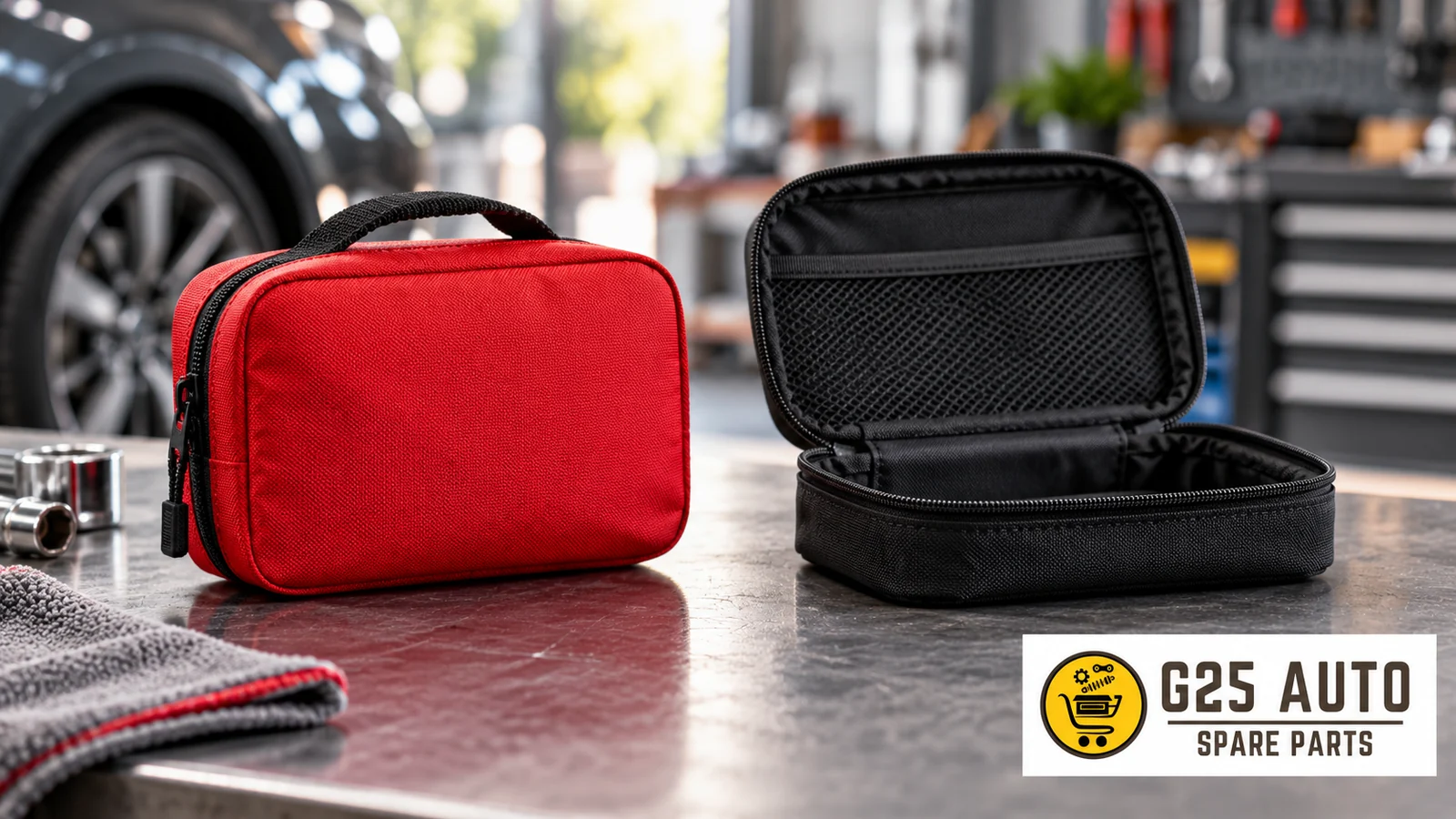
Short answer: When choosing a first aid kit for a vehicle, evaluate the empty case and the set with contents separately. Gather the product reference, written list of parts to be sent, and storage information for your own vehicle in the same order record. Bag similarity in images does not prove package scope. Request the seller to clarify ambiguity regarding labels on products inside the bag; do not draw conclusions about medical use or regulatory compliance from an accessory listing.
Bag, case or set with contents?
When you search with the term first aid kit, ask from the start what the offer actually covers. Do not compare a listing offering only a carrying case with a set containing materials as if they were the same product. Read the scope in the offer description instead of the short title written next to the photograph. If there is no contents list in the description, do not assume all objects in the image will be sent. Request in writing from the seller the names of both the case and the included parts.
If you want to replace only the outer case of your existing bag, state this as a separate need. Do not assume by yourself that your existing contents will fit the new case or that the package is evaluated together with them. The seller’s stock code, product manufacturer reference and package name may be different record fields. Note where each one came from. This way you can distinguish which product and which package a response received later is about.
Manufacturer example shows the limit of storage information
The official manual selected for Volvo V60 2022 recommends storing the first aid kit in a suitable place in the luggage compartment; it gives the right-side area as an example. It also describes the bag that can be attached to the panel with hook-and-loop tape. This description is only for the relevant vehicle example; it does not show that every bag has the same attachment or will be placed in the same location in all vehicles.
Find the correct manual for your own vehicle and read the storage section. Rather than applying a location description you saw in the source to a different vehicle, base it on the explanation related to your vehicle version. If the attachment type of the bag in the listing is unclear, direct this as a question to the seller. Do not write that the product in the listing is the same as that accessory just because the manual describes an accessory. Verify the product reference separately; a storage description does not replace a parts matching document.
Record package contents line by line
If you are examining a set with contents, ask the seller to list the materials to be sent by name. Also record the quantity fields in the list from the offer’s own description; do not transfer numbers from another set into this record. This article does not define a specific material list or standard set. Its purpose is to clearly document what the seller is offering. Do not add to your order record a product whose inclusion has not been explained as if it were there.
When requesting images of materials’ packaging and labels, specify that you want readable photographs. If there is a date on the label, evaluate what that date means with the product’s own description; do not complete an unreadable date by guessing. Do not write information belonging to one material as common information belonging to the entire bag. Questions regarding the use of products are a separate matter; the check being done here is to compare the definition and documents of the ordered package.
Keep unknowns visible in comparison table
When deciding between two offers, rather than saying one appears more comprehensive, compare what information is actually disclosed. Do not rank an open bag versus a closed bag in photographs based on image alone. Fill in the following fields separately for each offer. If the seller has not responded, keep the phrase document pending; do not complete the table by writing your own guess for missing information.
| Check field | Information to record | In case of uncertainty |
|---|---|---|
| Offer scope | Empty case or set with contents description | Request written scope |
| Product reference | Complete code on label and offer | Request readable photograph |
| Contents list | Parts to be sent and stated quantities | Do not extract list from image |
| Material labels | Readable record for each product | Leave incomplete field blank |
| Storage information | Description in own vehicle’s manual | Do not transfer other vehicle example |
Add the offer link and response date next to the table. If the same seller offers different package options, specify which option you are comparing. Clarify in correspondence the possibility that a response was given for another package. Understand the scope of offers before moving to price comparison; this article does not provide any price, stock or campaign information. Separately evaluate the current conditions of the package you select through the relevant offer.
Write questions to be sent to seller clearly
- Does this offer cover only the case, or is a set with contents being sent?
- Can you share the written list of products to be sent and the quantities stated in the offer?
- Can you provide the complete reference of the bag and a readable label photograph?
- Can I see the packaging and label information for the products in the contents separately?
- If there is a storage or attachment description for the bag, can you share the relevant manufacturer document?
Gathering questions in a single message helps you associate answers with the same offer. If you receive only a complete set answer, ask what list this expression covers. When an image is sent, verify that all text on it is readable. If the title in the listing changes, do not assume yourself that the previous answer also applies to the new description; ask the seller to clarify the scope again.
Compare package with order record at delivery
When the product reaches you, first determine which order it belongs to. Make separate comparisons on the bag’s label, package scope and seller’s written list. Record any field where you see a difference with a photograph; for example, if a different reference came instead of the described case, write which codes are different. Do not name a missing or unclear part by guessing. Keep the seller’s description together with the relevant order record.
This comparison does not mean experimenting by using the materials in the contents. If clarification is needed about a label or packaging, request the manufacturer’s relevant information. The bag looking proper does not by itself show that all content fields have been verified. Conversely, only one field being unclear does not automatically make other fields wrong. Keeping each finding under its own heading makes it easier to explain the specific difference when speaking with the seller.
Frequently asked questions
Are empty first aid case and set the same product?
Read the scope of the offer. Do not assume a package indicated to offer a case is a set with contents. Request the list of parts to be sent and clearly record which option you purchased in the order.
Does same model name verify storage location?
Check the manual for your own vehicle version. Do not directly transfer an example from another model year or trim. Evaluate the product’s attachment description and vehicle manual as separate documents.
Is preparing a contents list from a photograph sufficient?
A photograph is useful for preparing questions; separately request a written description of what will be sent in the package. Do not guess unreadable labels or unseen quantities. Keep unanswered questions open in the order record.
Source: Volvo V60 2022 — First aid kit. Verification: October 31, 2026. Manufacturer example is limited to the vehicle and storage description stated above.