
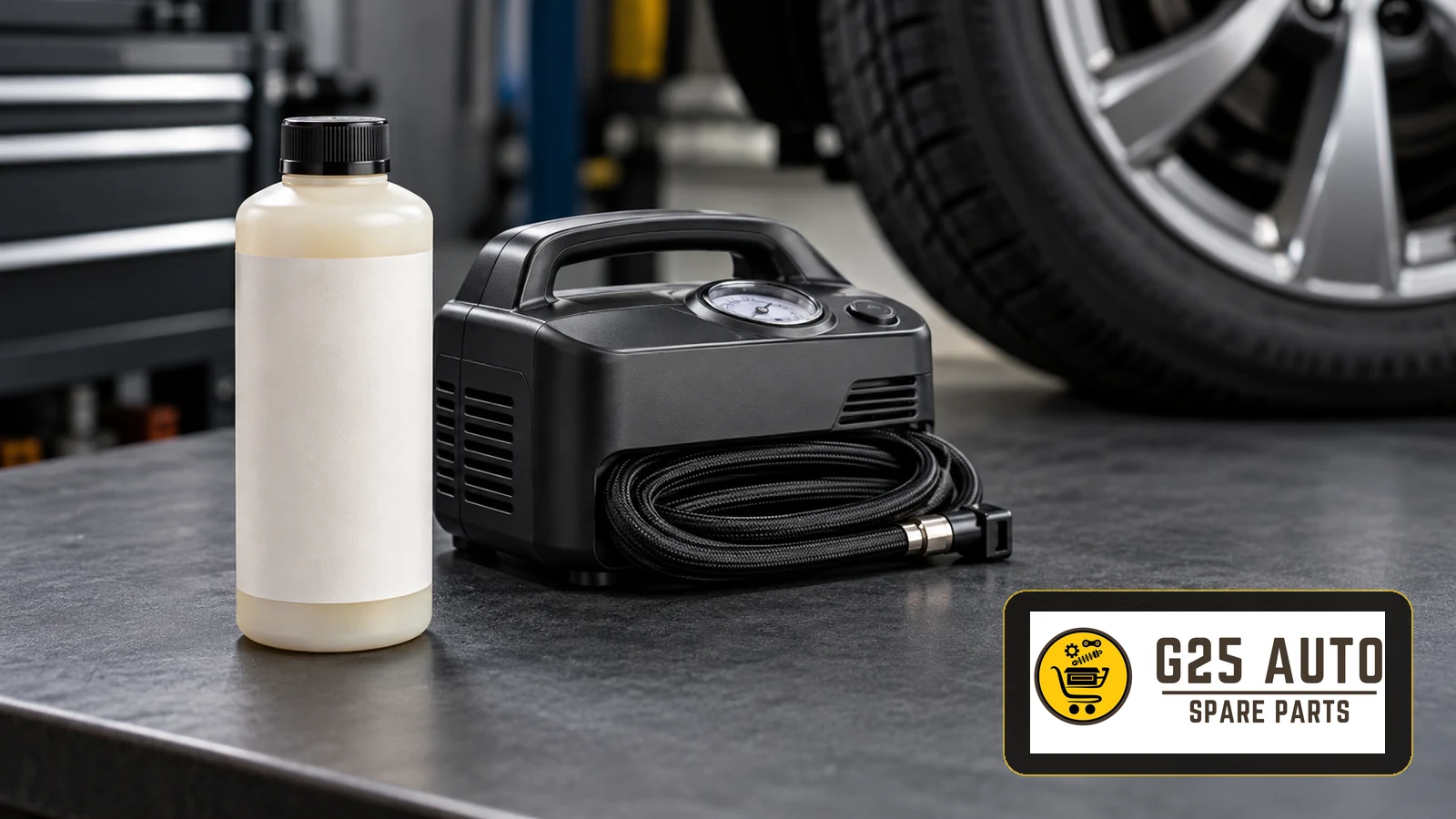
Short answer: For the sealant bottle in your tire repair kit, first check the expiration date on the label, then verify the exact reference of your current kit and the replacement product. If you cannot read the date, do not make a decision based on estimation. Bottle, compressor, and complete kit are not the same order. Confirm which part is needed using your vehicle’s own manual and the kit manufacturer’s current information; do not select based on photo similarity alone.
Why should you place the date check at the beginning of your order?
Hyundai’s specific vehicle manual, linked below, states that the sealant material must not be used after its expiration date has passed. It also indicates that the date is located on the container. Use this warning as a starting question to identify your own kit. The label on a bottle in another vehicle or a usage example seen online does not replace the instructions for the product you have. The purpose here is not to explain application steps, but to correctly prepare the record to be checked.
Write the purchase date and the expiration date on the product in separate fields. A recent invoice does not indicate the date of the bottle inside. Similarly, do not decide the validity of the bottle by looking at the vehicle’s model year. If the label on the physical product you have is unreadable, record this as a clear uncertainty. Having “date unreadable” written in the information sent to the seller or service center is more useful than an estimated date.
Reading the label and identifying the product are different checks
Do not treat all numbers on the bottle as the same type of information. Do not infer whether a marking is a date, production record, or product reference from its appearance alone. Record the entire label, the explanation near the marking, and any information on the box together if available. If the meaning of a field is unclear, request an explanation from the manufacturer. Do not use an unclear code as proof of vehicle compatibility or remaining service life.
What can be included in a photo record?
You can record the general appearance of the label visible without opening the product and the readable reference section. Note the date when you took the photo. If one side is visible, do not assume the other side contains the same information. When requesting images from the seller, ask whether it is a representative catalog photo or an image of the product to be shipped. This distinction prevents the date question from remaining unanswered even if the product name is correct.
Bottle, compressor, and complete kit distinction
Specify in your order message which product you are looking for with the term “tire repair kit.” Is only the sealant bottle needed, is a different part missing from the existing kit, or is a complete product being researched? Do not compare all listings in the same scope without determining this. Do not automatically assume that accessories shown in photos are included in the sales package. Requesting the package contents in writing from the seller helps you understand the product scope.
The presence of a compressor in the vehicle does not indicate it can be used with any selected bottle. This article does not provide a connection compatibility list. Report the exact identity of your existing equipment and ask which kit reference the replacement product is listed for. Cap, hose, or connection similarity in images is not final proof of selection. Do not order a product whose match cannot be verified based on the assumption that “it will somehow connect.”
| Product sought | Information to clarify |
|---|---|
| Sealant bottle | Exact product reference, date, and associated kit matching |
| Compressor | Existing kit identity and sales package scope |
| Complete kit | Vehicle application and list of parts included in the box |
| Separate accessory | Part name, reference, and related product documentation |
Prepare an information file for the replacement reference
Gather vehicle information, readable product markings on the existing kit, and any previous order records. If it is unknown whether different equipment was subsequently used on the vehicle, state this. Do not assume that the box left by a previous owner is the original kit belonging to the vehicle. If the box and bottle carry different references, ask the service center or manufacturer about this discrepancy instead of completing the match yourself.
Record the seller’s own stock code and the manufacturer’s product reference separately. Knowing which organization the code in the quote belongs to helps you compare the same product when consulting with a second seller. If a different code is suggested in place of one code, ask which document this change is based on. Support the verbal “same” statement with a clear product match that includes vehicle and kit information.
Product with unclear date or problematic packaging
For an unreadable date, do not calculate remaining time from the bottle’s appearance. Request a more legible label image or manufacturer explanation from the seller. If no response is received, the uncertainty is not considered resolved. Apply the same approach to packaging that is open, said to be used, or has visible damage. Testing the product or transferring its contents to another container is not a check method suggested by this article.
During delivery, compare the reference in the listing with the reference of the product received. If there is a difference, clarify the situation with the seller instead of attempting installation or use. Save the responses you received before purchase regarding date, product identity, and package contents. Do not derive time limits regarding return conditions or warranty coverage from this guide; read the relevant seller documentation and product terms separately.
Brief list of questions to ask the seller
- What is the exact manufacturer reference of the product to be shipped?
- Does the photo belong to the product to be shipped?
- Can the date field on the bottle be shared in readable form?
- Which document matches this reference to my existing kit?
- Does the package contain only the bottle, or does it include other parts?
- If a reference change is suggested, can the record be shared?
How do you keep the record after delivery?
Store the product reference, the date read on the label, the purchase document, and the matching response in the same file. If you will create a calendar reminder, base it on the information read from the product label and the related instructions. This article does not provide a fixed check or replacement interval applicable to all bottles. Separately check the storage and placement instructions in your vehicle’s manual for your own application.
When sharing your record with another person, specify which information was read directly from the label and which was a seller response. This way, in the next check, undocumented commentary and verified information do not get mixed. If the vehicle changes, do not automatically use the old matching record for the new vehicle.
Frequently asked questions
Is it necessary to additionally read the date on a newly purchased bottle?
Yes, the purchase document and the date on the bottle are different records. Request information before ordering and compare the label on the delivered product.
Can I select a bottle used in another vehicle?
An example from another vehicle is not proof of selection by itself. Verify the reference using your own vehicle’s and existing kit’s information.
If the date is unreadable, can I trust the product appearance?
Do not determine the date from appearance. Report the uncertainty to the seller or manufacturer; do not assume the date check is complete without receiving an explanation.
Is this article sufficient for roadside application?
No. Only product selection and record checking are covered here. When a problem is experienced, base your actions on the vehicle’s own instructions and appropriate roadside assistance guidance.
Source
Hyundai official owner’s manual — Components of the Tire Mobility Kit. Verification: October 31, 2026. The vehicle example in the source should not be used as common application instructions for all kits.