
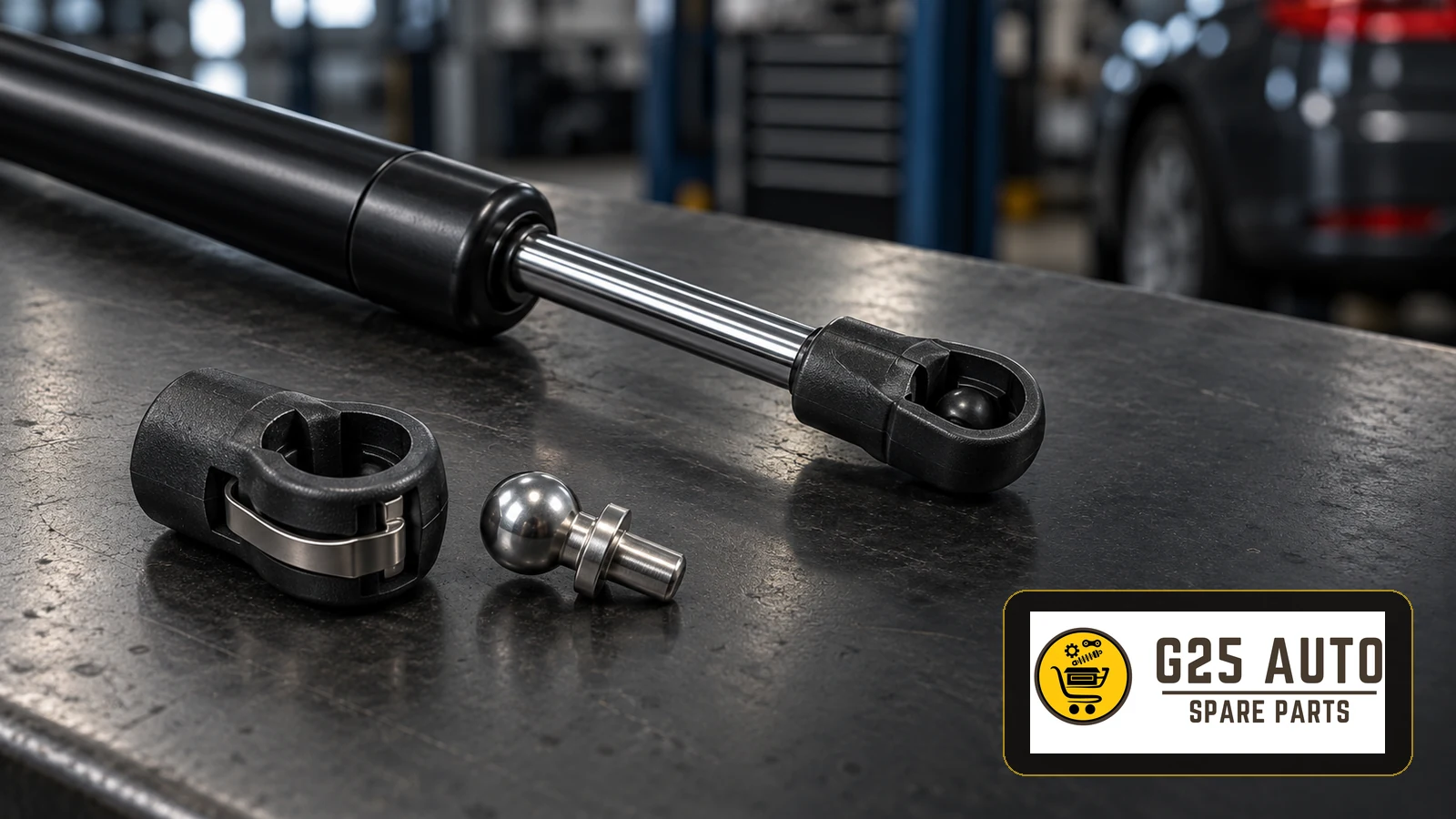
A tailgate that drops, needs unusual lifting effort or has a loose gas strut connection needs inspection of the support and its mountings before a replacement is ordered. The retaining clip secures the relevant end fitting; replacing it does not establish that the gas spring, socket or mounting stud is serviceable. For European and Balkan workshops, fleets and distributors, the right repair starts with a supported lid, a documented fault and an application-verified part.
Identify the fitted system first
Record the vehicle identification, body style, production details and whether the closure operates manually or electrically. Photograph the installed supports, readable markings and both mounting points. Keep the left and right positions identifiable in the job record. An enquiry described only as a boot strut leaves the supplier to resolve details that the workshop can document directly.
A gas spring provides lifting assistance; it is not automatically the same component as an electric tailgate drive. Stabilus distinguishes gas-spring supports, dampers and powered drives in its tailgate range. For an electrically operated closure, use the vehicle procedure to establish the repair scope and required isolation or setup. Do not assume a conventional strut is an alternative to the fitted drive.
Turn the complaint into a useful inspection record
Support the lid before investigating
Keep people clear of an unsupported or unreliable lid. Arrange the support and assistance required by the vehicle repair instructions before touching a connection. Monroe’s lift-support instructions require another person to hold the closure and warn against improvised sticks. They also require eye protection and prohibit opening, heating or puncturing the unit. A brief observation that the lid stays up is not a complete condition assessment.
Inspect the complete connection
Record visible damage, corrosion, displaced retainers, cracked end fittings and concerns at the mounting bracket. Describe where movement or noise occurs instead of treating a sound as proof of a gas leak. Photograph suspect fluid traces and identify their origin during the inspection; do not diagnose internal failure from an unexplained mark alone. Check the vehicle repair information before deciding which components can be serviced separately.
Ask the operator when the complaint occurs and whether the closure has been repaired or modified. Keep that history separate from confirmed findings. Where the vehicle cannot be inspected safely or an application detail remains unresolved, record the missing evidence and keep the repair decision open.
Recognise the retainer before releasing it
Clip procedures depend on the end fitting. Stabilus’s installation sheet treats plastic ball sockets, metal sockets with wire retainers and eyelet mountings separately. For its illustrated plastic-socket method, the spring clip remains attached; the described metal wire-retainer method involves withdrawing the wire. These are examples of different designs, not a universal removal instruction.
Identify the actual fitting and follow its supplied instructions. Do not apply one clip-release method to every socket. Confirm whether a replacement retainer is separately specified and whether the socket, stud and bracket are acceptable for reuse. Do not improvise with a similar-looking clip or bend a damaged retainer back into service.
Prepare an application-specific parts enquiry
Send the supplier the vehicle details, closure equipment, fitting position, installed reference and clear connection photographs. Ask for written confirmation of the proposed application and what the supplied unit includes. A readable reference is useful evidence, but it should be checked against current catalogue information rather than presented as a guarantee.
Monroe’s European gas-spring guide identifies length, stroke, required specification and end fittings as selection considerations for non-direct-fit units. It recommends paired replacement and working on one support at a time. Use the current application instructions to establish the order quantity, fitting orientation and replacement method; do not transfer a generic force value or measurement into an unrelated vehicle enquiry.
For B2B purchasing, separate technical approval from the commercial quotation. Confirm the manufacturer reference, quantity, included fittings and any unresolved application question before authorising the order. Obtain actual availability and contractual terms from the supplier. Keep the response with the job so another workshop or fleet coordinator can see what was agreed.
Complete the installation and handover checks
Use the vehicle and component instructions for the supported replacement sequence, retention checks and any powered-system procedures. Stop if the proposed part does not align as specified. Do not force a fit to compensate for an unresolved application mismatch.
Protect the piston rod during handling. Stabilus’s application guidance explains the importance of avoiding lateral loads, rod contamination and inappropriate installation orientation. Its general examples do not supply a vehicle-specific setting. Complete the prescribed movement and closure checks, then record the result and any outstanding concern before releasing the vehicle.
Workshop and procurement checklist
- Identify the vehicle, closure type and manual or powered equipment.
- Record the complaint and arrange the prescribed lid support.
- Inspect the strut, retainer, socket, stud and mounting bracket.
- Identify the connection design before choosing a release method.
- Verify the proposed part, fitting position and replacement quantity.
- Confirm included hardware and the documented reuse requirements.
- Complete installation and functional checks using applicable instructions.
- Retain the parts confirmation, findings and handover record together.
Frequently asked questions
Can a new clip fix a falling tailgate?
Only if inspection establishes the relevant connection fault and the specified repair. A clip replacement alone does not verify the support’s condition.
Should both gas struts be replaced?
Monroe recommends replacing paired supports together. Confirm the applicable vehicle and replacement-part instructions when defining the job.
Is a matching appearance enough for ordering?
No. Ask the supplier to verify the application and supplied fittings against the vehicle details and installed reference.
Is there a universal replacement age?
Use the applicable maintenance guidance and assessed condition. Record the actual complaint rather than assigning every support the same service life.