
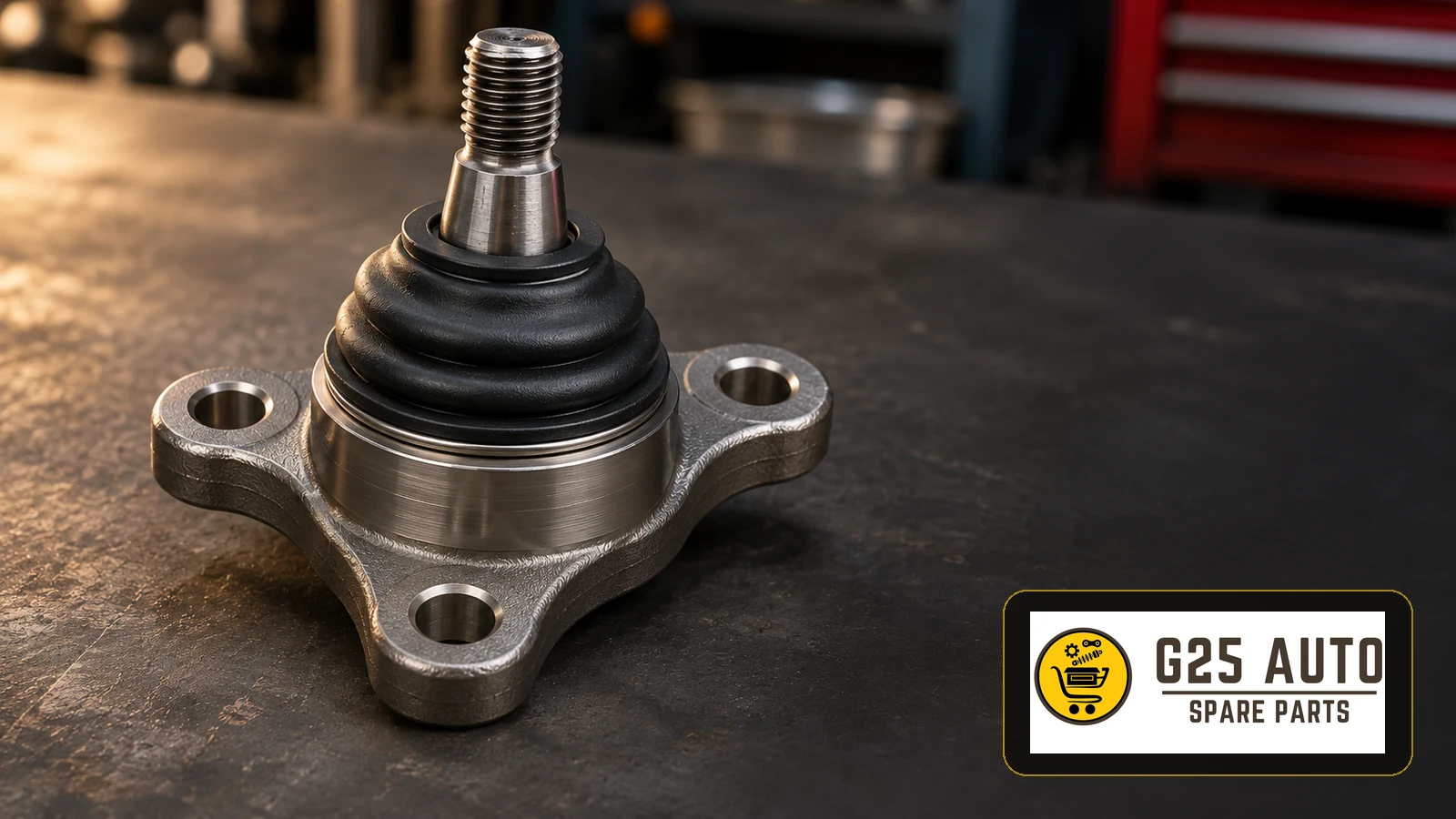
A suspension ball joint connects a control arm to the steering knuckle. Its ball-and-socket design lets the suspension move as the wheel travels over bumps and allows a steered wheel to turn.
What Is a Ball Joint and How Does It Work?
A ball joint has a metal housing and a ball stud that pivots inside it. The housing is secured to one part of the suspension, while the stud connects to the other. A rubber dust boot helps retain grease and keep dirt and moisture away from the joint.
Depending on the suspension design, a wheel may have an upper and a lower ball joint, or a lower joint with a strut above it. The inner and outer joints in the steering linkage are tie rod joints. When identifying a replacement, check which assembly the joint belongs to.
What Does a Ball Joint Do?
Allowing the Wheel to Steer
The tie rods transmit steering movement to the knuckle. The suspension ball joint lets the knuckle pivot relative to the control arm as the wheel turns.
Allowing Suspension Travel
The joint changes angle as the wheel moves up and down. This lets the suspension travel while the wheel is steered.
Carrying Loads
Ball joints are subjected to forces during cornering and when the wheel moves over uneven roads. Whether a joint carries the vehicle’s weight depends on the suspension layout.
Symptoms of a Worn Ball Joint
Ball joint wear may develop gradually. Several of the following signs can also come from other steering, suspension or tyre faults, so the joint needs to be inspected before a replacement is ordered.
Changes in Steering Feel
- A loose or less precise feel at the steering wheel
- Vibration felt through the steering wheel
- Binding or changes in steering effort
- Difficulty keeping the vehicle on a steady line
Unusual Noises
- Creaking or clicking while turning
- A knock or clunk over speed bumps or rough surfaces
- Noise around the suspension during low-speed manoeuvres
Changes in Handling and Tyre Wear
- Wandering on a straight road
- Uneven wear, particularly near a tyre shoulder
- Less predictable handling in corners
- Pulling under braking, which also calls for a check of the brakes and other possible causes
How a Workshop Diagnoses a Ball Joint Fault
Visual Inspection
A technician checks the dust boot for splits and grease leakage and looks for corrosion or damage around the joint. A torn boot can let in contamination. The condition and movement of the joint still need to be checked.
Mechanical Checks
With the vehicle safely supported, the technician checks for movement at the joint using the procedure for that suspension design. Observing the joint directly helps distinguish ball joint play from movement at the wheel bearing, tie rod end or a control arm bush.
Wheel Alignment Checks
An alignment check can identify angles outside the specified range. If the readings change again soon after an adjustment, the workshop should inspect for looseness or damage in the suspension and steering before adjusting the alignment again.
Original and Aftermarket Ball Joints
| Feature | Original part | Aftermarket part |
|---|---|---|
| Warranty | Check the vehicle brand’s or seller’s terms. | Check the supplier’s or manufacturer’s terms. |
| Fitment | Match the vehicle-specific part reference. | Verify the cross-reference and intended application. |
| Availability | Check with the vehicle brand’s parts network. | Check with the distributor for the chosen brand. |
| Quality control | Identify the part through the vehicle maker’s catalogue. | Review the manufacturer’s documentation for the specific part. |
| Choice | Check the available options for the original reference. | Compare documented options for the same application. |
What to Check When Choosing a Ball Joint
Original Part Reference and Fitment
Start by identifying the correct part reference. Vehicles sold under the same model name can have different suspension parts. Check the following details where the catalogue calls for them:
- Vehicle identification number (VIN)
- Engine variant
- Production date
- Trim level or suspension package
Confirm which position the joint fits and whether it is available separately or supplied with the control arm. Check the fitment before installation. A part that appears similar can fit or sit differently in the suspension.
Manufacturer Documentation
Look for a traceable manufacturer and a catalogue entry for the intended application. A quality management certificate alone does not establish that a particular ball joint fits the vehicle or meets the specifications for that application.
Materials and Construction
Check the housing, stud and protective boot for damage before installation. A damaged or poorly seated boot can allow contamination into the joint.
Ball Joint Replacement Checklist
- Confirm fitment against the VIN and catalogue reference.
- Inspect the joint on the opposite side and decide whether it also needs replacement.
- Check the related steering and suspension joints for play.
- Use the vehicle maker’s fitting procedure and torque specifications.
- Check wheel alignment after installation as specified for the vehicle.
- Inspect nearby components, including control arm bushes and dampers.
- Confirm the repair with the workshop’s post-installation checks and a road test when safe.
- Keep the invoice and any warranty documentation.
- Record the replacement part’s brand and reference.
Looking After Ball Joints
Routine Inspection
Ask the workshop to inspect the joints during scheduled suspension checks. Pay particular attention to the condition of the dust boots and any signs of leakage.
Driving Habits
Slow down for speed bumps and avoid hitting potholes where possible. If a hard impact is followed by a new noise or a change in steering, have the suspension checked.
Wheel Alignment
Follow the vehicle maker’s service guidance. If the car starts to pull or the tyres wear unevenly, have the suspension inspected as part of the alignment check.
Replacing One Side or Both
Inspect both sides when one joint is worn. Decide whether to replace the other joint based on its condition and the vehicle maker’s instructions.
Frequently Asked Questions
How long does a ball joint replacement take?
Labour depends on access, corrosion and whether the joint can be replaced separately from the control arm. Allow time for the required checks after installation.
Can I drive with a faulty ball joint?
Have suspected ball joint wear assessed promptly. If a joint is confirmed unsafe or the wheel shows significant play or abnormal movement, arrange recovery. A joint that separates can cause loss of wheel control.
Can I replace the ball joint on just one side?
One side can be replaced if the other passes inspection and the vehicle maker’s procedure allows it.
Is wheel alignment needed after replacement?
Follow the alignment procedure for the vehicle after the work. If the measurements are outside the specified range, the workshop should correct the alignment.
Can an aftermarket ball joint be a suitable choice?
An aftermarket joint can be suitable when the catalogue confirms the exact application and the supplier can document the part reference and warranty terms.
How many kilometres does a ball joint last?
Service life varies with loads, road conditions, use and the condition of the boot. Use inspection findings and the vehicle maker’s guidance when deciding whether replacement is due.
Conclusion
A suspension ball joint lets the wheel steer and the suspension move. Investigate new clunks, steering play or uneven tyre wear, and confirm the fault before replacing parts.
Use the VIN and the vehicle’s parts catalogue to select the correct joint. After installation, complete the required steering, suspension and alignment checks.