
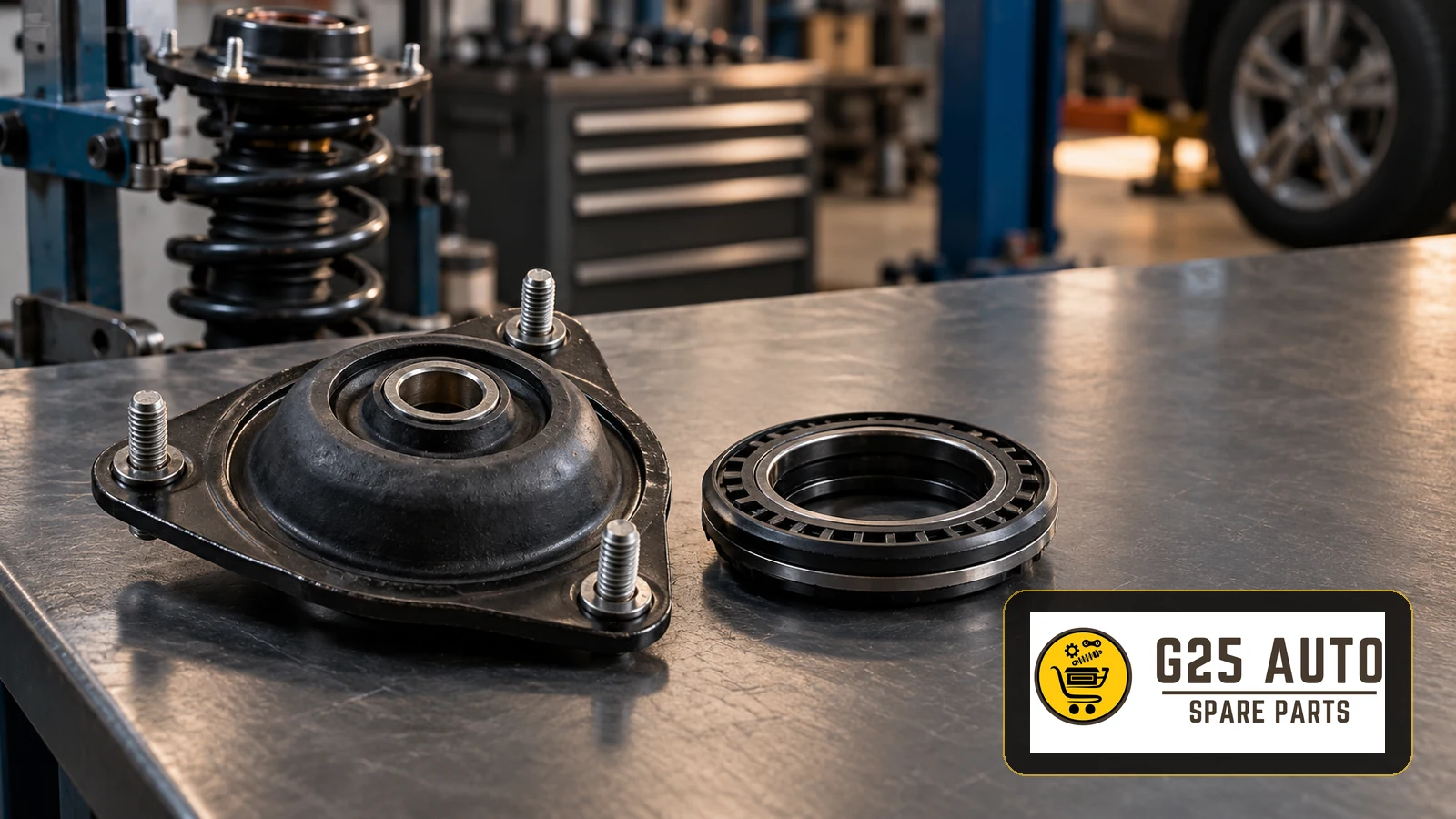
Choose a replacement strut top mount and bearing only after the workshop has confirmed the fault and matched the vehicle’s suspension specification to a current parts catalogue. Noise while steering, knocking over bumps or a change in steering feel can justify inspection, but none identifies the failed component on its own. For European and Balkan workshops, fleet buyers and distributors, the purchase should specify the correct mount, bearing and required hardware as a documented repair package.
Understand the mount and bearing as separate functions
The top mount connects the suspension strut to the body and uses rubber and metal elements to isolate vibration. In suspension designs where the strut turns with the steering, a bearing allows that rotation. Depending on the application, the bearing may be integrated with the mount or supplied separately. A rear mounting or a non-steering arrangement must not be assumed to use the same bearing configuration.
These distinctions affect both diagnosis and ordering. A listing for a mount does not automatically establish that a bearing is included. Ask for the exact contents of the proposed reference. SKF’s top mount kit information describes separate and preassembled options and recommends replacing the mount and bearing together to reduce repeat repairs.
Confirm the cause before replacing parts
Record when the symptom occurs
Document whether the noise occurs during low-speed steering, on uneven surfaces or after recent suspension work. Note steering effort, vibration and any change in self-centring. KYB Europe’s safety guidance identifies steering noise, steering-wheel vibration and knocking as reasons to have mounting kits inspected. The observation belongs on the job record; the workshop still needs to locate its source.
Inspect the surrounding suspension and steering components as well as the top mount. Tyre condition, spring seating, joints, bushes and attachment points can affect the assessment. A wheel movement test alone cannot assign play specifically to the strut bearing. Similarly, oil near a mount needs its source identified before it is treated as evidence of mount failure.
Separate wear from an installation problem
Check the rubber-to-metal connection for damage, displacement or separation using the vehicle manufacturer’s inspection method. Assess bearing movement as the design permits. If symptoms began after a repair, review the fitted reference, component orientation and fastening procedure before ordering another part. Record the findings rather than relying on an assumed replacement interval.
Match the exact application
Start with the VIN and the production, body and suspension identifiers requested by the catalogue. Confirm the axle and any left/right distinction, then resolve notes for standard, sport or other suspension options. The vehicle’s registration description alone may leave an application restriction unresolved.
An existing part reference or photograph can support identification, but the old component may have been incorrectly selected. Retain the current catalogue result and ask the supplier to confirm any conflicting information in writing. For distributors handling mixed European vehicle fleets, a clear enquiry with the vehicle details and installation position is more useful than a request for a visually similar top mount.
Compare complete quotations
Check what the kit contains
Specify whether the offer contains a mount, bearing, spring seat or isolator, and which fasteners accompany it. Confirm how many vehicle positions each package covers. A single kit, an axle set and a bearing-only listing are different purchasing units even when their descriptions look similar.
Plan the associated work while the strut is accessible. Inspect the damper, spring, protective boot and compression stop and include replacements required by their condition or fitting instructions. KYB Europe recommends renewing suspension mounting kits when shock absorbers are replaced. Resolve the repair scope before placing the order.
Evaluate genuine and aftermarket references individually
Request the manufacturer’s product reference, documented application and fitting information for each option. A familiar brand or an OE-quality description does not independently prove suitability. Compare the contents and requirements of the exact products offered.
For cross-border B2B purchasing, retain the supplier’s written response on availability, delivery expectations, returns and warranty terms for that order. Clarify who will handle a technical query if the delivered kit differs from the quotation. These are commercial checks, not properties that can be inferred from the product category or country of sale.
Purchase-order checklist
- Vehicle identity: VIN and catalogue-required production and suspension details recorded.
- Position: axle, side and all application restrictions confirmed.
- Reference: exact manufacturer and product reference retained with the catalogue result.
- Contents: mount, bearing, associated seats and included hardware listed explicitly.
- Quantity: package coverage and the inspected scope across the axle documented.
- Associated work: surrounding components assessed and necessary replacements itemised.
- Completion: current fitting instructions and applicable geometry checks included.
- Supplier record: order-specific commercial terms and technical contact confirmed.
Plan fitting and verification
Strut disassembly can involve stored spring energy. Qualified technicians need suitable spring-handling equipment and the vehicle and component manufacturers’ procedures. Follow the specified orientation, seating arrangement, replacement-fastener requirements and tightening method. Use the applicable tightening values from service information rather than a generic torque figure.
Include geometry assessment in the job plan. KYB’s installation resources recommend alignment after strut replacement and explain that requirements vary by vehicle design. Complete the checks required for the actual work performed, then verify steering operation and investigate remaining noise. Retain the fitted references and completion record for fleet maintenance and any later supplier enquiry.
Frequently asked questions
Does steering noise prove the top bearing has failed?
No. It is a reason for inspection. The workshop must distinguish the bearing from other steering, suspension and installation causes.
Is the bearing always included with a new mount?
No. Construction and kit contents vary. Confirm the exact reference and contents before ordering.
Can the mount and bearing be replaced together?
Yes, where applicable. Check the manufacturer’s repair recommendation and order the complete combination required for that vehicle.
Is there one replacement mileage for every vehicle?
No universal mileage establishes the condition of every mounting kit. Use inspection findings and the applicable maintenance and repair guidance.