
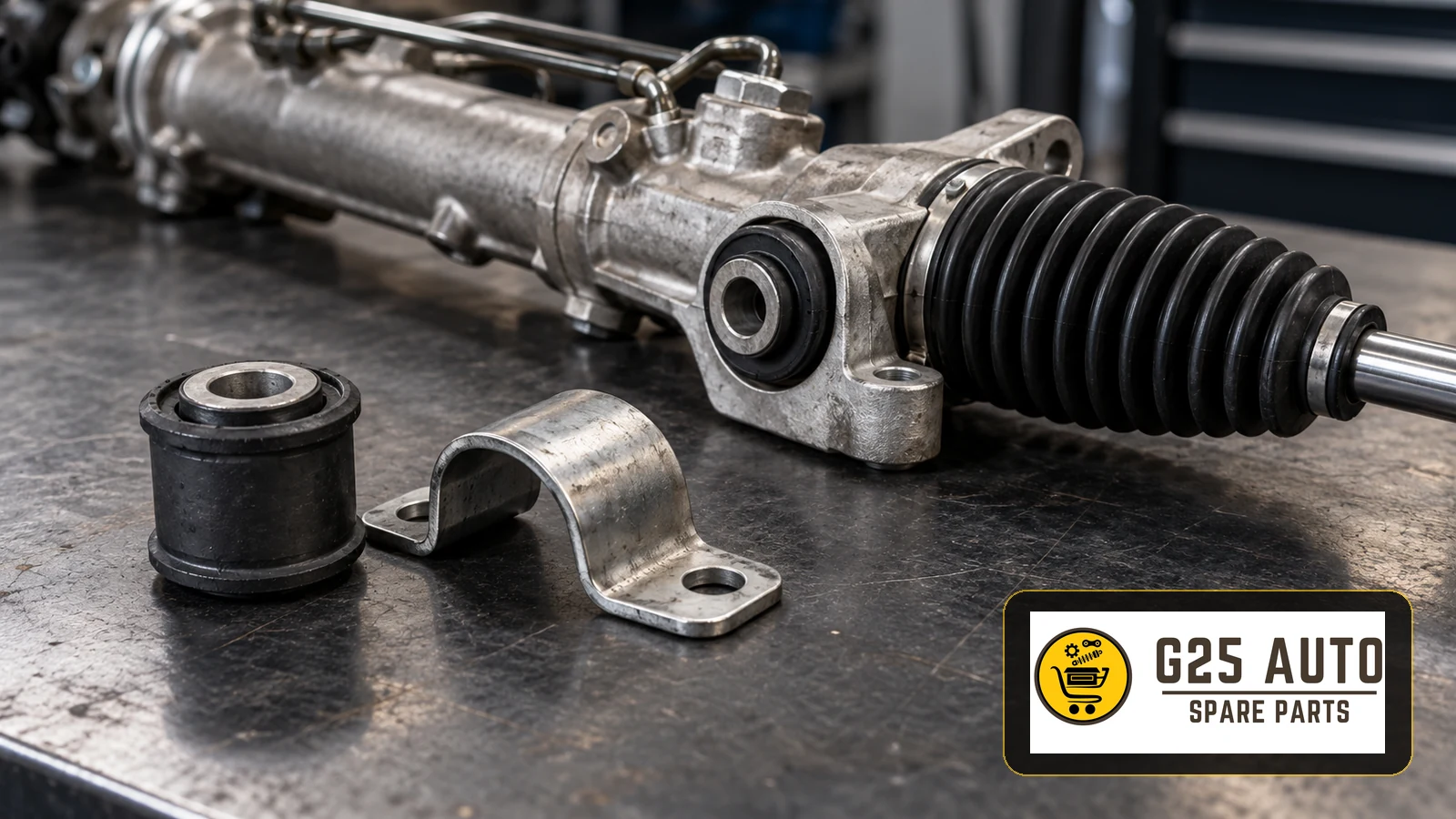
Steering rack mounting bushes locate the steering gear at its support points and, where the design uses compliant mounts, help control vibration transmission. A damaged bush needs a diagnosis of the complete mounting arrangement before parts are ordered: a knock or loose steering feel does not identify the failed component by itself. For European and Balkan workshops, fleets and distributors, the practical starting point is the installed rack, the condition of its supports and the repair allowed by the vehicle manufacturer.
Identify the mounting arrangement
A rack mounting bush is an external support component. It is different from an internal rack guide, a steering column coupling and the bellows covering an inner tie rod. These parts can appear under similar descriptions in translated catalogues. Send a contextual photograph alongside the enquiry so the workshop and supplier are discussing the same location.
Mounting arrangements vary. Establish whether the relevant application uses a separate insulator, a sleeved bush, a bracket assembly or another specified support. Do not assume that every rack has the same rubber-and-metal construction or that a worn mounting element is available as a separately serviceable part.
Separate symptoms from the cause
Record when the complaint appears: while steering at parking speed, crossing an uneven surface or driving under other identifiable conditions. Note any recent rack, subframe, suspension or tyre work. This history helps the technician choose an inspection, but it does not prove that the bushes are responsible.
MOOG’s suspension noise diagnostic guidance includes rack-and-pinion bushes among several components assessed during a professional dry park test. Tie-rod ends, ball joints and other loose or damaged parts can also be involved. The useful principle is to locate the actual source before selecting a replacement.
Inspect the complete support path
A qualified technician should assess the bush, sleeve where fitted, bracket, fasteners, rack housing and receiving support. Record visible tearing, separation, displacement, corrosion or damage, together with any observed movement under the applicable inspection conditions. A photograph of surface cracking alone does not establish the permitted movement or the full repair scope.
Distinguish movement within a compliant mount from movement at a loose fastening or damaged support. Use the vehicle’s service information to judge the finding; there is no clearance or levering force that this guide can apply to every rack. If steering control is impaired or a mounting security defect is suspected, keep the vehicle out of service pending professional assessment.
Vibration isolation does not remove the original fault
A historical GM vibration analysis bulletin describes revised hydraulic rack mounting bushes for specified full-size SUVs. In that application, tyre-related causes had to be addressed before the revised isolators could provide their intended benefit. This is an application-specific example of distinguishing a vibration source from its transmission path, not a retrofit recommendation for other vehicles.
Build a precise parts enquiry
Provide the VIN, production details, steering configuration and readable identification from the installed rack. Include left-hand or right-hand drive and the required fitting position where the catalogue distinguishes them. If the rack has previously been replaced, reconcile its markings with the vehicle record rather than relying solely on an old invoice.
Ask the supplier to confirm the catalogue application and any superseded reference. Compare the stated construction, bracket arrangement and package contents with the supported repair. Similar appearance or a shared model name cannot settle an uncertain application. Resolve conflicting information before the order is released.
Define the kit and material requirement
Specify whether the request is for one bush, a complete mounting set or an assembly. Confirm which sleeves, brackets and fasteners are included and which additional items the service procedure requires. Do not promise that a bush-only repair will be possible before serviceability and support condition have been checked.
Material choice must follow the supported application. Avoid treating a harder replacement or a polyurethane conversion as an automatic durability or steering improvement. Request documented suitability for the intended repair and vehicle use, rather than inferring equivalence from a material label.
Workshop and purchasing checklist
- Record the complaint and the technician’s diagnostic findings separately.
- Identify the vehicle, installed rack and relevant mounting position.
- Inspect the bush and the surrounding bracket, fasteners and support.
- Confirm whether a separate bush replacement is supported for that assembly.
- Match the catalogue reference, construction and required package contents.
- Obtain the applicable fitting instructions and required tooling before work starts.
- Follow the specified fastening, alignment and electronic checks where required.
- Retain the part reference, inspection evidence and completed repair checks.
Control installation and handover
Pressing method, orientation and fastening requirements belong to the specific procedure. MOOG’s control-arm bush fitting guidance illustrates how radial orientation and pressing depth can matter for certain suspension bushes. It is a different component example; its positions and methods must not be transferred to a steering rack mount.
Use current instructions for the rack being repaired, including any requirements for supporting assemblies, replacing hardware and checking geometry or electronic functions after disturbance. Do not import suspension ride-height tightening rules or universal torque values into this job. Complete and document the prescribed checks before the vehicle returns to service.
For cross-border trade, put the confirmed application, kit contents and any unresolved question on the quotation. At receipt, compare the delivered reference and visible arrangement with the agreed order before installation. For fleets, keep that record with the vehicle’s rack replacement history so a later enquiry starts from the assembly actually fitted.
Frequently asked questions
Does a steering knock prove a mounting bush has failed?
No. Several steering and suspension faults can produce noise. A technician must locate the cause and assess mounting security before parts are selected.
Can every rack mounting bush be replaced separately?
No. Confirm the parts listing and approved service procedure for the installed rack. The supported repair may involve a larger assembly.
Must all bushes be replaced together?
Inspect the complete arrangement and follow the applicable repair scope. Do not assume either single-piece replacement or a complete set is always appropriate.
Is wheel alignment always required afterwards?
Follow the vehicle procedure for the work performed. Establish alignment and other post-repair checks before quoting; a universal rule would overlook differences in design and disturbance.