
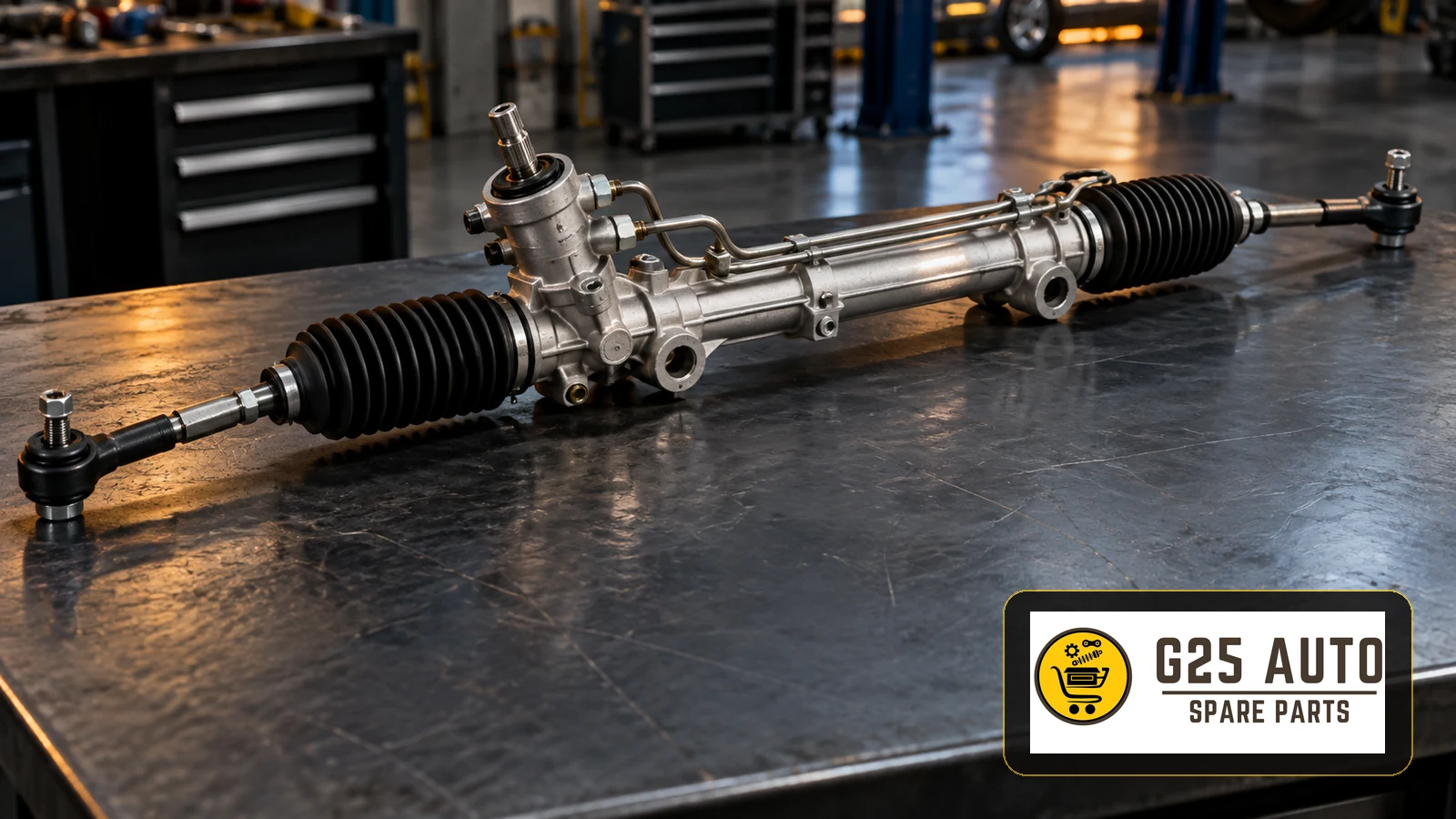
A steering rack should be replaced when a qualified diagnosis identifies a defect requiring replacement and the applicable repair information supports that decision. Heavy steering, noise, free play or a warning message alone does not establish rack failure, and there is no universal mileage replacement interval. For European and Balkan workshops, fleets and parts distributors, a reliable order starts with the steering system actually fitted, documented findings and a confirmed replacement specification.
Identify the steering system before discussing the rack
In a rack-and-pinion system, the pinion converts steering input into movement of the rack, which acts through the steering linkage. The complete steering gear may be described as a rack, steering box or steering assembly in different catalogues. Confirm the physical assembly being discussed rather than relying on a translated name alone.
Establish whether the vehicle has unassisted, hydraulic, electrohydraulic or electric assistance. An electric motor elsewhere in the system does not necessarily mean that an electrically assisted rack is fitted. CARDONE’s EPS identification bulletin distinguishes column assistance from arrangements with assistance at the pinion or rack. This distinction matters when identifying which assembly is being ordered.
For a cross-border enquiry, include a contextual photograph of the installed unit and readable identification markings. Record left-hand or right-hand drive and any catalogue distinctions relevant to the vehicle. If a previous repair changed the assembly, flag that history before asking a supplier to resolve the application.
Treat symptoms as evidence for diagnosis
Describe the complaint in the driver’s words, then record the workshop’s observations separately. Note when it occurs, whether it is intermittent and whether recent steering, suspension or tyre work preceded it. A repeatable description is more useful to the next technician than an unsupported conclusion such as “rack worn out”.
Heavy steering, noise and excessive movement
Ask the technician to distinguish the rack itself from the surrounding steering linkage, supports and assistance system. Do not use a generic free-play threshold or a noise description to approve replacement. An uncertain steering-control or mounting-security condition needs professional assessment before the vehicle returns to service.
Keep the inspection report with the parts request. It should identify the confirmed defect, the tests or inspections used and the proposed repair scope. If the report only records symptoms, return the enquiry for clarification before committing to an expensive assembly.
Hydraulic leaks and electronic faults
Where hydraulic assistance is fitted, have the leak source established rather than assuming that visible fluid means a failed rack. For an electronic complaint, retain the diagnostic report and applicable fault codes. CARDONE’s electronic steering technical sheet calls for diagnostic-code retrieval and checking relevant manufacturer bulletins, while referring detailed work to the original equipment service information.
Ask the workshop to explain how its findings support the proposed replacement. A fault-code description copied onto an order is not a complete diagnostic record. Do not promise that replacing the rack will resolve a complaint whose cause remains unconfirmed.
Decide the repair scope without a mileage rule
Vehicle age and distance travelled provide context; they do not create a replacement deadline. Likewise, a damaged protective boot requires assessment of the affected assembly, but does not by itself settle whether a boot repair, specialist work or a complete rack is appropriate. Confirm what the vehicle procedure and the installed unit permit.
Separate the diagnosed defect from consequential work and unresolved concerns on the quotation. If specialist assessment is proposed, describe that as a separate decision rather than offering a generic repair kit as a confirmed solution. Do not infer internal serviceability from the availability of seals or other loose parts in a catalogue.
CARDONE’s steering service bulletin summary emphasises finding and correcting the original cause of failure before installing a replacement. It also directs installers to the vehicle service manual. Its individual bulletin references are not universal repair instructions or confirmation that a particular vehicle needs every listed operation.
Prepare a replacement rack enquiry
Send the VIN and relevant production information, installed unit identification, steering configuration and photographs together. Ask the supplier to confirm the catalogue reference and explain any supersession or conflicting identification. Similar shape, a shared model name or an old invoice cannot resolve a disagreement between those records.
Define the assembly and commercial terms
State whether the quotation concerns a new or remanufactured assembly, and request the actual package contents. Clarify which associated parts are included and which the workshop must source separately under the repair procedure. Do not assume that tie rods, boots, hardware or electronic components accompany every rack.
Request written warranty terms and, where applicable, exchange-core conditions. Put any return requirements and acceptance conditions on the order before dispatch. Compare the documented offer and supported application; avoid treating an original-equipment label, aftermarket label or lower quotation as proof of quality, availability or suitability.
Workshop and purchasing checklist
- Record the complaint and the confirmed diagnostic findings separately.
- Identify the installed assistance system and steering gear.
- Reconcile vehicle details, rack markings and catalogue application.
- Confirm the supported repair scope before ordering an assembly.
- List included parts and additional procedure-dependent items.
- Check the installation information and electronic commissioning requirements.
- Agree documented warranty and any exchange-core terms.
- Retain receiving checks and the completed workshop handover record.
Plan installation and verification before ordering
Make sure the receiving workshop has the current fitting information and equipment for that application. The electronic steering sheet linked above discusses centring and programming on units that require it; this does not mean that every replacement rack uses the same commissioning sequence. Establish the actual requirements before booking the job.
Follow the applicable procedure for hydraulic preparation where relevant, fasteners, steering geometry and any electronic checks or calibration. This guide supplies no universal torque, fluid specification or programming recipe. Record the prescribed checks and their results before handover, and investigate unresolved symptoms rather than repeatedly replacing parts.
At receipt, compare the delivered identification and visible arrangement with the agreed order before installation. Keep the final part reference, invoice and workshop findings with the vehicle record. That purchasing trail helps a fleet or distributor investigate a later enquiry without depending on memory or assumptions about what was fitted.
Frequently asked questions
Should a rack be changed at a fixed mileage?
No universal interval applies. Use the vehicle’s maintenance information and a diagnosis of its actual condition.
Does heavy steering prove rack failure?
No. Identify the assistance system and establish the cause before approving a replacement.
Does every electric steering system have an electric rack?
No. Some systems provide assistance at the column. Confirm the installed arrangement and catalogue application.
Will a replacement rack always need programming?
Requirements depend on the application. Confirm the fitting and commissioning instructions before ordering and scheduling the repair.