
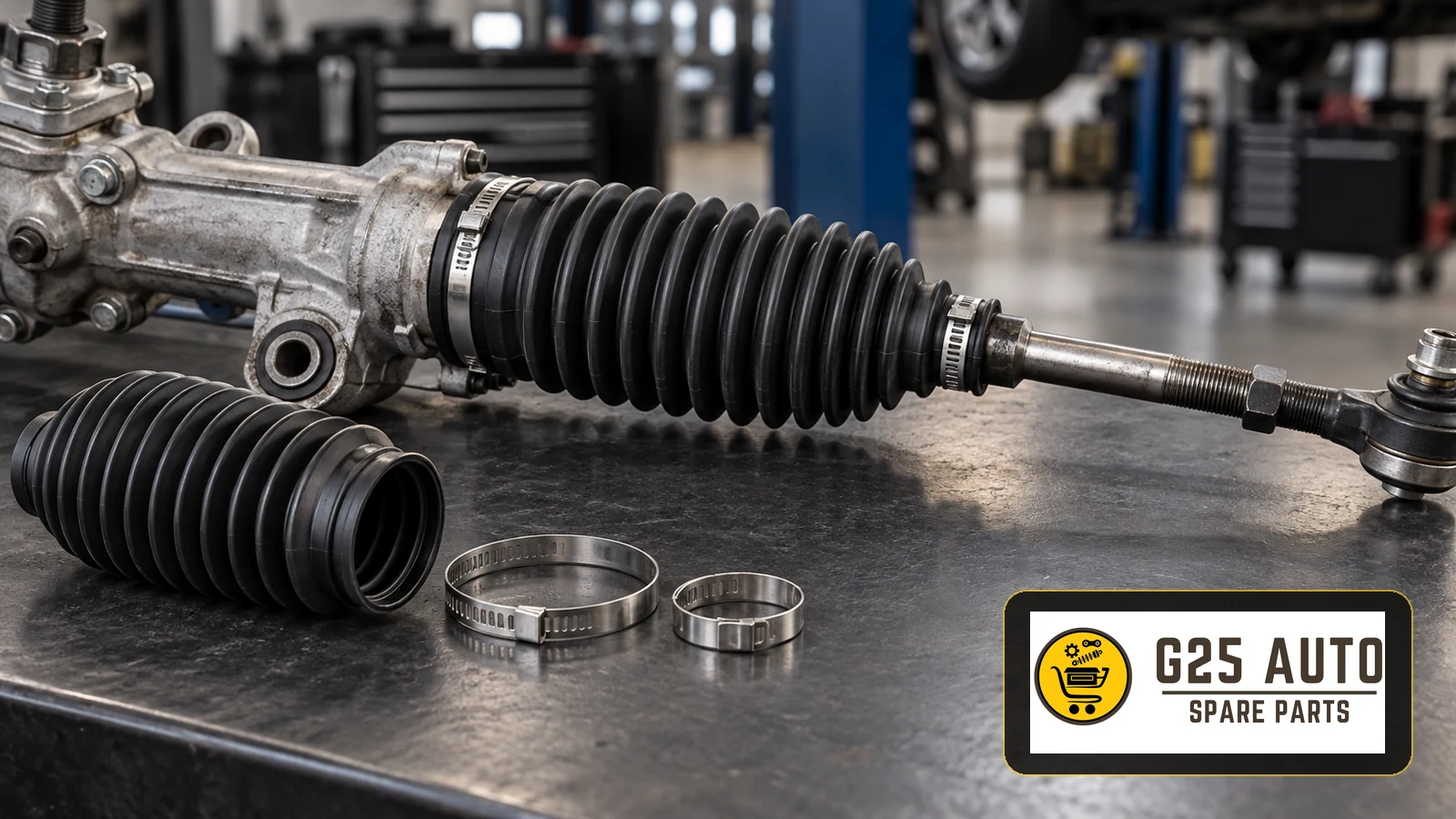
Steering rack bellows and their clamps protect the rack ends and inner tie-rod area from water and road contamination while allowing steering movement. A split boot or loose clamp needs professional assessment, but a new bellows will not repair a leaking hydraulic rack seal or a worn joint. For European and Balkan workshops, fleet operators and distributors, the right order starts with identifying the installed rack, inspecting the damage and confirming the complete repair requirement.
Understand what the bellows protects
The accordion-shaped boot sits between the steering rack housing and the tie-rod area. It is distinct from the small dust cover on an outer tie-rod end and from a seal around the steering input shaft. Use a photograph showing the component in context when terminology differs between a workshop and a cross-border supplier.
MOOG’s steering rack bellows overview describes protection against external contamination and preservation of lubricant around the linkage. That protective function matters when assessing a torn boot: the condition of the parts underneath must be established before deciding that replacing the cover alone is sufficient.
Identify whether the vehicle has a manual, hydraulic or electrically assisted rack. Do not assume that every steering assembly contains power steering fluid. On a hydraulic rack, the bellows is a protective cover; it is not the pressure seal responsible for retaining fluid inside the hydraulic working circuit.
Inspect damage before specifying the repair
Ask a qualified technician to record splits in the folds, abrasion, displaced ends, distorted shape and damaged or missing clamps. Include the opposite side in the assessment. A visible defect warrants attention even if the driver has not reported a change in steering feel.
The workshop should determine whether contamination, corrosion, joint wear or another steering fault has developed beneath the damaged cover. Noise, heavy steering and free play have several possible causes; a photograph of a torn boot does not explain every symptom. If steering control or assistance is impaired, keep the vehicle out of service pending professional assessment.
A damp boot is a finding, not a complete diagnosis
Distinguish external contamination, grease residue and hydraulic fluid leakage. A historical GM bulletin on steering gear boot stains explains that heat-liquefied assembly grease could resemble a leak on its named vehicles. Its inspection criteria apply to those applications; they should not become a universal acceptance threshold for other racks.
Where a hydraulic leak is confirmed, the workshop must identify the supported repair scope for that gear. Replacing or tightening the bellows cannot restore a failed internal hydraulic seal. Document the diagnostic conclusion separately from the parts enquiry so a low-cost cover is not mistakenly quoted as a complete steering repair.
Match the bellows and clamps to the installed rack
Provide the VIN, production details, steering configuration and readable rack identification. Include left-hand or right-hand drive and the required fitting position where the catalogue distinguishes them. Record known rack replacement history: the assembly currently installed needs to agree with the proposed application listing.
Check the current catalogue reference, any supersession and the supplier’s supporting application data. Similar appearance, a model name or a reference copied from an old invoice is not enough. Ask for clarification if vehicle data and rack markings point to different options.
Confirm the package rather than assuming a complete kit
Establish whether the offer covers a single bellows or a set, which clamps are supplied and whether any other specified fitting materials are included. Check the required clamp design and installation method against the applicable instructions. Avoid substituting a convenient tie or hose clamp solely because it can be tightened around the boot.
The DTNA Cascadia bellows replacement procedure illustrates why this detail matters: it specifies new clamps, their seating and controlled crimping, and warns that overtightening can compromise retention. This commercial-vehicle example does not supply clamp settings or fitting materials for an unrelated passenger car.
Workshop and purchasing checklist
- Record vehicle identity, steering configuration and installed rack markings.
- Identify the affected side and photograph the boot, seating areas and clamps.
- Obtain the technician’s findings on contamination, corrosion, leakage and joint condition.
- Confirm whether a bellows repair alone is supported for the assessed condition.
- Match the proposed reference to current application information.
- Confirm bellows quantity, clamp types and all specified fitting items.
- Check product identification, traceability and supplied instructions at receipt.
- Agree the required installation, alignment and release checks before booking the job.
Compare original-equipment and aftermarket offers on documented application, package contents, instructions and technical support. Obtain the commercial terms for the actual quotation. A brand label or broad quality statement does not establish interchangeability, material suitability or a guaranteed service life.
Finish the job without twisting the new boot
Installation belongs with a qualified technician using the applicable vehicle and component instructions. Those documents determine access, clamp renewal, seating, any lubrication requirements and post-repair checks. Do not apply a universal tightening torque or grease recommendation to every bellows design.
CARDONE’s boot-clamp technical note highlights premature damage caused by boots twisting during alignment adjustments. The technician should check the final boot position and follow the correct clamp procedure when adjusting the tie rods. The note’s example dimensions should not be transferred to another application.
Determine alignment requirements from the applicable procedure and work performed. Do not promise that alignment is unnecessary because the order contains only a boot. Retain the diagnostic findings, fitted reference and completion checks in the job record, giving the fleet customer a clear account of what was repaired.
Frequently asked questions
Will a new bellows stop a hydraulic rack leak?
It will not repair a failed internal hydraulic seal. Confirm the fluid source and the permitted repair before ordering the cover as the sole remedy.
Must both sides always be replaced?
Inspect both sides and follow the application instructions and findings. A supplier’s paired kit does not establish a universal replacement rule.
Can the existing clamps be reused?
Check the specified clamp design and renewal instructions. Renew items designated for single use or found damaged; do not assume an opened clamp remains serviceable.
Is there a fixed replacement mileage?
Use the vehicle maintenance information and observed condition. A general article cannot assign one inspection interval or service life to all rack bellows.