
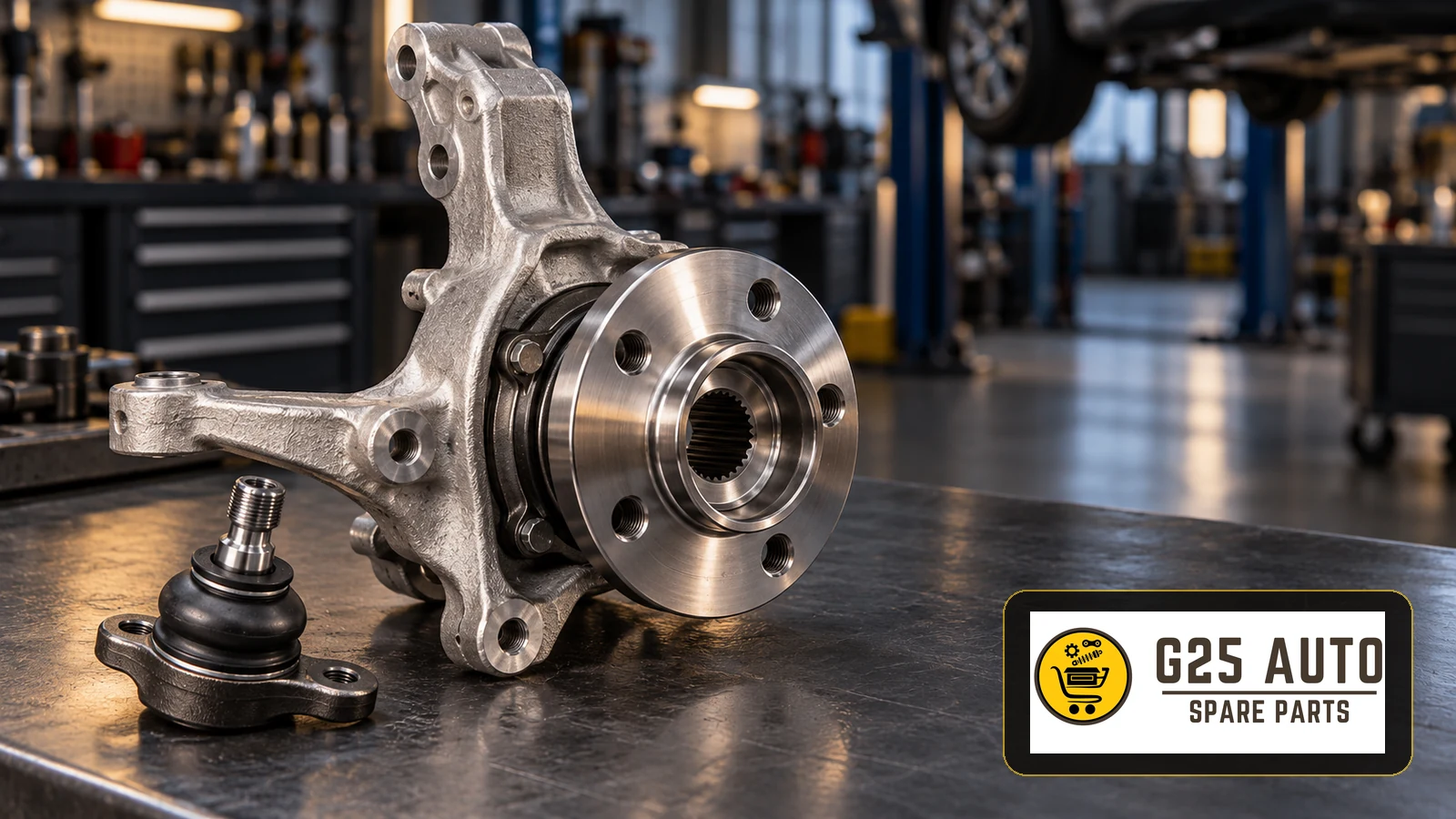
A steering knuckle, or wheel carrier, locates the wheel bearing and connects the wheel end to the suspension; the wheel hub rotates in the bearing and carries the wheel. A hub connection is not another name for a ball joint or tie-rod end. For a correct repair, identify the damaged component, confirm the vehicle-specific hub and carrier arrangement, and match the replacement and fitting procedure before ordering.
Understand which component the enquiry describes
For European and Balkan workshops buying across languages, a request for an “axle carrier” or “hub connection” needs clarification. Ask for the position on the vehicle and photographs showing the complete wheel end and the suspect interface. Agree on the component name in the quotation so that a workshop requesting a carrier does not receive only a bearing kit.
Carrier, hub and bearing
The carrier is the structural mounting component. On a steered wheel it is commonly called a steering knuckle. The hub provides the rotating wheel-mounting flange, while the bearing supports rotation and wheel-end loads. Depending on the application, the bearing may be pressed into the carrier or supplied as a flanged hub unit secured to it. These arrangements require different parts and tools.
Ball joint and tie-rod end
A suspension ball joint allows articulation between a suspension member and the carrier. A tie-rod end transfers steering movement to the knuckle. Both may use a ball-and-socket construction, but they have different functions and catalogue identities. Their attachment points also vary with suspension design. A complete carrier assembly must have its included components listed explicitly.
Diagnose the wheel end before selecting a replacement
Knocking, vibration, uneven tyre wear or an imprecise steering feel can have several causes. Record when the complaint occurs: over bumps, while braking, during cornering or as speed changes. A symptom description helps plan the inspection; it does not establish that the carrier is defective.
Check the carrier for cracks, impact damage and suspect mounting areas, and inspect adjacent joints and bushes for damage or play using the vehicle manufacturer’s test method. Locate the movement at the actual interface rather than attributing all wheel movement to the bearing. Suspected structural damage or an insecure wheel-end connection requires the vehicle to remain out of service pending professional assessment.
Bearing noise can be misleading. SKF’s hub-unit diagnostic guidance recommends checking the surrounding wheel-end components and using the vehicle manufacturer’s specifications. An ABS warning also requires the prescribed system diagnosis, including relevant wiring and connectors; the warning alone does not justify replacing a knuckle or hub.
Build an unambiguous parts enquiry
The purchasing objective is a documented application match. A model name, photograph or apparently similar casting is insufficient on its own. Use the VIN and catalogue to identify the application, then resolve production changes, equipment variants and any replacement-number history. Treat markings on the removed part as evidence to verify, since a casting mark may differ from the service part number.
Workshop and distributor checklist
- Record VIN, production date and the relevant engine, transmission and drive configuration.
- Specify front or rear axle and vehicle left or right side.
- Confirm the service part reference and any supersession through the application catalogue.
- Identify the bearing arrangement and the carrier, suspension and brake mounting interfaces.
- Confirm the wheel-speed sensor and encoder arrangement, including connector details where applicable.
- State whether the quotation covers a bare carrier, separate bearing, hub unit or assembled carrier.
- List included and separately required fasteners, retainers, shields and sensors.
- Obtain fitting instructions and confirm that the workshop has the required tools.
Ask the supplier to resolve any conflict between catalogue data and the removed assembly before accepting the order. Keep the confirmed reference, assembly scope and product identification on the job record. Compare genuine and independent aftermarket proposals against these same requirements; broad quality or compatibility claims do not replace application evidence.
Control the carrier and bearing interfaces during repair
Inspect the seat and choose the correct tools
A new bearing cannot compensate for a damaged carrier seat. Schaeffler’s FAG wheel-bearing technical brochure highlights inspection of the bearing seat and checking for deformation. Assess the cleaned seat against the applicable repair criteria before reusing the carrier. Avoid improvised alterations intended to make an incorrect or damaged interface fit.
For a conventional press-fit bearing, the fitting force must act through the ring being installed. NSK’s replacement example shows outer-ring loading when installing that bearing into the knuckle and appropriate inner-ring support for hub installation. Its example concerns a specific first-generation design; other bearing generations need their own instructions and tooling.
Use the application procedure for reassembly
Retrieve the specified tightening sequence, torque and any angle stages for each disturbed connection. Confirm which nuts, bolts and retaining parts require renewal. Protect the sensor, encoder, seals and cable routing throughout the repair. Surface preparation and lubrication must follow the applicable instructions rather than a universal workshop habit.
Verify the completed repair
Check wheel-end rotation, retention and any specified play or runout before releasing the vehicle. Confirm secure sensor wiring and complete the required diagnostic checks. Assess wheel alignment after carrier or suspension work according to the vehicle procedure; record the results and investigate readings that suggest remaining deformation. A controlled road check follows only when the static inspection confirms the vehicle is ready.
Frequently asked questions
Is a hub connection the same as a ball joint?
No. Clarify whether the enquiry concerns the hub-to-carrier interface, a suspension ball joint or a steering tie-rod end.
Does bearing failure mean the carrier needs replacement?
Not automatically. Inspect the carrier and bearing seat against the repair criteria before deciding which components can remain in service.
Does a complete carrier include the ABS sensor?
Assembly scope varies. Require an itemised component list instead of assuming the sensor, hub or hardware is included.
Is there a universal replacement interval?
No single mileage applies to every carrier, hub and joint. Base the decision on inspection findings and the vehicle’s service requirements.