
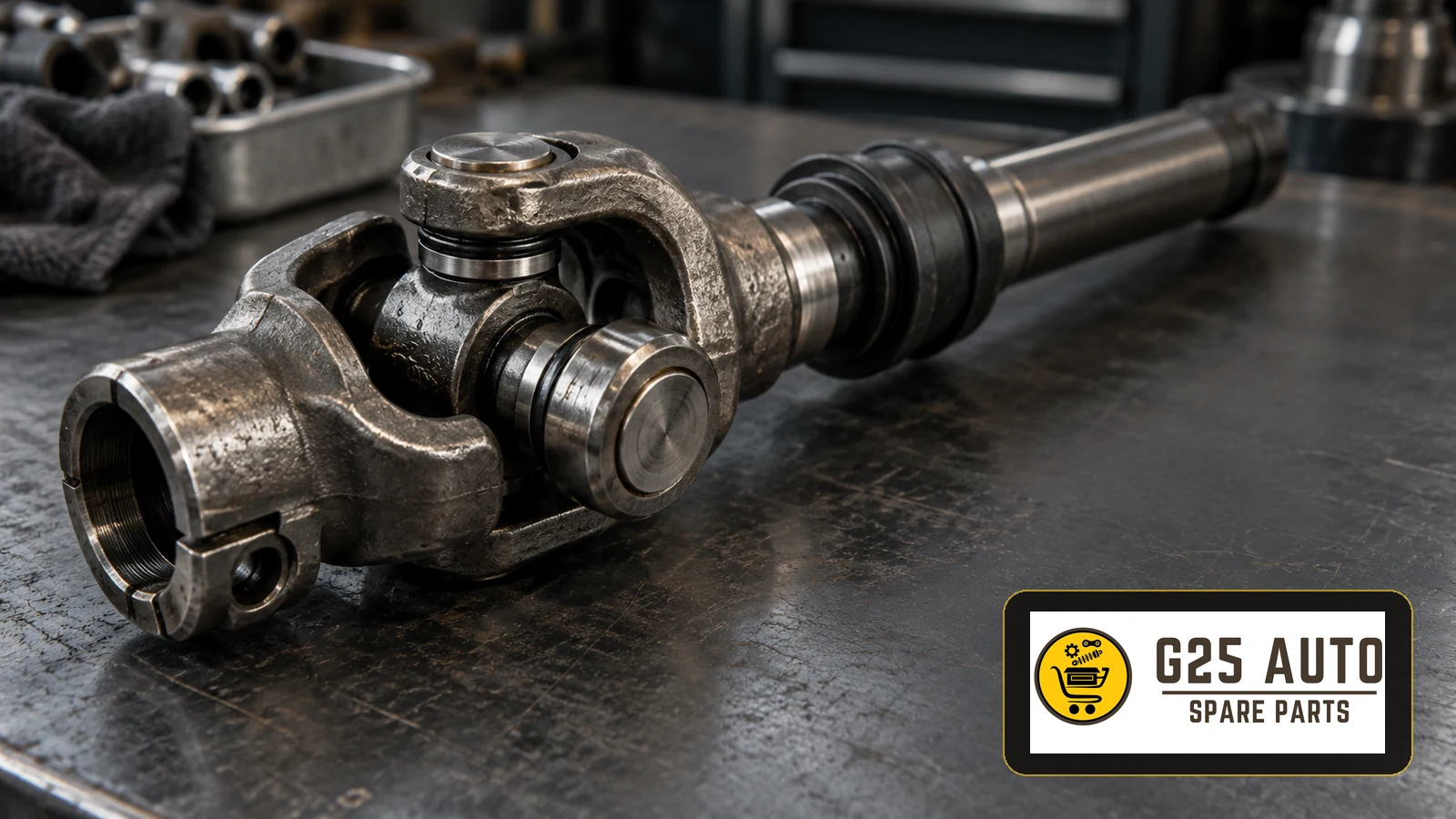
A steering column universal joint transfers steering input between shafts that meet at an angle. Binding, looseness or damage in this connection requires a qualified diagnosis before a replacement is ordered. For European and Balkan workshops, distributors and fleet buyers, the essential steps are to identify the affected joint, establish whether it is separately serviceable and verify the correct replacement against the vehicle application.
Understand which steering component is involved
The terms column joint, steering coupling and intermediate steering shaft can describe different order scopes. A workshop may need a joint alone, a shaft containing joints or another component in the connection. Ask for the location and the manufacturer’s component description rather than relying on a translated trade name.
A universal joint accommodates an angle in the mechanical steering connection. It should not be confused with a flexible rubber coupling or with the column assembly itself. Do not assume every joint has a rubber boot, provides vibration isolation or is itself a controlled crash-collapse device. The replacement must preserve the arrangement specified for that vehicle.
Separate the joint from its attachment
The joint’s bearings and the shaft-to-yoke connection are different inspection points. A complaint at the column may involve the joint, its attachment or an adjacent component. Finding a loose connection does not establish that the joint bearings are sound, and fitting a new joint does not resolve an incorrectly assembled attachment.
Record symptoms without turning them into a diagnosis
Useful observations include notchy or stiff steering, a knock when steering direction changes and apparent lost movement between input and response. Record when the complaint occurs, whether it is repeatable and whether recent steering work or an impact preceded it. Noise, vibration and a warning lamp alone do not identify a failed universal joint.
Ford’s lower intermediate shaft corrosion report documents how corrosion-related joint stiffening could affect other steering components in specified Crown Victoria, Grand Marquis and Town Car vehicles. This is an application-specific example, not evidence that another vehicle is affected by that recall. It illustrates why changes in steering feel should prompt investigation rather than a routine parts substitution.
Where steering control is impaired or a connection may be insecure, keep the vehicle out of service pending professional assessment and arrange appropriate recovery. A road test should not be used to establish whether a visibly unsafe connection will hold.
Ask for findings at the actual fault location
The workshop should assess the connection using applicable service information and distinguish joint resistance or play from column, steering gear and other steering or suspension faults. Request photographs and a written finding identifying the defective component. Surface appearance alone is insufficient to decide either that a joint is serviceable or that it requires replacement.
Confirm joint-only or complete-shaft replacement
Do not assume that every steering joint can be pressed out and renewed independently. Establish the permitted repair scope from the vehicle procedure and the replacement manufacturer’s application information. A complete assembly and a separate joint should not be treated as equivalent quotations without that confirmation.
For example, Dorman’s steering shaft joint listing describes a separately supplied joint for specified applications, with sealed bearings and no greaseable provision. It demonstrates that serviceability and lubrication arrangements belong to the identified product. It does not establish suitability for a European vehicle or justify lubricating another joint as a repair.
Where bearing retention, the yoke or the shaft is damaged, obtain the prescribed repair decision. Avoid treating added lubricant, improvised fastening or modifications to a joint as substitutes for a documented repair.
Build a verifiable B2B parts enquiry
Use the VIN alongside production information, steering configuration and the current catalogue. Left-hand and right-hand drive versions should be explicitly identified. Check an old part reference for supersession and application restrictions; neither a reference match nor a photograph should be presented as an unconditional fitment guarantee.
- Record the VIN, model, production details and steering configuration.
- Identify the precise joint location and the workshop’s diagnosis.
- Provide legible existing references and clear connection photographs.
- Confirm whether the approved repair uses a joint or a complete shaft.
- Verify the catalogue application and any superseding references.
- Confirm the required fastening hardware and what the package includes.
- Request applicable installation information and product traceability.
- Record the agreed specification and resolve discrepancies before installation.
Compare evidence rather than broad quality labels
For original-equipment and aftermarket offers, compare the confirmed application, documented repair scope, supplied hardware and technical support. Request the supplier’s written commercial terms for the actual order. A certification claim, a familiar brand or a lower quotation does not by itself demonstrate the correct steering connection or an equivalent service life.
Agree installation and release requirements
Hyundai’s Sonata intermediate shaft connection bulletin separately addresses bearing-cap retention, shaft engagement, bolt position and damaged threads for its specified vehicles. Those distinctions show why checking bolt tightness alone is insufficient. Its measurements, fasteners and campaign procedure must not be transferred to other applications.
Before work begins, the technician should obtain the vehicle procedure covering steering-wheel position, restraint-system precautions, connection alignment, hardware replacement and tightening. Confirm any required steering-angle checks or calibration and alignment assessment from that procedure. There is no universal instruction here to disconnect a battery, rotate a disconnected wheel, grease a joint or perform wheel alignment after every joint replacement.
For fleet records, retain the diagnosis, fitted part identity and completed inspection details. Release the vehicle only after the qualified workshop has completed the applicable safety and functional checks. Use the actual service information and inspection findings for future maintenance planning rather than a generic joint replacement mileage.
Frequently asked questions
Does a steering knock prove the column joint has failed?
No. The joint, its connections and other steering components can produce similar complaints. Locate the fault before ordering.
Can the joint always be replaced separately?
No. Confirm the repair scope for the exact application; some orders require a complete shaft assembly.
Will lubrication cure a stiff joint?
Do not assume so. A sealed joint may have no service lubrication provision, and an apparent improvement does not establish a safe repair.
Is there a standard replacement interval?
Use the vehicle’s maintenance guidance and condition assessment. Do not apply a universal mileage or promised service life to steering joints.