
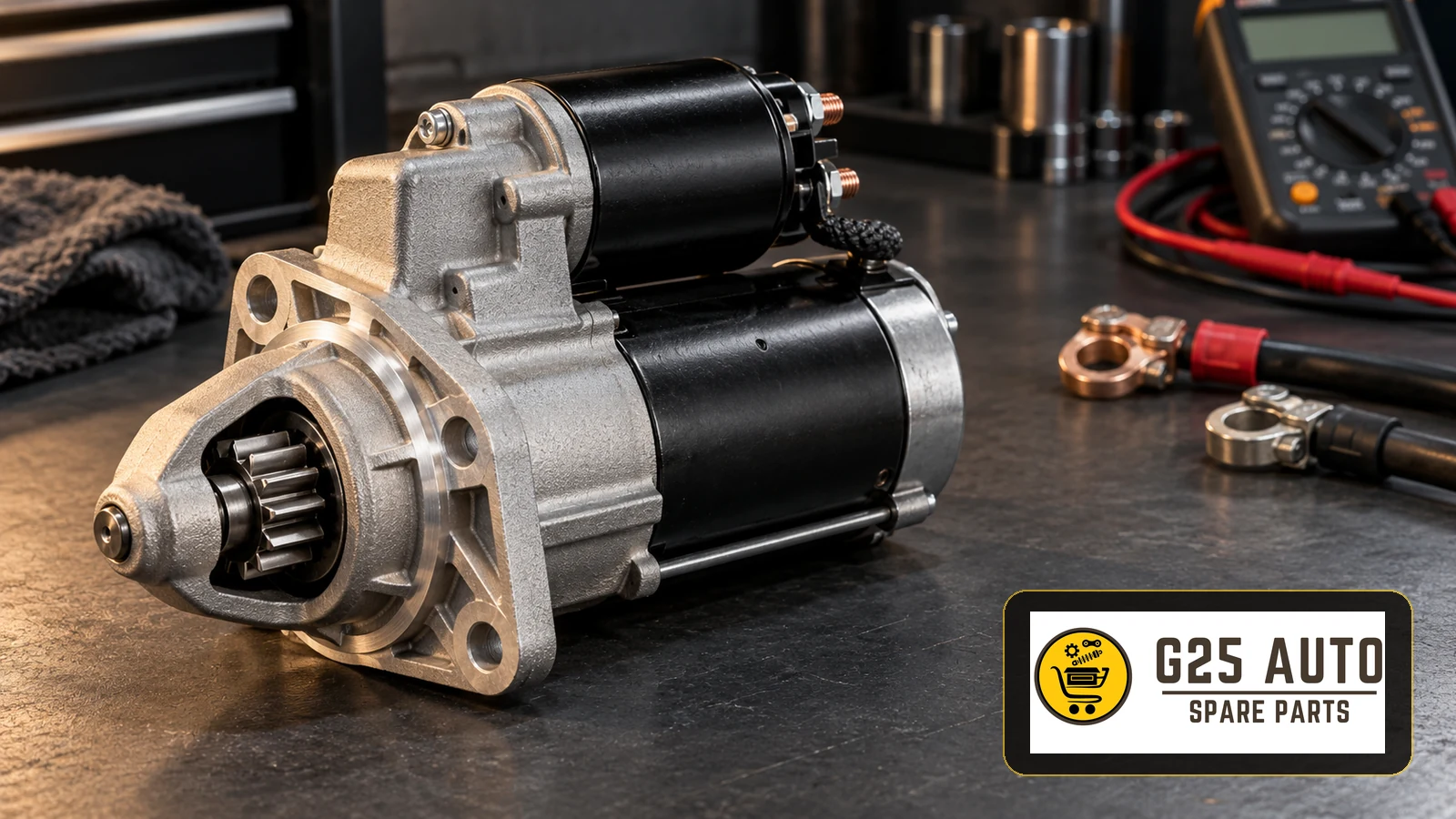
The starter motor is an electrical unit that supplies the initial movement needed to start an engine. When the starting command is given, it turns the flywheel to crank the engine. A fault in the starting system can prevent cranking or make starting difficult, so diagnosis and correct replacement-part selection matter.
How Does a Starter Motor Work?
The starter motor follows a straightforward operating sequence. When the ignition switch requests starting, the battery supplies the starting circuit. The relay and solenoid control the engagement and electrical supply to the motor; the precise circuit arrangement depends on the vehicle.
When the solenoid operates, the drive mechanism, often called the Bendix drive, moves the pinion into engagement with the flywheel ring gear. The electric motor turns the gear, rotating the flywheel and moving the engine’s pistons. This cranking action allows the engine’s combustion process to begin.
Once the engine starts and the starting command ends, the starter drive disengages from the flywheel. This disengagement protects the starter from being driven by the running engine.
Symptoms of Starter Motor Problems
Recognising starting-system symptoms helps identify where further checks are needed. The main signs to investigate are listed below.
No Sound When the Ignition Key Is Turned
If there is no sound when starting is requested, the problem may involve the starter motor, battery, fuse, starter relay or wiring connections. A systematic check is needed before identifying the faulty component.
A Clicking Sound Without Engine Cranking
A single click may indicate that part of the starter control mechanism is operating while the motor fails to turn. Possible causes include the electrical supply, internal windings, brushes or connections; the sound alone does not establish the diagnosis.
Slow or Weak Cranking
If the starter operates but turns the engine slowly, possible causes include a weak battery, poor earth connections, worn brushes or mechanical wear within the starter.
The Starter Spins but Does Not Crank the Engine
If the starter spins without turning the engine, its drive mechanism may not be engaging correctly. Worn gears or a problem within the drive mechanism can produce this symptom.
Squealing or Metallic Noises
Abnormal noises during cranking may indicate damage to the starter pinion or flywheel ring gear. Both components should be inspected when investigating the noise.
Diagnosing a Starter Motor Fault
After observing the symptoms, professional checks are needed to confirm the cause. Diagnosis includes the following checks.
- Battery test: Measure battery voltage and assess its condition using the appropriate test procedure rather than a universal voltage threshold.
- Cable and connection inspection: Check the starter wiring for corrosion, loose connections and damage.
- Starter relay test: Check that the relay operates correctly.
- Mechanical inspection: Where removal is required, inspect the brushes, commutator, drive mechanism and other mechanical parts using the applicable procedure.
- Current-draw test: Measure the starter’s current draw and compare it with the correct reference values for the application.
Replacement may be appropriate if testing shows that repair is impractical or uneconomical. That decision should follow diagnosis rather than symptom recognition alone.
Starter Motor Checklist
The following checklist follows the starting-system checks step by step.
- Check battery voltage and condition against the applicable test requirements.
- Inspect battery cable connections and clean or secure them using the correct procedure.
- Check the earth cables.
- Check the starter circuit fuse.
- Listen for relay operation when starting is requested.
- Test the ignition switch and its operating mechanism where applicable.
- Check for loose connections at the starter motor.
- Have a technician check the starter’s mechanical operation using the specified procedure.
- Visually inspect the flywheel ring gear where accessible.
- Seek professional diagnosis if the cause remains uncertain.
Comparing Original and Aftermarket Starter Motors
| Feature | Original Part | Aftermarket Part |
|---|---|---|
| Price | Check the current quotation. | Check the current quotation; a lower price is not universal. |
| Availability | Confirm with the supplier. | Confirm with the supplier; availability varies. |
| Warranty | Check the terms offered for the part and installation. | Check the supplier’s stated terms. |
| Quality documentation | Check the documentation for the specified part. | Check the manufacturer’s documentation rather than assuming equivalence. |
| Compatibility | Verify the exact application. | Verify the exact application and cross-reference. |
| Brand choice | The vehicle-brand parts route. | Different manufacturers may offer alternatives for the application. |
How to Select the Correct Starter Motor
The central task is finding the correct part for the vehicle. Different model years and engine versions within the same model range may use different starters.
Checking Original and Replacement Part Numbers
The original part number is an important reference when identifying a replacement. The existing starter may carry a label or stamped identification. Check this reference against the documented original part or aftermarket cross-reference.
Part identification may be available in technical documentation, service records or on the existing unit. A catalogue search can help identify options, but the application details still need checking.
Checking Against the Vehicle Identification Number
The vehicle identification number, or VIN, helps establish the vehicle’s production details and original specification when used with an appropriate parts catalogue.
For vehicles built around a model-year change, the year alone may be insufficient. A VIN-based lookup helps narrow the application, but should be considered alongside the installed unit and other vehicle details.
Engine Code and Production Date
The same vehicle model may be offered with different engines. Petrol and diesel versions, different engine capacities and different power outputs can require different starter motors.
Check the engine code in the vehicle’s identification information or service documentation. The production date also matters because manufacturers may introduce technical changes within a model year.
Original or Aftermarket?
There is no single answer for every replacement. The decision depends on the vehicle’s requirements, the available documented options and the buyer’s circumstances.
When an Original Part May Be Preferred
For a vehicle under warranty, review the applicable warranty terms before deciding on a replacement. Originality may also be relevant for a classic or collectible vehicle.
Performance or luxury vehicles may have application-specific starting systems. Any proposed replacement must meet those particular requirements; its suitability cannot be inferred from the vehicle category alone.
Considering a Quality Aftermarket Part
An aftermarket starter may be an option where the manufacturer documents its suitability. Claims about shared factories or identical specifications should be checked for the particular product rather than assumed.
Different aftermarket manufacturers may offer a choice of products. Assess their product documentation and relevant certification carefully; a brand name or general quality certificate alone does not establish suitability for the vehicle.
Starter Motor Care and Service Life
The starter is not generally treated as a routine service item, but the following operating and maintenance considerations remain relevant.
- Keep the battery in good condition: A weak battery can cause starting difficulties and should be investigated.
- Avoid prolonged cranking: Follow the vehicle’s starting instructions and permitted cranking periods rather than applying a universal time limit.
- Keep connections in good condition: Corroded terminals can cause voltage drop and starting problems.
- Release the starting command once the engine runs: The starter drive should disengage rather than remain engaged with the running engine.
- Consider cold-weather starting conditions: Cold oil can increase cranking resistance; follow the vehicle’s specified cold-start instructions.
Frequently Asked Questions
How Can I Distinguish a Starter Fault from a Battery Fault?
Dim dashboard lights or lights that fade during a starting attempt may point towards a battery or supply problem. Normal-looking lights combined with silence or clicking do not prove that the starter itself is faulty. Battery testing and starting-circuit checks are needed; voltage alone does not provide a definitive diagnosis.
Can a Starter Motor Be Repaired, or Must It Be Replaced?
Some faults can be repaired through work on brushes, the commutator or the drive mechanism. Repairability and cost depend on the unit’s construction and condition. A technician can assess whether repair is practical compared with replacement.
Can an Aftermarket Starter Motor Damage My Vehicle?
An aftermarket part must be checked for the correct application and documented specifications. Choosing a recognised manufacturer and checking the part reference are useful steps, but the aftermarket label alone does not establish equivalence or guarantee an outcome.
How Long Does a Starter Motor Last?
There is no universal service-life figure. Starting frequency, battery condition, operating conditions and maintenance affect the unit’s life. Frequent short journeys can involve more starting cycles, so mileage alone is an incomplete measure.
Can I Replace the Starter Motor Myself?
Access and replacement procedures vary by vehicle. Correct electrical connections and safe battery isolation are essential, using the vehicle-specific instructions. If you are uncertain about the procedure or access, have a qualified technician carry out the work.
Conclusion
The starter motor is essential to cranking the engine. Recognising symptoms, establishing their cause and selecting the correct replacement are the main steps in resolving starting problems.
Use the VIN, engine code, production date and relevant part references together when identifying a replacement. Original and aftermarket options should each be assessed against the exact application.
When considering an aftermarket part, review its documented suitability, supplier information and warranty terms. Arrange the appropriate checks after installation rather than assuming equivalent performance or a guaranteed saving.
Starting problems can appear unexpectedly. Understanding the symptoms and maintaining the battery and electrical connections can help identify developing issues, although these precautions cannot guarantee that a breakdown will be avoided.