
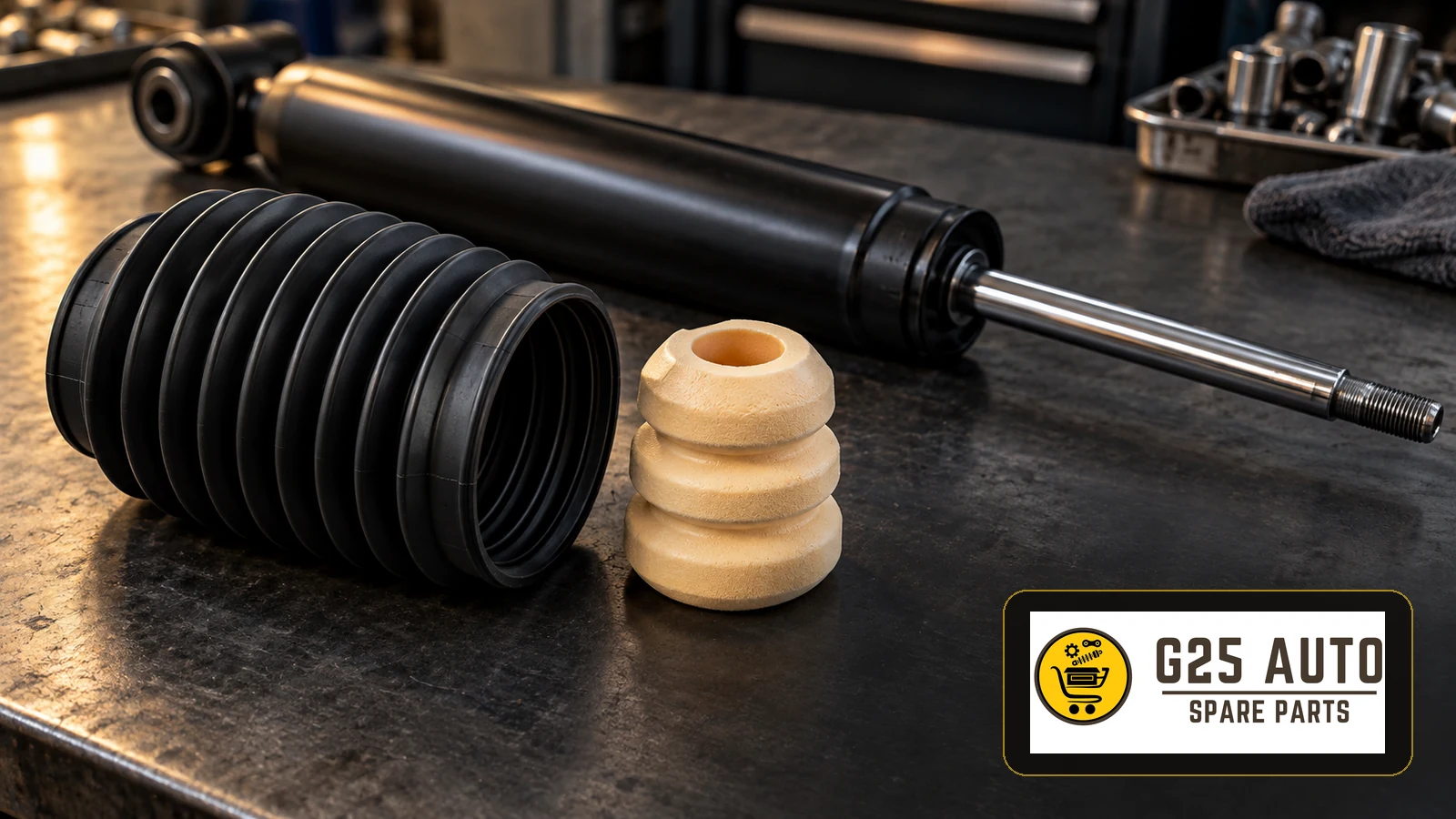
A damaged shock absorber dust boot or bump stop should be assessed during suspension inspection and replaced with a kit specified for the exact vehicle and suspension configuration. The boot helps shield the piston rod and seal area from contamination; the bump stop limits compression travel and cushions its end. For European and Balkan workshops, distributors and fleet buyers, a sound order combines a confirmed application, explicit kit contents and a documented fitting plan.
Two components with different jobs
The dust boot protects the rod area
The dust boot, also called a gaiter or dust cover, provides a barrier around the exposed rod area. A split, missing or displaced cover reduces that protection. It is not an oil seal, and replacing it cannot repair a leaking damper. The workshop should inspect the damper separately before deciding which components the job requires.
The bump stop manages compression travel
The bump stop, sometimes called a jounce bumper or compression buffer, is part of the suspension’s compression-travel control. Its shape and material belong to the specified application. It should not be treated as a generic piece of foam that can be selected by appearance alone. KYB Europe’s protection-kit guidance explains the protection function and recommends renewing these kits when replacing shock absorbers.
Inspect before specifying the repair
Record visible splits, missing sections, crumbling material and a cover or buffer that no longer stays in its intended position. Inspect the attachment arrangement against the relevant service information. Different designs retain the cover differently, so a universal instruction to clamp both ends can lead to an incorrect repair.
Note when any noise or harsh impact occurs and examine the surrounding suspension. A knock over a large bump can justify inspection, but it does not identify the bump stop as the cause. Springs, mounts, joints and fasteners may also require attention. A torn boot likewise does not establish that the damper has already failed.
Assess rod condition and signs of leakage using the damper manufacturer’s criteria. If access requires lifting or disassembly, use a qualified technician and the appropriate equipment. Do not turn a limited visual check into a promise that the complete suspension is serviceable.
Identify the application precisely
Use vehicle and suspension information together
Give the supplier the VIN and the production and suspension details required by the current catalogue. Confirm the axle, installation position and any restrictions for standard, sport or other suspension variants. For a modified vehicle, establish the installed suspension specification before ordering a kit intended for the original arrangement.
Keep the catalogue result with the enquiry. An old part reference or photograph can help resolve a question, but neither proves the previous component was correct. Ask the supplier to resolve conflicting references before authorising supply. Do not substitute a similar-looking boot or shorten a buffer to make an uncertain selection fit.
Confirm the kit’s scope
A product labelled protection kit may contain a boot and buffer for one position or components for an axle. Establish the exact contents and package coverage. Check whether required retainers, seats or fasteners are included or need separate ordering. A picture showing two components does not establish the number of vehicle positions covered.
Distinguish a protection kit from a top mounting kit. The latter addresses the strut-to-body mounting arrangement and may include a bearing; it does not automatically supply the dust cover and bump stop. Ask for an itemised quotation when both are needed.
Build a useful B2B purchase order
Compare the exact references offered by each supplier, including application notes, contents and available fitting information. A brand name, a quality-system certificate or an OE-equivalent description does not establish fitment by itself. Evaluate the documentation for the proposed product rather than assuming identical performance across a whole category.
For cross-border orders, obtain written confirmation of availability, delivery expectations, returns and warranty terms for that quotation. Record the supplier’s technical contact and the process for resolving a contents discrepancy. No price, stock level or delivery commitment can be inferred from the component type.
Purchase-order checklist
- Vehicle: VIN and catalogue-required production details recorded.
- Suspension: installed specification, axle and position confirmed.
- Reference: manufacturer and exact product reference matched to current application notes.
- Contents: boot, buffer and required associated components itemised.
- Quantity: package coverage and the repair scope across the axle agreed.
- Condition: damper, spring, mount and surrounding components assessed separately.
- Fitting: applicable instructions, equipment and completion checks identified.
- Supply: order-specific commercial terms and technical support recorded.
Fit and verify the complete repair
Where the job involves a spring-loaded strut, disassembly requires control of stored spring energy. Qualified technicians should follow the vehicle and component manufacturers’ procedures, use suitable spring-handling equipment and obtain the applicable tightening information. Protect the piston rod surface and follow the specified seating, orientation and fastening method.
After assembly, confirm that the protection components sit as intended and complete the checks required for the work performed, including any applicable geometry assessment. Record the fitted references and investigate any remaining noise. For fleet maintenance, use subsequent service inspections to monitor condition; avoid assigning one replacement mileage to every vehicle or operating environment.
Frequently asked questions
Does a torn boot mean the shock absorber must be replaced?
No. Inspect the damper separately. Boot damage reduces protection, but the repair scope depends on the findings and applicable guidance.
Can I order a bump stop by its visible size?
Appearance alone is insufficient. Match the exact vehicle and suspension application through the manufacturer’s current catalogue.
Must a kit contain parts for both sides?
No. Package contents vary. Confirm coverage and inspect both sides before agreeing quantities and the repair scope.
Can new protection parts cure an oil leak?
No. A boot and buffer do not repair a damaged seal or damper. Diagnose the leak and specify the required repair separately.