
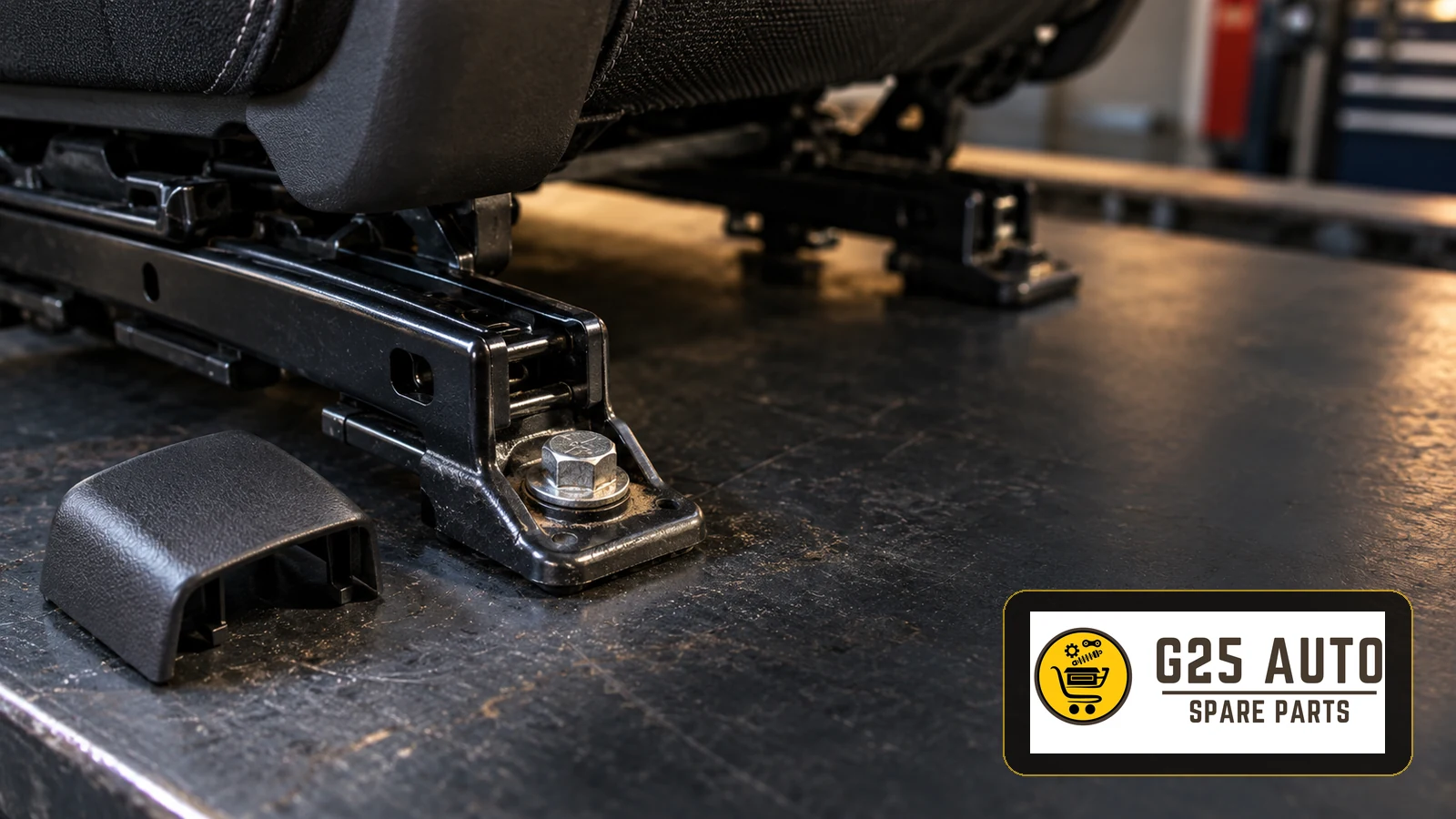
Seat rail mounting bolts and their plastic covers form part of the system that secures vehicle seats to the body or floor. Select these parts carefully, check OEM or part references, and verify the application using the vehicle identification number, production date and relevant vehicle details. Damaged or missing mounting bolts can compromise seat stability. Missing covers expose the fasteners and should be assessed separately from the structural connection.
What Are Seat Rail Mounting Bolts and Plastic Covers?
Seat rail mounting systems provide the mechanical attachment points between the driver or passenger seat and the vehicle body. Their bolts must meet the strength and dimensional requirements specified for the application. Plastic covers provide a finished appearance, protect bolt heads from external contact and help prevent passengers from touching exposed metal parts.
Although these components look simple, the structural mounting is important to vehicle safety. A seat moving out of position during a collision can endanger occupants. Part selection and installation therefore require care.
Fault Symptoms and Inspection
Problems around the seat rail mounting system may produce noticeable symptoms:
Common Symptoms
- Squeaking or rattling from the seat while driving
- Unusual movement or looseness in the seat
- Sticking or resistance when sliding the seat forwards or backwards
- Broken or detached plastic covers at rail mounting points
- Exposed bolt heads where covers should be fitted
- Metallic noises from the seat base
- A seat adjustment mechanism that does not operate correctly
Diagnostic Checks
These symptoms suggest a potential problem, but a professional inspection is needed to establish its cause:
- Visually inspect the seat rail connections
- Check bolt fastening in accordance with the service procedure and specified torque requirements
- Test the rail mechanism through its full range of movement
- Inspect plastic covers for breakage, cracks or distortion
- Check body attachment points for corrosion or damage
Important: seats may be integrated with restraint systems and airbag sensors. Read the vehicle service manual before carrying out any work.
Original and Aftermarket Parts Compared
| Feature | Original Equipment Part | Aftermarket Part |
|---|---|---|
| Application suitability | Check the manufacturer’s reference for the vehicle and seat version | Verify the supplier’s application data and technical specifications |
| Material quality | Check the specified material and strength requirements | Assess documented specifications rather than relying on a brand name alone |
| Supply lead time | Confirm current availability with the supplier | Confirm current availability with the supplier |
| Range | Available references depend on the vehicle version | Alternative manufacturers or options may be available |
| Warranty coverage | Check the applicable manufacturer terms | Check the supplier and manufacturer terms |
Both routes may have advantages and limitations. An aftermarket option needs documented suitability for the application; an original reference also requires correct identification. Consider the vehicle’s age, intended use and budget alongside the technical requirements.
What to Check When Selecting Parts
Verification Process
Check the following information when selecting a seat rail mounting bolt or plastic cover:
- Vehicle identification number (VIN): use the vehicle identifier to support catalogue identification; it does not replace checking the seat variant
- Engine code: record it where required by the vehicle catalogue, without assuming it determines seat mounting compatibility
- Production date: revisions within a model range may change the required parts
- OEM or part reference: compare the existing reference with current application information
- Seat type: manual, powered, memory and sports seats may use different mounting arrangements
Ordering without this information increases the risk of an unsuitable part. A professional parts supplier can use these details to help identify the appropriate reference.
Technical Specifications
Technical requirements matter for both the bolt and its cover:
- The bolt strength class specified for the application
- Correct thread dimensions and engagement
- The plastic cover’s resistance to UV exposure and temperature, where relevant
- The tightening requirements specified for installation
- The required corrosion protection coating
Pre-installation Checklist
Before installing new seat rail mounting bolts and plastic covers, check the following:
- Has application suitability been checked using the VIN and relevant seat details?
- Has the OEM or part reference been cross-checked?
- Are bolt dimensions and threads correct for the mounting?
- Do the plastic covers have the appropriate shape and colour?
- Are the necessary special tools available?
- Are the service manual’s tightening requirements known?
- Have the removed parts been inspected for damage?
- Has the rail been cleaned and, where specified, lubricated?
- Are the body attachment points free from damage or corrosion?
- Have safety sensors and wiring been located?
- Has the post-installation test procedure been planned?
Finding Parts for a B2B Enquiry
For specialist components such as seat rail mounting parts, work with a supplier able to provide clear identification and technical information. European and Balkan trade buyers preparing a G25Auto enquiry can organise the required information before requesting a part.
The search process can follow these steps:
- Have the vehicle VIN, relevant vehicle details and production date ready
- Record the OEM or part reference from the existing component
- Include these identifiers in the parts enquiry
- Read the application information in the product documentation carefully
- Request technical clarification if anything is uncertain
- Review the applicable return and warranty terms before ordering
Original and aftermarket options may be available depending on the application and supplier. Assess each product’s technical specifications, application information and warranty terms before selecting it for the vehicle.
Post-installation Checks
After fitting the seat rail mounting bolts and plastic covers, carry out the required checks:
- Confirm that all bolts have been tightened according to the specified procedure
- Slide the seat forwards and backwards through its full travel
- Check for unusual noise, vibration or sticking
- Inspect the plastic covers for correct seating and fit
- Test the seat locking mechanism in its intended positions
- For powered seats, verify the relevant electrical functions
Frequently Asked Questions
How Long Does It Take to Replace a Seat Rail Bolt?
The time depends on access, the seat type and the work required. Powered or more complex systems may take longer. Establish the work scope before estimating a workshop time.
Is the Plastic Cover Decorative or Functional?
It provides a finished appearance and shields the bolt head from contact. Depending on its design, it may also limit exposure to dirt and moisture. It is separate from the bolt’s structural fastening function.
Should Every Bolt Be Replaced If One Is Loose?
Inspect all mounting bolts and establish why the connection became loose. A loose bolt may affect load distribution. Replace fasteners where required by their condition and the vehicle manufacturer’s service procedure, rather than assuming every bolt can be reused or must be replaced.
How Can an Aftermarket Plastic Cover Be Distinguished from an Original?
An aftermarket cover may carry a different manufacturer’s mark or no mark. Material, colour and surface finish may differ. Appearance alone does not establish suitability: compare the reference, shape and fixing arrangement.
Where Can the OEM Part Reference Be Found?
A reference may be marked on the component. Vehicle documentation, an authorised parts service or a catalogue lookup using the VIN may also help identify the applicable reference.
Safety Precautions
Observe the following precautions when working around the seat rail mounting system:
- Before work involving airbags or associated connections, follow the manufacturer’s isolation procedure, including battery disconnection and the specified waiting period
- Avoid damaging electrical connections beneath the seat
- Use suitable handling methods or assistance when lifting heavy seats
- Do not overtighten bolts, as this can damage the threads
- Complete the prescribed checks after installation
- Avoid damage to seat belt mounting points
Maintenance and Service Life
To help maintain the seat rail mounting system:
- Inspect fastening condition at the intervals specified for the vehicle and whenever symptoms arise
- Keep the rail mechanism clean and use the specified lubricant where required
- Avoid excessive loading
- Clean the plastic covers regularly
- Identify and address signs of corrosion
- Move seat adjusters smoothly without forcing them
Conclusion
Seat rail mounting bolts secure the seat, while their plastic covers provide protection and a finished appearance. Verify the VIN, relevant vehicle details, production date and OEM or part reference before selecting components or starting installation.
Assess original and aftermarket parts against the application requirements, documented quality and commercial terms. A reliable supplier can support identification, but suitability still needs to be checked for the specific vehicle and seat.
Follow the service procedure and obtain professional assistance where needed. Carry out the prescribed checks after replacement and maintain the mounting system according to the vehicle’s requirements.
For a B2B parts enquiry, provide the identifying information and request the relevant technical specifications. This supports an informed selection without assuming availability or guaranteed compatibility.