
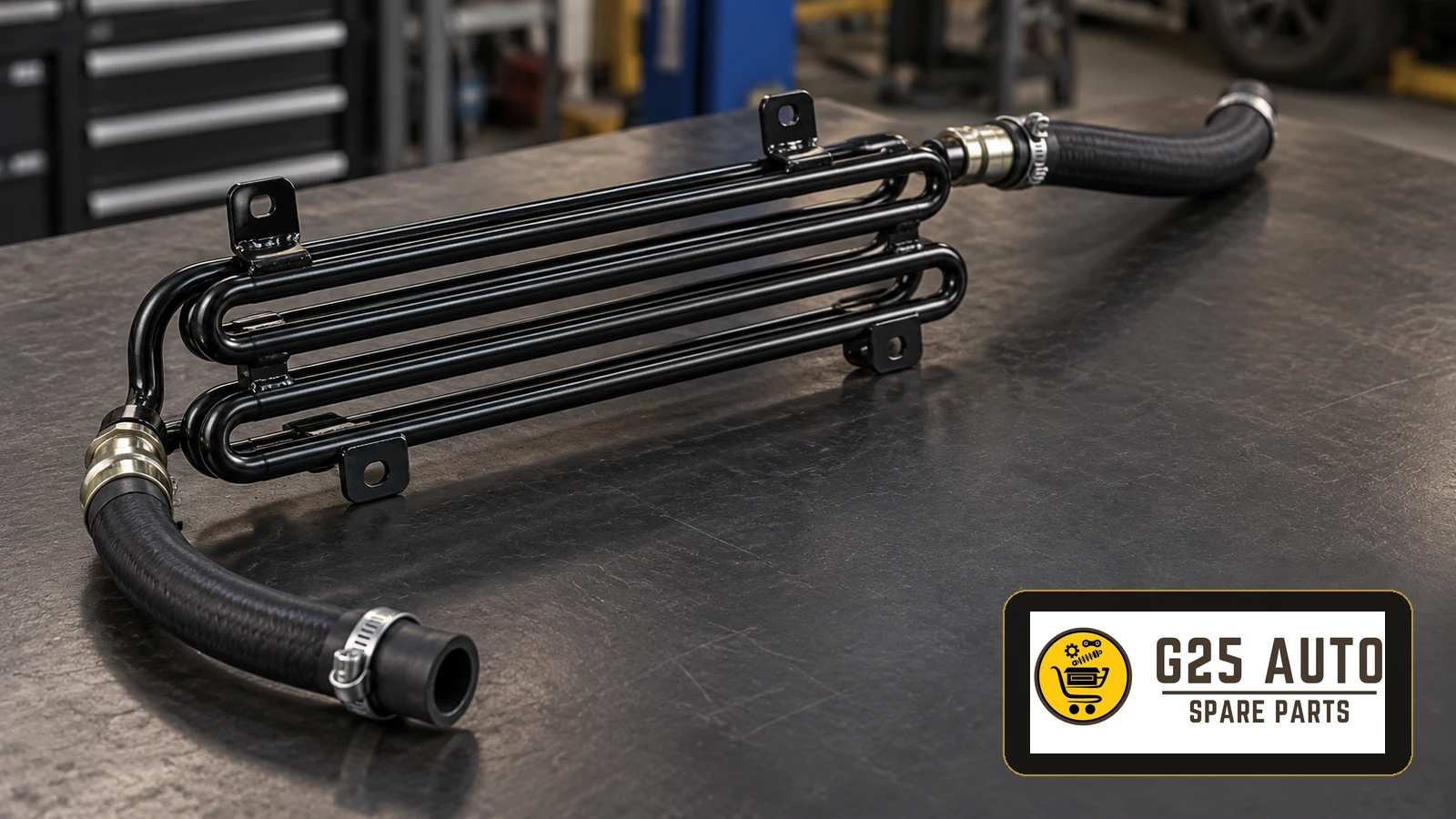
A power steering cooler removes heat from the hydraulic fluid, while the return line carries fluid back towards the reservoir. When either needs repair, identify the exact circuit, diagnose leakage or restricted flow and confirm the replacement against the vehicle application. For European and Balkan workshops and parts distributors, the cooler, connecting hoses and fittings should be treated as a matched repair scope.
Identify the hydraulic circuit first
Start by confirming that the vehicle has hydraulic steering assistance and the cooling arrangement fitted to it. An electrically driven hydraulic pump still belongs to a hydraulic system; fully electric assistance is a different arrangement. Do not infer the presence of a cooler from a model name or vehicle category alone.
The pressure line delivers fluid to the steering gear. The return circuit takes it back, through a cooler where fitted. A cooler may use exposed tubing or a finned construction. The return route can contain both rigid pipe and flexible hose, so the workshop should identify the failed section and its connections before requesting a quotation.
Lower pressure does not mean interchangeable hose
Return-side service is distinct from pressure-side service. The fluid specification, hose construction, connections, routing and operating conditions must suit the application. A hose with a similar bore is not enough evidence for substitution. Ask the supplier to confirm suitability for the specified power steering circuit rather than choosing general-purpose hose by appearance.
Preserve the intended cooling arrangement. Joining hoses together is not an acceptable permanent replacement for an installed cooler. Any proposed change in cooler type or routing needs application-specific technical approval.
Separate leakage, air entry and flow restriction
Collect the complaint before ordering: falling fluid level, visible leakage, foaming, noise or changing steering assistance. Record when it occurs and any recent hydraulic repairs. These observations guide diagnosis but do not identify the defective part by themselves.
Ask the technician to inspect the actual fluid path, including pipe bends, supports, hose sections and connections. Record corrosion, chafing, kinks, cracks, swelling and wet joints. Fluid can travel along a pipe or adjacent structure, so a photograph of a wet area should be accompanied by confirmation of the leak’s origin.
Air entry can resemble a pump problem
CARDONE’s technical note on air entering power steering hoses links defective hose and loose connections with aerated fluid and noise. This supports checking the hose circuit before condemning a pump. The diagnostic equipment and test conditions must follow the applicable service instructions; the note’s test pressure is not a universal specification.
A cooler can be restricted without an external leak
CARDONE’s clogged cooler bulletin describes restricted flow and contamination as causes of noise, intermittent assistance and premature component failure. It specifically discusses Ford Aerostar as an example. Use it to understand the failure mechanism, not to transfer a vehicle-specific test or bypass procedure to another application.
Request documented findings using the manufacturer’s test method and acceptance criteria. Fluid colour, odour or an assumed temperature difference across the cooler cannot alone establish the repair scope. A restriction investigation should consider the relevant hoses, reservoir and any fitted filtration as well as the cooler.
If steering assistance changes unexpectedly or leakage threatens safe operation, stop normal vehicle use and arrange professional assessment. Do not authorise continued driving merely because the reservoir can be topped up.
Build an application file for the supplier
Cross-border enquiries work best with a consistent identification record. Include the VIN, production details, engine and steering configuration, left- or right-hand drive, and the precise position of the requested pipe or hose. State whether the enquiry concerns the gear-to-cooler section, the cooler itself or the route back to the reservoir.
Add legible installed references and photographs showing the entire assembly, both ends, mounting points and adjacent routing. Ask the supplier to verify the offered reference, production restrictions and any supersession against the application. The VIN and old reference support verification; neither is an unconditional fitment guarantee.
Compare the same delivery scope
Clarify whether the quotation includes hoses, seals, connectors, clips and mounting brackets or only the cooler body. Have the workshop identify separately required items from the repair procedure. Do not assume every seal or clamp is reusable, or that every connection uses the same fastening method.
Evaluate genuine and aftermarket offers against the same confirmed application, documentation and contents. Request traceability, the supplier’s technical support arrangements and written commercial terms for the actual order. A brand category alone does not establish equivalent service life, warranty coverage or an installed cost advantage.
Plan cleanliness and repair completion
A replacement pipe will not resolve contamination elsewhere in the circuit. CARDONE’s power steering flushing guidance emphasises removing contaminants, using the vehicle’s recommended fluid and avoiding dry pump operation. Treat these as planning principles; use the applicable vehicle and component instructions for the actual cleaning, filling and bleeding process.
Before installation, confirm the required fluid specification, seals, connection procedure and routing. The workshop should prevent twisting, unsupported sections and contact with surrounding components. Where flushing cannot restore a contaminated component to an acceptable condition, determine the replacement scope from the relevant technical guidance.
Record the final fluid-level check under the specified conditions, connection inspection, bleeding outcome and steering function checks. Agree any follow-up inspection according to the repair instructions. Avoid inventing a standard replacement mileage, cooler temperature target or post-repair distance for every vehicle.
Workshop and purchasing checklist
- Confirm the hydraulic steering system and installed cooling arrangement.
- Record the complaint and any restriction on vehicle use.
- Identify the failed section with diagnostic evidence.
- Supply application details, installed references and routing photographs.
- Verify the offered reference and its application restrictions.
- Confirm included fittings, seals, hoses and mounting hardware.
- Agree fluid, cleanliness, installation and bleeding requirements.
- Retain the fitted reference and documented completion checks.
Frequently asked questions
Does every hydraulic steering system have a separate cooler?
Check the actual vehicle configuration. Do not order a cooler solely because another version of the model has one.
Can ordinary rubber hose replace a return hose?
Only use a replacement confirmed for the application and fluid circuit. Similar dimensions do not establish material or connection suitability.
Does pump noise prove the cooler is blocked?
No. Air entry, fluid supply and other faults can produce similar complaints. Diagnosis must identify the cause before replacement.
Should all hoses be renewed with the cooler?
Inspect the circuit and follow the relevant repair and component instructions. Define the replacement scope from condition, contamination and documented requirements rather than a universal rule.