
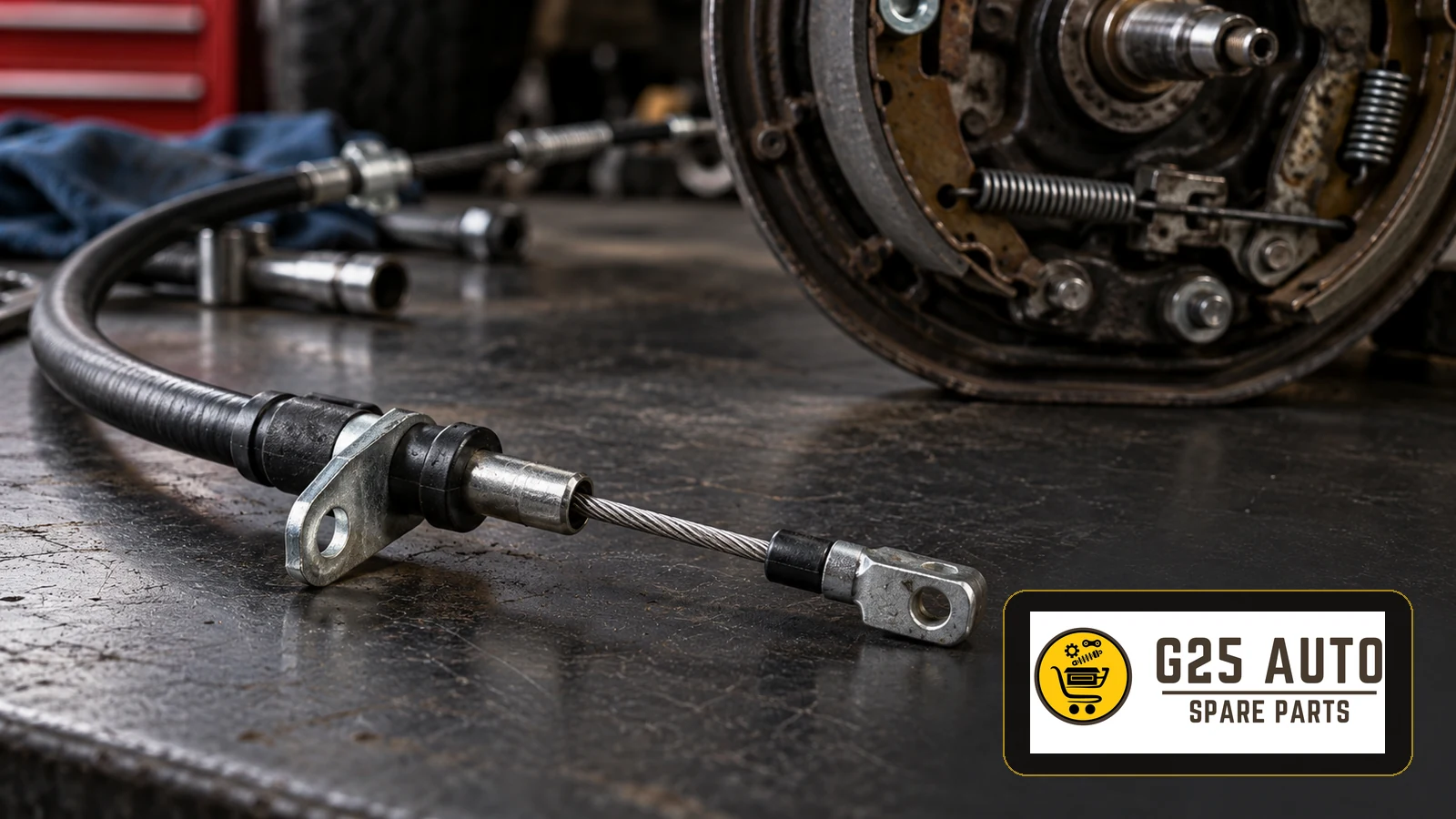
A parking brake cable transmits movement from the hand lever or pedal to the rear brake mechanism. This safety component can wear, corrode or break. A faulty cable can leave a vehicle unable to hold on a slope.
What Is a Parking Brake Cable and How Does It Work?
In cable-operated systems, a stranded steel cable connects the lever or pedal to the rear brakes. Applying it tensions the cable and operates the brake pads or shoes.
Some systems have a primary cable running to an equaliser and secondary cables leading to the rear wheels. The arrangement helps distribute operating force; the layout varies by vehicle.
Symptoms of Parking Brake Cable Faults
Signs requiring investigation include:
Common Fault Symptoms
- Excessive lever travel: Cable wear or incorrect adjustment may be involved.
- Reduced resistance: An unusually loose lever may indicate a broken cable.
- Failure to hold on slopes: The system needs prompt professional attention.
- A stiff or immovable lever: Corrosion or cable seizure may be responsible.
- Abnormal rear noises: Cable damage or rubbing may contribute.
- Uneven operation: A cable fault may affect brake balance.
- A persistent brake warning light: Investigate the vehicle-specific warning; it does not identify cable failure alone.
What Diagnosis Requires
A workshop should inspect the cable system, its movement and tension, and check travel where required. Replacement should follow diagnosis rather than symptoms alone.
When to Replace a Parking Brake Cable
Reasons to consider replacement include:
- Visible wear or fraying.
- Corrosion causing seizure within the sheath.
- A broken or failing cable.
- Adjustment mechanisms reaching their limits.
- Mechanical damage after an accident.
- A replacement requirement in the manufacturer’s maintenance instructions.
Original and Aftermarket Parking Brake Cables Compared
| Factor | Original Part | Aftermarket Part |
|---|---|---|
| Fitment | Confirm the specified application. | Check the application and physical details. |
| Cost | Request a current quotation. | Compare quotations for the required specification. |
| Availability | Confirm with the supplier. | Confirm with the supplier. |
| Quality standards | Review the manufacturer’s specification. | Review documented product specifications. |
| Warranty | Check applicable terms. | Check applicable terms. |
| Range | Vehicle-brand application listings. | Application listings across different brands. |
Checklist for Selecting the Correct Cable
Before ordering or replacing a cable:
- Prepare vehicle details: Make, model, year and engine.
- Record the VIN: Use it to support catalogue checks.
- Check the engine code: Confirm the relevant configuration.
- Identify the production date: Revisions may affect selection.
- Find the part reference: Check the existing label or catalogue.
- Identify cable quantity: Confirm the system layout.
- Check sheath construction: Compare the specified type.
- Check length: Compare application dimensions, especially on modified vehicles.
- Check accessories: Confirm included clips and clamps.
- Assess the supplier: Choose an experienced, traceable business.
- Review documentation: Check relevant product evidence.
- Read warranty terms: Clarify the claims procedure.
Why Check the Part Reference and VIN?
Guessing fitment is particularly inappropriate for a safety-related brake component.
OEM Part Reference
A vehicle manufacturer’s reference helps identify a specified part. Verify its application and any replacement references; a code alone does not guarantee interchangeability.
Vehicle Identification Number
The VIN supports checks of production details, equipment and catalogue references. Different production versions can use different cables, so confirm the actual configuration.
Engine Code and Production Date
Check vehicle labels and documentation for the engine code. Engine variants and production revisions may affect the brake configuration and cable selection.
Original or Aftermarket? A Balanced Assessment
The choice depends on the application, budget and documented specification.
When Might an Original Part Be Preferred?
Review warranty conditions and the manufacturer’s requirements. An original part may be appropriate where a suitable alternative has not been confirmed, including newer or unusual applications.
When Might an Aftermarket Part Be Suitable?
An aftermarket cable may suit the application when fitment and quality are documented. European and Balkan trade buyers should compare specifications and supplier terms rather than assume equivalent quality, lower cost or immediate availability.
How Can Quality Be Assessed?
Review manufacturer traceability, relevant documentation, warranty terms and required installation accessories. Packaging or a general certification claim alone does not establish suitability.
Parking Brake Cable Installation Considerations
Incorrect installation can compromise braking. Replacement requires professional knowledge and the vehicle-specific procedure.
Before Installation
- Secure the vehicle on stable, level ground before releasing the parking brake as instructed.
- Use the specified lifting and support procedure.
- Record existing cable routing and attachment points.
- Prepare the required tools and replacement parts.
During Installation
- Remove old cables carefully and inspect and clean attachment points.
- Route new cables according to manufacturer instructions.
- Adjust tension to the specified procedure.
- Check every connection and retaining device.
After Installation
- Verify lever travel against vehicle specifications.
- Check rear brake operation and balance.
- Confirm full release without binding or brake drag.
- Verify parking brake performance using the prescribed workshop test.
Parking Brake System Maintenance
Regular inspection helps identify deterioration:
- Follow the manufacturer’s inspection schedule.
- Check sheaths for damage and corrosion associated with moisture and road salt.
- Release the lever fully after use.
- Follow vehicle instructions for operation during prolonged storage.
- Maintain the rear brakes at the required intervals.
- Avoid driving with the parking brake applied.
- Do not force a frozen cable; arrange appropriate inspection.
Frequently Asked Questions
At What Mileage Should the Cable Be Replaced?
No universal mileage applies. Condition, use and manufacturer instructions determine inspection and replacement.
Can a Vehicle Be Used with a Broken Cable?
A failed parking brake is a safety concern, especially on slopes. Arrange repair and check applicable roadworthiness requirements.
Should One Cable or the Complete Set Be Replaced?
Inspect the other cables for similar deterioration. Follow the manufacturer’s replacement guidance and verify balanced operation.
What Is Cable Adjustment, and When Is It Needed?
Adjustment sets cable tension and operating travel. Check it according to the vehicle procedure, especially if travel changes.
Do Electronic Parking Brakes Have Cables?
Some use motors at the brakes; others operate cables through an actuator. Confirm the vehicle’s system.
Why Do Cable Prices Differ?
Application, construction, manufacturer, original or aftermarket supply and included accessories affect quotations. Ask suppliers for current terms.
Conclusion
Parking brake cables need correct identification, inspection and maintenance. Check part references, VIN, engine configuration and production details before ordering.
Assess original and aftermarket options against documented requirements and use professional installation.
Pay attention to changes in operation and arrange expert inspection when abnormalities appear.