
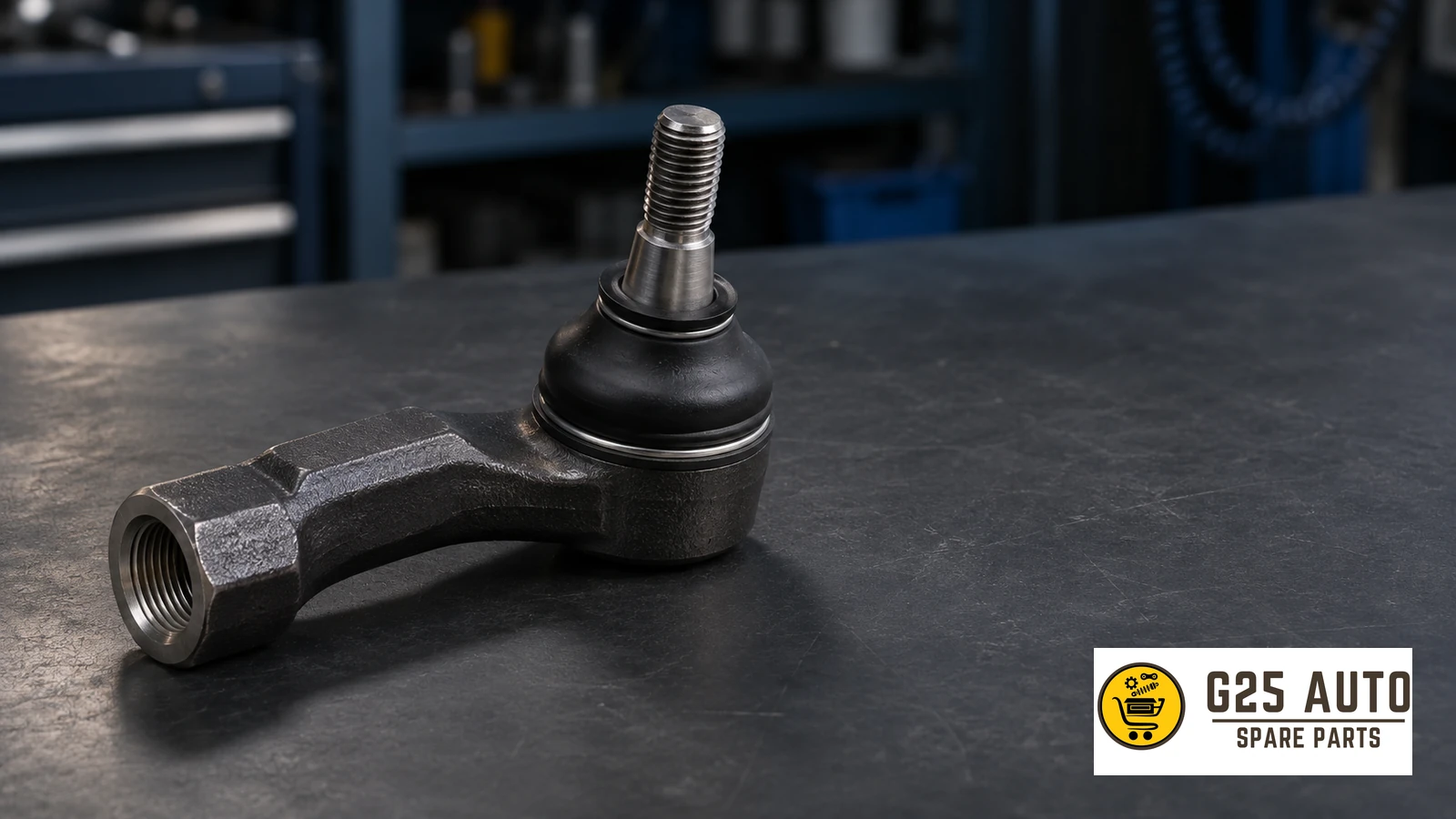
The outer tie rod end is a joint in the steering linkage that affects how the wheels respond to the steering wheel. Play in the steering, clicking noises and uneven tyre wear can point to a worn tie rod end. A workshop inspection can establish where those symptoms come from.
What Is a Tie Rod End and How Does It Work?
The outer tie rod end connects the steering linkage to the steering knuckle at the wheel. It sits at the outer end of the tie rod and transfers movement from the steering gear to the wheel.
The joint generally has a ball stud inside a metal housing. A rubber dust boot protects the joint and helps retain its grease. The joint articulates as the steering and suspension move, and it can wear over time.
What the Tie Rod End Does
- Transfers steering movement to the wheel.
- Allows the linkage to articulate as the suspension moves.
- Forms part of the linkage used to set wheel toe.
- Helps maintain a consistent steering response.
Signs of a Worn Tie Rod End
Changes in steering feel, noise and tyre wear can give a technician clues about the condition of the joint.
Common Warning Signs
- Steering play. The steering wheel may feel loose or the wheels may respond with a delay.
- Unusual noises. You may hear clicking or knocking while turning or driving.
- Steering wheel vibration. Vibration may become more noticeable at higher speeds.
- Uneven tyre wear. One edge of the tyre may wear faster than the other.
- Pulling to one side. The vehicle may drift left or right on a straight road.
- Dust boot damage. The rubber cover may be visibly torn or damaged.
Why a Workshop Inspection Matters
Other steering and suspension problems can cause similar symptoms. A technician can raise the vehicle and check the tie rod ends for play and damage to determine whether the movement comes from the joint.
When Does a Tie Rod End Need Replacing?
Base the replacement decision on the condition of the joint. A workshop can assess wear, play and damage using the service procedure for the vehicle.
Factors That Can Affect Wear
- Road surface and driving conditions.
- Driving style.
- Loads carried by the vehicle.
- Maintenance and inspection history.
- The condition and quality of the fitted part.
- Climate and exposure.
Comparing Original and Aftermarket Tie Rod Ends
| Check | Original part | Aftermarket part |
|---|---|---|
| Fitment | Confirm the reference in the vehicle manufacturer’s catalogue. | Check the supplier’s cross-reference and vehicle application. |
| Specification | Check the specification for the original reference. | Review the specification supplied for the replacement. |
| Availability | Ask about the exact reference. | Check availability for the matching replacement. |
| Warranty | Review the terms for the original part. | Review the terms for the aftermarket part. |
| Price | Request a quote for the exact reference. | Compare quotes for confirmed applications. |
| Choice | Check which reference the vehicle catalogue specifies. | Compare manufacturers that list the same application. |
What to Look for When Choosing a Replacement
When comparing original and aftermarket tie rod ends, consider the vehicle, its use and your budget. Check the fitment and supplier information for the exact part before ordering.
Parts Selection Checklist
- Original part reference. Find the number in the vehicle parts catalogue or ask a workshop to look it up.
- Vehicle identification number. Have the VIN ready for the catalogue lookup.
- Engine code. Check it when the catalogue distinguishes applications within the same model.
- Production month and year. Check for changes during the production run.
- Existing part markings. Use readable markings as an additional reference.
- Left or right. Confirm the side if the catalogue lists different parts.
- Inner or outer. Specify the outer tie rod end when that is the part being replaced.
- Supplier. Choose one that provides traceable part and fitment information.
Why Correct Fitment Matters
A tie rod end forms part of the steering linkage. An unsuitable joint may be difficult to fit and can affect steering safety.
Risks of Fitting the Wrong Part
- The part may fail to seat correctly or require force to fit.
- The joint may wear or fail prematurely.
- Steering control may be compromised.
- Other steering and suspension parts may be damaged.
- Loss of steering control increases the risk of a crash.
Confirm the original part reference and application before buying. The VIN, engine code and production date help a supplier distinguish between catalogue variants.
Tie Rod End Inspection and Maintenance
- Follow the vehicle’s service schedule.
- Inspect the dust boots for tears and have a damaged boot or joint assessed.
- Avoid hard impacts with deep potholes and kerbs where possible.
- Have the wheel alignment checked when the service procedure calls for it.
- Include the other suspension components in routine checks.
- Maintain the specified tyre pressures.
- Keep within the vehicle’s load limits.
What to Check on an Aftermarket Tie Rod End
Compare the information manufacturers provide for the exact replacement reference.
Information to Look For
- Published product and application specifications.
- Traceable manufacturer details.
- Warranty terms for the part.
- A documented cross-reference to the original part.
Frequently Asked Questions
How long does it take to replace a tie rod end?
Labour time depends on the vehicle and how easily the existing part can be removed. Ask the workshop for an estimate that includes the alignment check.
Should the wheel alignment be checked after replacement?
Yes. Replacing a tie rod end can change the wheel toe. Have the alignment checked and adjusted as required by the vehicle’s service procedure.
Should both sides be replaced if only one is worn?
Have both sides inspected. The condition of each joint and the vehicle’s service instructions determine what needs replacing.
Can you drive with a faulty tie rod end?
A failing joint can affect steering control. If you suspect a fault, stop driving when safe and arrange an inspection or recovery.
Do aftermarket tie rod ends wear out sooner?
Service life depends on the part specification, correct fitment and operating conditions. Check the application and the manufacturer’s published details for the part you are considering.
Conclusion
Have steering play, unusual noises or uneven tyre wear investigated. If the tie rod end needs replacing, use the original reference and vehicle details to confirm fitment. Have a workshop check the steering and alignment after the repair.