
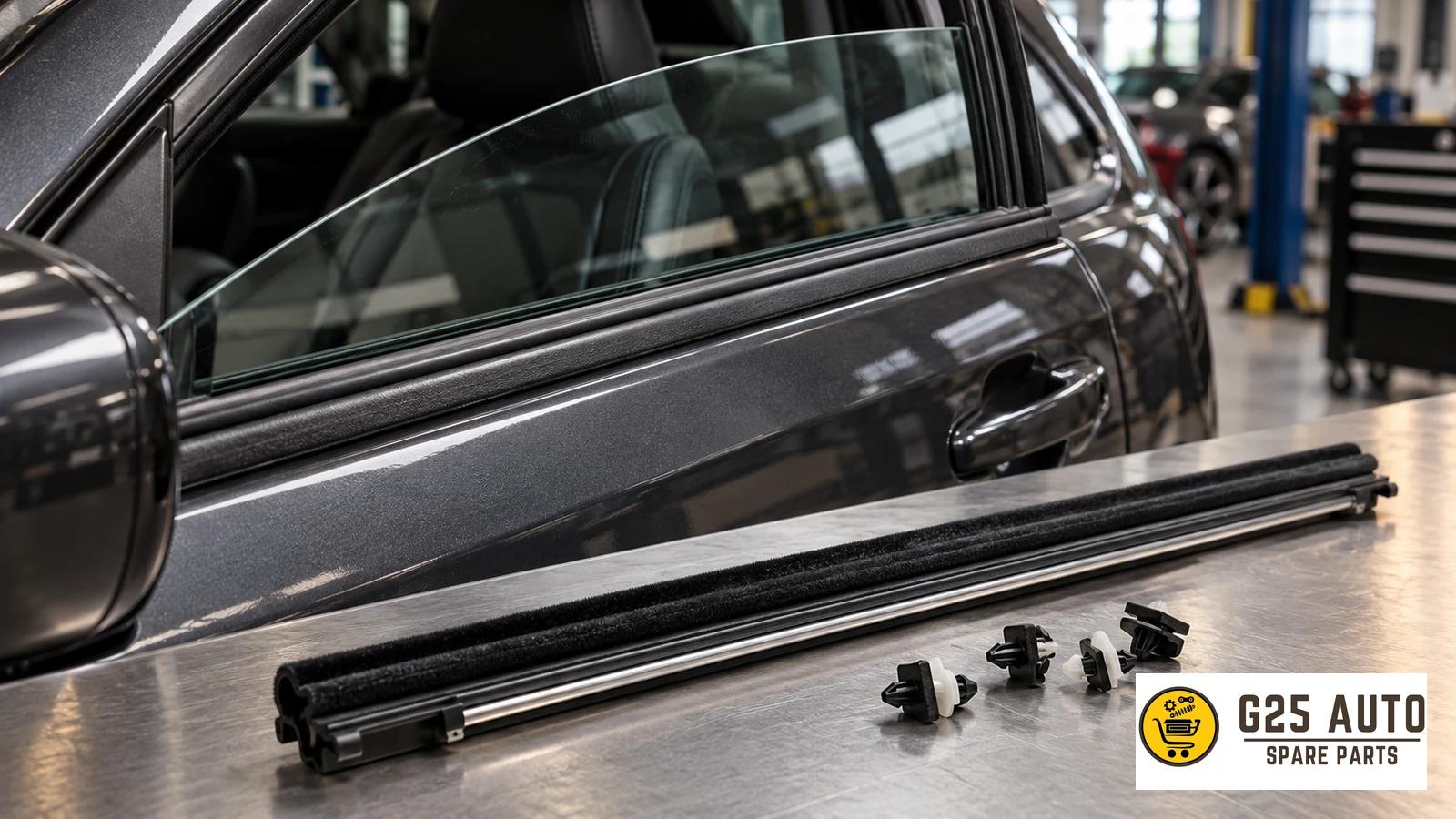
Outer door window belt weatherstrips and their retaining clips are small but important parts of the window system. They help limit water, dust and airflow at the junction between the glass and outer door panel, while allowing the glass to move. Weatherstrips and clips can deteriorate through wear, sunlight and weather exposure, so they should be inspected and replaced when necessary.
What Is an Outer Door Window Belt Weatherstrip, and How Does It Work?
The outer window belt weatherstrip is a flexible sealing strip fitted on the outside of the door, between the glass and the door’s metal frame. It may use EPDM rubber or another suitable flexible material, depending on the design, and performs several related functions.
Its main tasks include providing a low-friction contact surface, limiting the entry of water and dust, helping reduce wind noise and maintaining contact as the glass moves up and down. It should not be assumed to make the door cavity completely watertight. Plastic or metal retaining clips secure the weatherstrip to the door panel.
Signs of Wear: When Is Replacement Needed?
Deterioration of the outer weatherstrip or its clips can produce several symptoms. Recognising them helps identify when an inspection is needed:
- Squeaking or rubbing noises as the window opens or closes
- Water entering the interior around the window area in wet weather
- Draughts or whistling around the glass while driving
- Visible cracks, tears or hardening of the weatherstrip
- Discolouration or distorted sections of the strip
- Uneven or binding window movement
- The weatherstrip lifting out of position because clips have broken
- Increased dust and dirt accumulation along the glass edges
Checks Needed to Establish the Cause
If these symptoms appear, a professional inspection can help establish the cause. A workshop should check the following:
- The condition of the weatherstrip along its full length
- The integrity of the retaining clips
- The movement of the window mechanism
- Possible water leakage
- The flexibility and hardness of the weatherstrip
- The condition of the window guides and operating mechanism
An inspection is preferable to deciding on replacement from symptoms alone. Similar problems may arise from the window regulator or other parts of the mechanism.
Choosing Original or Aftermarket Parts
When replacing window weatherstrips and clips, the choices may include original parts and aftermarket alternatives. Both require assessment of the particular product and its application.
Original Parts
Original parts are supplied for the vehicle manufacturer’s specified applications. The correct reference must still be selected to obtain the appropriate dimensions and fit. Check the applicable product specifications and warranty terms rather than assuming a particular level of coverage.
Aftermarket Parts
Aftermarket parts are alternatives supplied outside the vehicle manufacturer’s original parts channel. Their materials and specifications vary by manufacturer. Assess the documented product characteristics and relevant application information when comparing alternatives, rather than assuming equivalence from the description alone.
Points to Check When Selecting a Part
Whichever category is selected, identifying the correct product is essential. An unsuitable part can cause installation difficulties, premature wear and operating problems.
| Feature | Original Part | Aftermarket Part |
|---|---|---|
| Compatibility | Verify the exact application and part reference | Verify the application and documented cross-reference |
| Material Quality | Check the specified material for the application | Check the individual manufacturer’s material specifications |
| Supply Time | Confirm with the supplier | Confirm with the supplier |
| Warranty Coverage | Check the applicable manufacturer or seller terms | Check the applicable supplier terms |
| Range of Options | Check the references offered for the vehicle | Compare suitable products from different manufacturers |
Why the Correct Part Reference Matters
A common ordering mistake is to select window weatherstrips and clips using only the vehicle make and model. Vehicles within the same model range may use different references depending on the body variant, equipment, production year or production date. Other vehicle details may also be requested by the parts catalogue.
Checking the OEM Part Reference
An OEM part reference is useful for identifying the intended application, but it should be checked against the relevant vehicle and catalogue details. When ordering weatherstrips and clips, check:
- The OEM part number or original reference
- The Vehicle Identification Number (VIN)
- The engine type and code, where required by the catalogue
- The production date, including month and year
- The body code
- The door position: front right, front left, rear right or rear left
An authorised workshop or a reliable parts supplier can use the VIN and catalogue information to help establish the appropriate reference. Skipping this check increases the risk of an incorrect order and wasted time.
Pre-Installation Checklist
Before replacing the outer window weatherstrip and its clips, use the following checks to prepare for the work:
- Have you checked the part reference against the VIN and application data?
- Are the replacement weatherstrip and any required clips available?
- Are suitable tools ready for removing the old strip?
- Have the window mechanism and guides been checked and cleaned as required?
- Have you inspected the new weatherstrip for condition and completeness?
- Have you checked that all retaining clips are sound?
- Have you allowed time for testing after installation?
- Have you read the available fitting instructions?
- If a fitting aid is specified, is a product approved for the material available?
Installation Procedure and Points to Watch
The skills and tools needed to replace a window belt weatherstrip and its clips depend on the door design. Professional assistance is recommended where the procedure is unfamiliar or access to the fixings is difficult.
General Installation Steps
The procedure may require removal of the inner door trim. In general, the old weatherstrip is carefully removed, the clips are inspected and replaced where necessary, and the mounting surfaces are cleaned. The new strip is then positioned correctly and secured with its clips. Window movement and water management should be checked after installation, following the vehicle’s service instructions.
Do not force the weatherstrip into place, as this can tear or distort it. Make sure every clip is fully seated: a missing or loose clip can allow the strip to lift out of position over time.
Parts Enquiries for European and Balkan Workshops
For G25Auto B2B parts enquiries across Europe and the Balkans, identify the required window weatherstrip, retaining clips and door position before requesting a suitable replacement.
Share the VIN and relevant part reference with the supplier when ordering. These details support application checks and help reduce the risk of selecting an unsuitable component.
Maintenance and Service-Life Advice
Simple maintenance habits can help preserve the condition of replacement window weatherstrips and clips:
- Use a silicone-based care product only where approved for the particular weatherstrip material and surface treatment
- Avoid aggressive chemicals and petroleum-based products that are unsuitable for the material
- Do not force the window if it is frozen in winter
- Clean the window guides as specified for the vehicle
- Avoid directing high-pressure washing jets straight at the weatherstrips
- Include visual checks of the weatherstrips in routine inspections, following vehicle guidance and operating conditions
Frequently Asked Questions
How Often Should a Window Weatherstrip Be Replaced?
There is no universal replacement interval. Service life varies with use, climate, material and maintenance. Follow the condition of the strip and look for signs of deterioration rather than relying on a fixed number of years.
Should the Clips Be Replaced as Well as the Weatherstrip?
Inspect the clips whenever the weatherstrip is replaced. Broken, cracked or weakened clips should be renewed so that the replacement strip can be held correctly.
Are Aftermarket Weatherstrips as Durable as Original Parts?
Durability depends on the particular materials, manufacturing quality, fit and operating conditions. Use a reliable supplier and check the product’s technical documentation and any claimed certification. Original or aftermarket status alone does not establish equivalent performance.
Can I Replace the Weatherstrip Myself?
Some designs can be replaced by a suitably skilled person with the correct tools. More complex door mechanisms or unfamiliar removal procedures are better handled by a professional workshop.
What Problems Can the Wrong Weatherstrip Cause?
An incorrect size or profile can contribute to water leakage, draughts, difficult window movement, premature wear and possible damage to the window mechanism.
Conclusion
Outer door window belt weatherstrips and their retaining clips are small components that contribute to comfort and window operation. Recognising deterioration, selecting the correct replacement and assessing product quality help support reliable service.
Use the VIN, OEM reference and relevant application data to check compatibility, whether choosing original or aftermarket parts. Assess each product on its documented specifications and install it carefully.
Routine maintenance and inspection can help preserve the weatherstrip and its clips, maintain cabin comfort and reveal potential leakage problems. Seek specialist assistance with part identification where necessary and verify the application before ordering.