
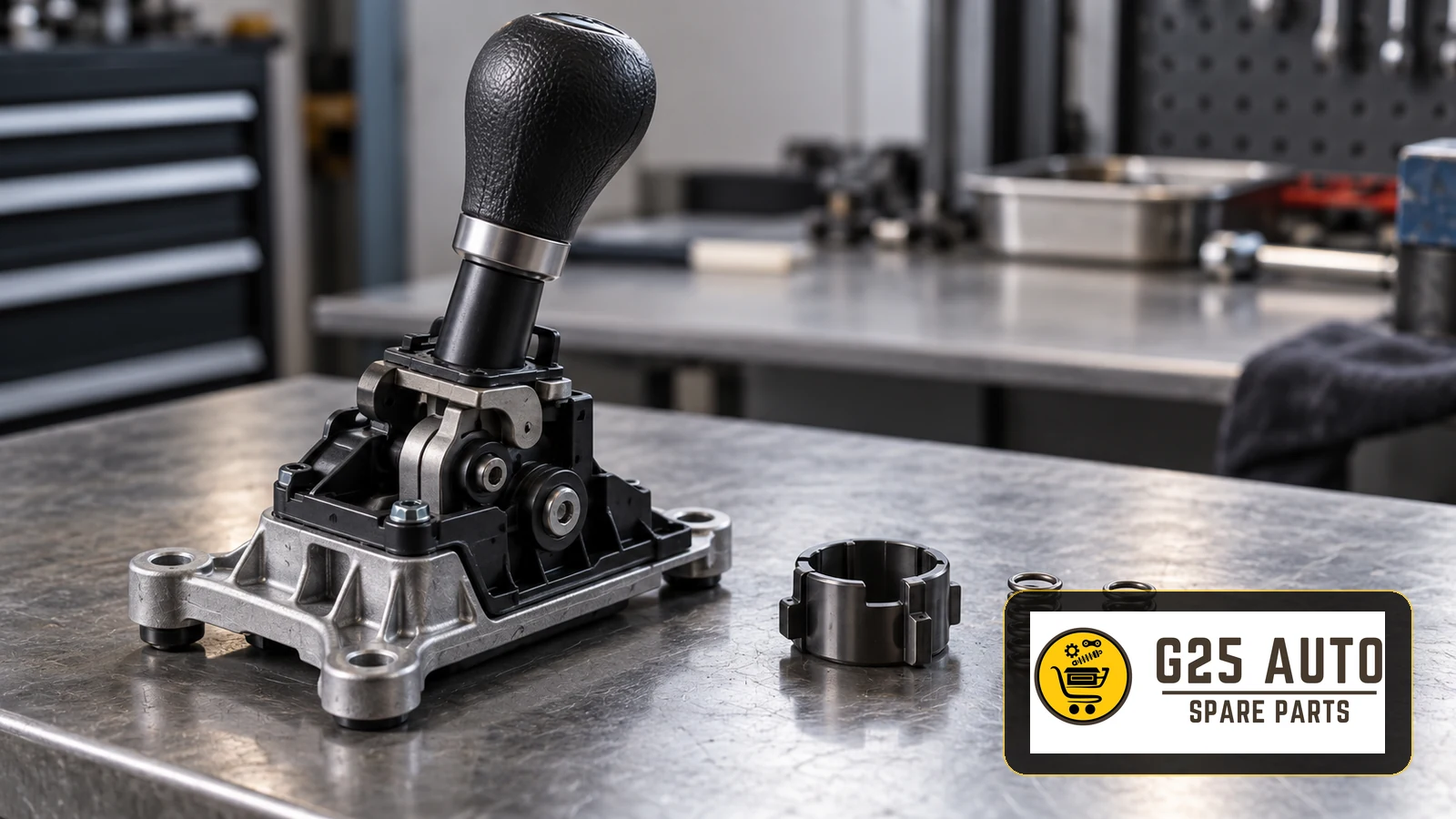
A manual gearbox reverse lockout mechanism helps prevent accidental selection of reverse. Depending on the design, it uses springs and locking components within the gear selection system. A return spring may centre the lever, while a separate lockout arrangement restricts access to reverse. If these components fail, gear selection can become difficult, reverse may be unavailable or the intended resistance to selecting it may be lost.
How the Reverse Lockout Mechanism Works
In a manual gearbox, the reverse lockout requires a deliberate action from the driver. Depending on the vehicle, selecting reverse may involve lifting a collar, pressing the lever down or moving it through a restricted gate. This helps reduce accidental selection, but should not be assumed to prevent every incorrect shift or to permit selection while moving.
Components associated with the arrangement may include:
- A locking pin or stud
- A compression or return spring
- A locking cage or housing
- Selector shafts and forks within the gear selection system
- The gear lever linkage assembly
The mechanism restricts access to particular selector positions. Return and lockout springs can provide centring force or resistance, according to the design. The additional action required to select reverse helps distinguish it from normal forward gear selection.
The Roles of Gear Selection Springs
A manual gear selection system may contain several springs with different functions. The arrangement must be identified for the particular gearbox.
Main Return Spring
A centring spring can bias the lever towards its specified position within the neutral gate. It helps the driver control movement between selection gates. This does not mean that releasing the lever should pull an engaged gear out of position.
Detent Spring
A detent spring applies force within the mechanism that locates selector positions. A weakened spring may affect the feel or retention of a position, although loose engagement or jumping out of gear requires diagnosis of the wider system.
Reverse Lockout Spring
This spring provides resistance associated with access to reverse. In some designs it is a separate component; in others it forms part of the lockout assembly. Its function and replacement options depend on the application.
Fault Symptoms
Problems in the lockout mechanism or its springs may be associated with:
- Reverse becoming unusually easy to select
- Difficulty selecting reverse, or being unable to select it
- The lever failing to centre as expected in neutral
- Metallic rattling during gear changes
- Excessive play in the lever
- Gears disengaging unexpectedly
- The lever sticking in particular positions
- Squeaking or grinding when selecting reverse
- A lever that offers unusually little resistance
These symptoms do not necessarily identify a lockout fault. Clutch problems, synchroniser faults or incorrectly adjusted shift cables can cause similar complaints. The cause must be established before ordering parts.
Reaching a Diagnosis
After observing the symptoms, a professional assessment is needed to determine the cause.
Visual Inspection
Where access is permitted by the service procedure, remove the gear lever gaiter and inspect visible parts of the mechanism for cracks, breakage and wear. Displaced springs or corrosion may be visible.
Functional Checks
With the engine switched off and the vehicle secured, a technician can assess gear selection in accordance with the service procedure. The feel and resistance should be compared with the specified operation. Reverse selection may differ from forward gear selection; an audible click is not a universal requirement.
Dismantling and Inspection
Further diagnosis may require removal of the lever assembly and inspection of the lockout components. Depending on the arrangement and available specifications, this includes:
- Checking spring force against the relevant specification
- Inspecting locking pins and their bores for wear
- Checking selector shaft movement
- Checking linkage joints for excessive play
Original and Aftermarket Parts Compared
| Feature | Original part | Aftermarket part |
|---|---|---|
| Compatibility | Verify the correct application and revision. | Verify the application and OEM cross-reference. |
| Material quality | Check the specified component requirements. | Check documented specifications for the supplied component. |
| Supply time | Confirm the actual lead time. | Confirm the actual lead time. |
| Warranty coverage | Check the applicable manufacturer or seller terms. | Check the applicable manufacturer or supplier terms. |
| Installation | Confirm the correct fitting procedure and required components. | Confirm compatibility, fitting instructions and required components. |
Checklist for Selecting the Correct Part
- Identify the vehicle identification number accurately.
- Record the engine code and engine type.
- Establish the production year and month, as changes may occur within a model year.
- Identify the gearbox type and version, including the number of forward gears.
- Find the original part’s reference number where available.
- Use cross-reference information when assessing an aftermarket option.
- Confirm the stated vehicle applications with the manufacturer.
- Check whether the spring is supplied individually or as a complete set.
- Check whether necessary clips, retaining rings or other fitting parts are included.
- Check the part reference and available quality documentation; a general certificate alone does not prove suitability.
Why OEM and Part Reference Verification Matters
Manual gearbox components can differ by vehicle model, production date and production batch. Vehicles with the same model name may use different gearbox versions. Confirm the relevant identification details before ordering.
Vehicle Identification Number Checks
The VIN helps a dealer or parts supplier identify the vehicle specification through the relevant catalogue. It should be used alongside gearbox identification where required. Its location varies by vehicle; check the vehicle documentation and identification labels rather than assuming one location.
Matching the OEM Reference
An original part reference can help identify replacement options. If a number is present on the existing component, check it against the catalogue and any superseding references. A matching cross-reference supports identification but does not by itself establish the quality of an aftermarket part.
Production Date Changes
Manufacturers can change designs during a model year. Two vehicles described as the same model year may therefore use different lockout components. Production month and year can be relevant to selecting the correct version.
What to Check When Choosing Aftermarket Parts
An aftermarket option should be assessed against the vehicle’s requirements and the information supplied with the part.
Manufacturer Reliability
Review the manufacturer’s history and available product documentation. Brand recognition alone does not demonstrate that a component meets the original requirements.
Material Quality
Spring material and manufacturing quality matter to performance. Poorly made springs may suffer fatigue and recurring faults. Ask for the applicable specifications rather than assuming a particular material grade or service life.
Compatibility Documentation
Check the manufacturer’s application and cross-reference lists for the relevant original part references. Buying without this information increases the risk of an unsuitable component.
Installation and Points Requiring Care
Replacing reverse lockout components and springs requires technical knowledge. Incorrect assembly can affect gearbox operation and safety. Follow the procedure for the specific vehicle:
- Record linkage positions and connections before removing the gear lever.
- Follow the specified spring orientation and preload requirements.
- Clean locking pins and mating areas; use lubricant only where the manufacturer specifies it.
- Check the operation of every gear after assembly, following the required procedure.
- Inspect a damaged lever gaiter and replace it as required.
Maintenance and Service Life
Appropriate use and maintenance include the following:
- Avoid applying excessive force to the gear lever.
- Stop the vehicle before selecting reverse.
- Lubricate linkage points only as required by the service instructions.
- Inspect the gaiter for tears that can allow dirt and moisture to enter.
- Fully depress the clutch pedal when changing gear, as instructed for the vehicle.
Frequently Asked Questions
When Should a Reverse Lockout Spring Be Replaced?
A change in lever feel, unusually easy reverse selection or difficulty selecting reverse calls for diagnosis. Replace the spring if inspection confirms a fault and replacement is permitted. There is no universal mileage threshold for this repair.
Should Only the Spring or the Complete Mechanism Be Replaced?
That depends on the fault and available repair options. Replacing a separately serviceable spring may be sufficient if it is the only failed component. Worn pins or other damaged parts require assessment of the assembly and the manufacturer’s repair provisions.
Should I Choose an Original or Aftermarket Part?
Either may be appropriate if its application and specifications are verified. An original label does not remove the need for correct identification, and an aftermarket label does not guarantee a saving. Confirm the OEM reference and relevant technical documentation.
Can I Carry Out the Repair Myself?
Access and complexity vary between vehicles. Appropriate tools, service information and experience are needed. If you are unfamiliar with gearbox selection components, use a qualified technician.
Does a Lockout Fault Affect Driving Safety?
It can. Loss of the intended protection against accidental reverse selection is a serious concern. Have the problem assessed promptly rather than continuing to rely on a faulty mechanism.
Which Vehicles Are More Likely to Develop This Problem?
Wear can occur in manual gear selection systems, and operating conditions and frequent shifting may influence it. High mileage or urban use alone does not establish that a lockout spring has failed.
Conclusion
Reverse lockout components and springs support the intended operation of a manual gear selection system. Do not ignore changes in operation; use an appropriate diagnostic process. If replacement is needed, verify the VIN, engine and gearbox identification, production date and original part reference.
Assess both original and aftermarket options against the relevant requirements and documentation. Whatever category is selected, compatibility should be supported by technical information.
Installation requires suitable knowledge and service instructions. Seek professional help where needed. Appropriate maintenance and correct operating habits help maintain the mechanism’s condition.