
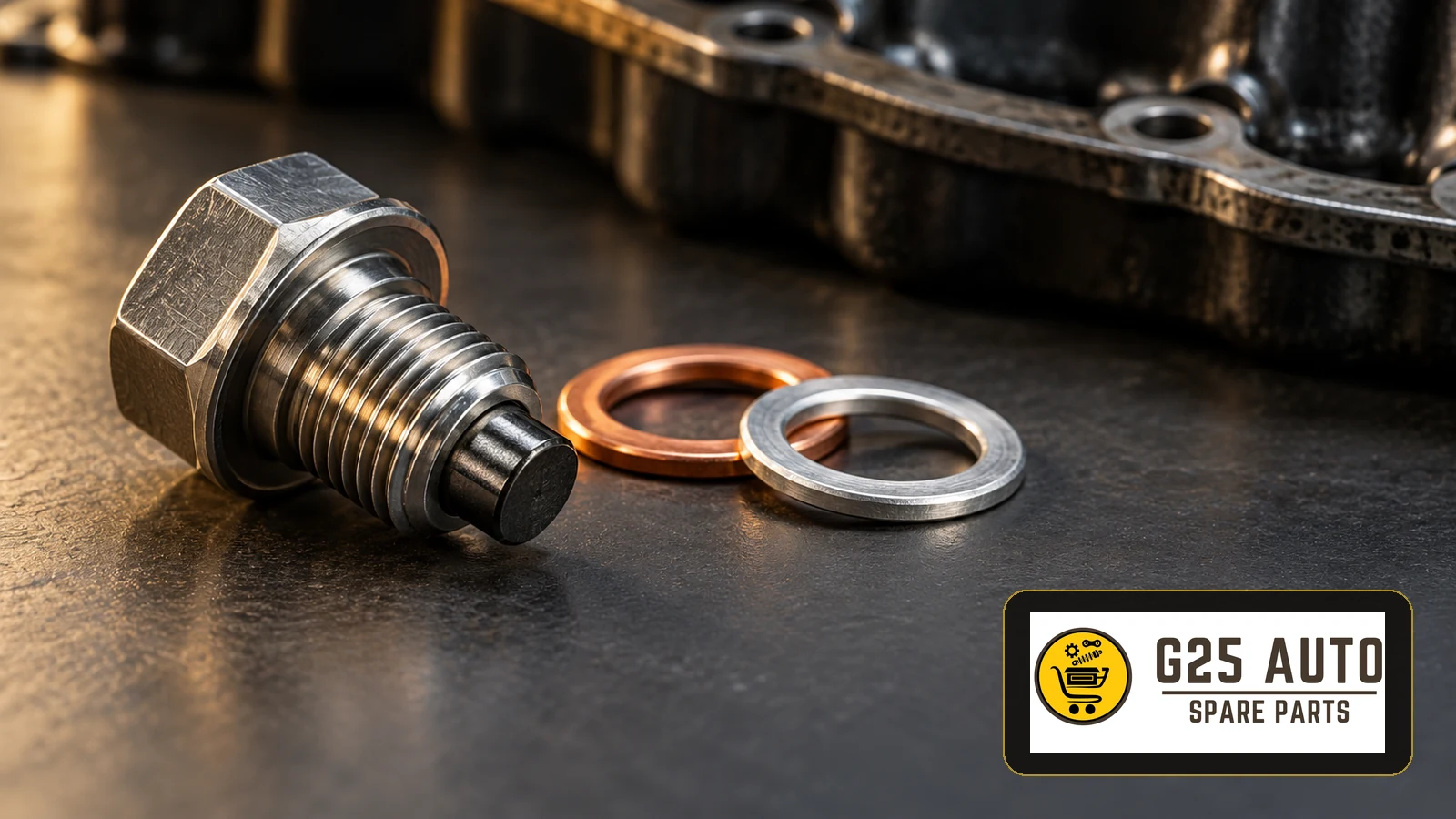
Selecting a magnetic engine oil sump drain plug and seal is an important part of maintaining the engine and preventing oil leaks. Check OEM or part references against the vehicle identification number, engine code and production date. The magnetic feature collects magnetically attracted wear debris; correct plug and seal selection also matters for sealing the sump.
What Is a Magnetic Drain Plug and Why Does It Matter?
A magnetic drain plug is a threaded plug in the lower part of the engine oil sump, removed during oil changes. Unlike a conventional plug, it incorporates a magnet at its tip or within its body. This attracts magnetic metal particles and wear debris produced during engine operation.
Moving engine components naturally experience microscopic wear. Wear particles can circulate in the oil and may contribute to damage elsewhere. A magnetic plug retains particles attracted to it, helping collect this debris. Its protective effect should not be treated as a guarantee against engine damage.
How Do the Drain Plug and Seal Work?
The drain plug and seal prevent oil escaping through the sump drain opening. In a typical arrangement, the plug screws into a threaded hole and the seal compresses between the plug head and sump sealing face. The exact arrangement depends on the application.
Main Components
- Drain plug body: May be made from steel or an aluminium alloy, depending on the design.
- Magnetic section: May contain a neodymium or ceramic magnet; check the product specification.
- Threads: May use metric or imperial dimensions.
- Seal: May be copper, aluminium or a rubber-based material.
- Sealing face: May be flat or tapered.
Fault Symptoms and Diagnosis
Detecting problems with the drain plug and seal early can help avoid serious consequences from oil loss. The following signs may indicate a problem:
Observable Symptoms
- Oil stains or pools on the ground beneath the engine.
- Oil dripping where the vehicle is parked.
- Oil traces on the engine undertray.
- An engine oil warning light on the dashboard.
- An unusual reduction in the oil level.
- Wetness or oil around the drain plug.
- A fresh oil smell beneath the engine.
Diagnostic Checks
These symptoms alone do not establish a diagnosis. Suitable checks by a qualified workshop may include:
- Cleaning the underside of the engine and observing where oil appears.
- Directly inspecting the drain plug area with the vehicle safely supported.
- Checking the plug installation against the specified procedure.
- Visually assessing the seal.
- Using an appropriate UV leak-detection method where applicable.
- Professional investigation with suitable diagnostic equipment.
Similar symptoms can come from other faults, including the upper engine cover gasket, oil filter, sump gasket or other sealing points. Identify the source before replacing only the drain plug.
Selecting the Correct Drain Plug and Seal
Finding the correct part for the vehicle is the critical selection step. An incorrect product can cause installation difficulties, leaks and potentially engine damage.
Checks Before Selection
Checklist
- Vehicle identification number, or VIN.
- Engine code, checked on the engine or in vehicle documentation.
- Production year and month, verified from the relevant vehicle records.
- Existing plug diameter and thread dimensions.
- Drain plug length.
- Seal type: flat, tapered, integrated or another specified arrangement.
- OEM part reference.
- Sump material, such as aluminium or steel.
Verification Using OEM and Part References
An OEM reference identifies a part specified by the vehicle manufacturer. It is an important cross-check, but a reference alone should not be presented as an absolute fitment guarantee. Possible sources include:
- Parts lists in the vehicle handbook or service documentation, where provided.
- Authorised workshop parts systems.
- The vehicle manufacturer’s online parts catalogue.
- Markings and codes on the existing component.
- Electronic parts catalogues such as TecDoc or ETKA.
Comparing Original and Aftermarket Products
A common purchasing decision is whether to choose an original part or an aftermarket alternative. Both require attention to the application and documented product specification.
| Feature | Original part | Aftermarket part |
|---|---|---|
| Compatibility | Check the correct factory reference and application. | Verify the dimensions and application rather than assuming compatibility from the brand. |
| Availability | Confirm the actual supply time. | Confirm the actual supply time with the supplier. |
| Range | Check the factory-specified variant. | Different product specifications may be available. |
| Magnetic strength | Check the specification of the relevant plug. | Any claim of greater magnetic strength needs product evidence. |
| Material quality | Check the applicable manufacturer specification. | Assess the documented materials and quality information. |
| Warranty | Check the applicable warranty conditions. | Check the applicable conditions; quality or brand alone does not guarantee warranty acceptance. |
When Might Each Option Be Considered?
Reasons to consider an original part:
- The vehicle remains under warranty and the applicable requirements need checking.
- The vehicle is new or a very recent model.
- The application involves a specialist performance engine.
- The buyer wants the specified factory part and documented fitment.
Reasons to consider an aftermarket part:
- A wider supplier network is useful.
- The buyer wants to compare different documented product specifications.
- An additional feature, such as a different magnetic specification, is being considered.
- Cost is being assessed for a vehicle outside its warranty period.
In either case, buy from a reliable supplier and verify all compatibility criteria.
Seal Types and Their Characteristics
The drain plug seal directly affects sealing performance. Different types have different characteristics and application requirements:
Copper Washer
Copper washers are commonly used in drain plug applications. Where the specified washer is a single-use crush type, replace it as directed during the oil change. Temperature capability and suitability must match the application.
Aluminium Washer
Aluminium washers can conform to the sealing face and are specified as original equipment in some applications. Follow the replacement requirements for the particular washer rather than assuming every aluminium seal has the same reuse limits.
Fibre or Rubber Seal
Some vehicles use fibre or rubber-based seals. These are more flexible, but their temperature performance and service life depend on the specified material and application.
Integrated Seal
Some plugs incorporate the seal. Replace the complete plug and seal assembly where the specified service procedure requires it.
Installation and Maintenance Recommendations
Correct installation matters as much as choosing the right part. Incorrect installation can cause even new components to fail prematurely.
Preparation Before Installation
- Clean around the sump drain opening.
- Inspect the threaded opening for damaged threads.
- Remove old seal remnants from the sump sealing face using the appropriate method.
- Visually inspect the new plug and seal.
Points to Observe During Installation
- Do not tighten the drain plug with an impact gun.
- Follow the exact manufacturer-specified tightening value and procedure for the application.
- Use a suitable torque wrench where the procedure specifies torque tightening.
- Make sure the seal is seated correctly.
- Keep the plug aligned and tighten in a controlled manner without cross-threading.
Important warning: Excessive tightening can strip sump threads, damage the seal and make future removal difficult. Insufficient tightening can cause oil leakage.
Inspecting and Cleaning Magnetic Plugs
Inspecting debris collected on the magnetic plug during an oil change can provide information about engine condition. Clean and assess it according to the applicable service procedure.
Assessing Typical Deposits
Fine magnetic dust may occur through normal wear. Do not automatically classify visible flakes as normal: assess their size, amount and context against the engine’s condition and service guidance.
Findings Requiring Attention
- Large metal pieces or swarf.
- Large, shiny metal flakes.
- Bronze- or brass-coloured particles found during inspection, which require investigation rather than a diagnosis based on colour alone.
- Much more metal debris than usual.
These findings call for a more detailed engine assessment.
Frequently Asked Questions
Must the Seal Be Replaced at Every Oil Change?
Follow the manufacturer’s instructions. A single-use crush washer deforms when tightened and should be renewed when specified; do not assume it will provide the same seal when reused.
Can a Conventional Plug Replace a Magnetic Plug?
Only use a plug approved for the application. A magnetic plug can collect magnetic debris, but this does not justify replacing a specified design or claiming a guaranteed extension of engine life.
What Should Be Done if the Drain Plug Threads Strip?
A workshop must assess the damage and approved repair options. Thread inserts or repair kits may be suitable in some cases; enlarging the opening or fitting an oversized plug should not be treated as a universal repair. Severe damage may require sump replacement.
Can Liquid Sealant Replace the Seal?
Do not substitute liquid sealant for the specified drain plug seal. Loose sealant can enter the oil system. Use the correct sealing arrangement and follow the applicable instructions.
How Often Should the Drain Plug Be Replaced?
The plug itself is not necessarily replaced at every oil change. Follow the application requirements, and replace a damaged plug, worn threads or a defective magnetic assembly as appropriate.
Can a Different Brand of Drain Plug Be Used?
A different brand can be considered when its dimensions, thread, length, seal type and application are verified. Aftermarket branding alone does not prove performance equivalent to the original component.
Aftermarket Parts Sourcing and Reliable Purchasing
Reliable suppliers matter when sourcing automotive replacement parts. Brand and supplier assessment are particularly relevant when considering aftermarket alternatives.
Points to check when buying parts include:
- The supplier’s experience and references.
- Current, detailed product catalogues.
- Availability of technical support and advice.
- Clear product warranty conditions.
- Clear return and exchange policies.
- Search and verification using OEM and part references.
Checks After Installation
After replacing the drain plug and seal, carry out the applicable checks:
Post-Installation Checklist
- Run or warm the engine as directed by the vehicle’s service procedure.
- Check around the drain plug for leaks.
- Stop the engine and check the oil level after the specified waiting period.
- Carry out a short road test where appropriate and safe.
- Check again for leaks after the test.
- Observe the parking area for oil spots over the following days.
- Repeat checks at any interval specified by the applicable service instructions.
Quality Standards and Certifications
Documented quality information can help assess a drain plug or seal. However, the scope and applicability of each claim must be checked rather than treating a list of markings as mandatory proof for every part:
- ISO 9001: A quality management system certification; check the organisation and scope covered.
- National standards: Check which standard is actually applicable to the product.
- TÜV: Examine the specific test or certification evidence claimed.
- CE: Do not assume this marking is applicable to every drain plug or proves vehicle compatibility.
- OE quality: Ask for supporting evidence rather than treating this wording as an independent approval.
These claims do not by themselves establish that a specific plug has passed all necessary tests or fits a particular engine.
Conclusion
Choosing a magnetic engine oil sump drain plug and seal may look simple, but it requires a technical compatibility check. Verify the vehicle identification number, engine code and production date against the correct part application.
Renew seals as specified, tighten the plug using the correct procedure and complete the post-installation checks. These steps support reliable sealing without guaranteeing fault-free operation. Inspecting collected debris can also highlight findings that need further assessment.
Neither original nor aftermarket parts are universally superior. What matters is a documented, suitable component from a reliable supplier. OEM reference checks help reduce selection errors when used alongside the full application information.
A professional approach to maintenance includes the correct selection and installation of small components. A drain plug or seal can cause serious problems when incorrectly selected or fitted, making informed decisions important for long-term vehicle condition.
Working with reliable suppliers and accessible technical support can help with maintenance planning. Assess product information, range and quality documentation when choosing a supply source.