
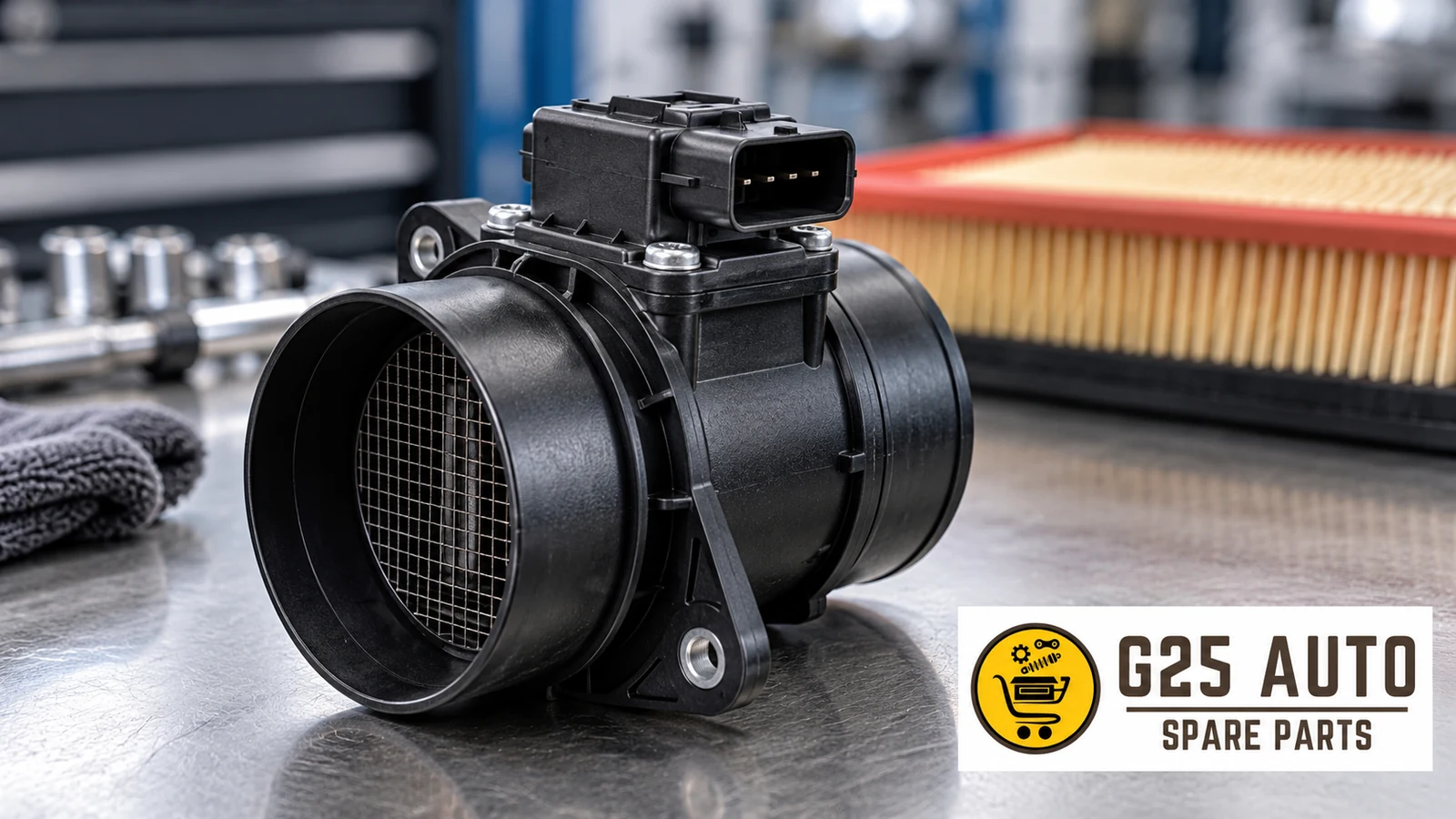
A MAF (mass air flow) sensor measures the air entering the engine and sends this information to the engine control unit (ECU). The ECU uses the reading when calculating fuelling. Incorrect readings can affect engine performance, fuel consumption and exhaust emissions.
What Is a MAF Sensor and How Does It Work?
The MAF sensor measures airflow towards the intake manifold and supplies data to the engine management system. Hot-wire and hot-film sensors are two common types. Both use a heated element whose response to cooling by the incoming air provides a measurement of airflow.
Operating Principle
A fine wire or film inside the sensor is heated. Incoming air cools the element, changing the electrical energy required to maintain its temperature. The sensor converts this response into an airflow signal, which the ECU uses when calculating how much fuel to inject.
The MAF Sensor’s Role in the Engine
Engine management uses airflow information to control the air-fuel mixture. The required mixture depends on the engine and its operating conditions. Incorrect sensor readings can disrupt this calculation and affect engine behaviour. Measurement accuracy matters, as deviations can change the engine’s response.
Symptoms of a MAF Sensor Fault
A faulty MAF sensor can cause several symptoms. These can also arise from other problems, so symptoms alone do not identify a failed sensor. Diagnosis requires appropriate test equipment and interpretation of the results.
Common Symptoms
- Engine warning light: A possible indication, although the light can relate to many different faults.
- Idle problems: Uneven or unusually high idle speed may occur.
- Loss of power: Reduced engine response may be noticeable during acceleration.
- Poor fuel economy: Fuel consumption may increase.
- Vibration or shaking: The engine may run unevenly, particularly at low speeds.
- Difficult starting: Starting may take longer or require more effort.
- Black exhaust smoke: This can accompany an excessively rich mixture.
Symptom Checklist
Check whether your vehicle shows any of the following:
- Does the engine warning light stay on or appear intermittently?
- Is the engine rough or uneven at idle?
- Is acceleration delayed or weak?
- Have you noticed a clear increase in fuel consumption?
- Does the engine sometimes stall?
- Has the exhaust smell changed?
- Are there problems when starting from cold?
How Is the Fault Diagnosed?
Diagnosing a MAF sensor fault requires a systematic approach. Symptoms raise suspicion, while the following checks help establish the cause.
Diagnostic Scan
An OBD-II scanner can read fault codes from the vehicle’s control system. Codes in the P0100-P0104 range can concern the MAF circuit or its performance. A stored code does not by itself prove that the sensor needs replacement; further investigation is required.
Live Data Analysis
Technicians monitor the sensor’s live output to assess its behaviour. Readings at idle and at different engine speeds should be compared with the vehicle manufacturer’s specifications and test conditions.
Physical Inspection
Inspect the sensor housing, electrical connections and air ducts for contamination, oil deposits, damage or loose connections. Check the air filter too, as its condition can be relevant to airflow and contamination.
MAF Sensor Replacement and Parts Selection
Once diagnosis establishes that replacement is needed, selecting the correct part is essential. An unsuitable sensor can cause engine management problems.
OEM Number and Compatibility Checks
Sensor applications vary between vehicles. Confirm the following information before ordering:
- OEM or original part number: Use the existing sensor’s number as a reference, checked against the application catalogue.
- Vehicle identification number (VIN): Use it to help identify the vehicle specification.
- Engine code: Different engines within the same model range may use different sensors.
- Production date: Part revisions may depend on when the vehicle was built.
Ordering without these details increases the risk of receiving an unsuitable part. Vehicle documentation and identification labels may provide relevant details; confirm any missing information before ordering.
Original and Aftermarket Parts Compared
| Feature | Original part | Aftermarket part |
|---|---|---|
| Compatibility | Confirm the correct manufacturer application and revision. | Check the stated application and cross-reference; equivalence is not automatic. |
| Quality standard | Check the specifications for the supplied part. | Check documented specifications; general certification claims alone do not establish suitability. |
| Warranty | Check the applicable seller or manufacturer terms. | Check the applicable supplier or manufacturer terms. |
| Availability | Confirm the actual lead time. | Confirm the actual lead time. |
| Cost | Obtain a quotation for the correct part. | Compare quotations for verified suitable parts. |
| Risk | Correct identification and a reliable supply source remain necessary. | Correct identification and a reliable supply source remain necessary. |
Recommendations for Choosing a Part
Neither category is automatically the best choice for every situation. Consider the vehicle’s requirements, applicable warranty terms and the documentation supplied with the part. An aftermarket option should be assessed on its verified suitability rather than an assumed price or performance advantage.
Whichever option you choose, use a reliable supplier. Poor-quality, incompatible or counterfeit parts can provide incorrect readings and cause engine management problems.
MAF Sensor Maintenance and Prevention
Cleaning may help in some cases of contamination, but it requires care and is not a solution for every fault.
Cleaning and Maintenance
Where the sensor manufacturer’s instructions permit cleaning, use only an approved product and procedure. Avoid mechanical contact with the delicate sensing element and do not use compressed air. If symptoms remain, continue diagnosis rather than assuming that cleaning has proved the sensor faulty.
Preventive Maintenance Checklist
- Replace the air filter at the specified service intervals.
- Have the intake system checked for leaks.
- Follow the engine oil service schedule.
- Check the oil vapour separator, where fitted, as specified.
- Inspect the sensor connections during relevant maintenance.
- Keep the engine area clean and address oil leaks.
Frequently Asked Questions
Can Cleaning Solve a MAF Sensor Problem?
Cleaning may help with light contamination where it is permitted. It cannot repair a damaged sensing element or an electronic fault. Persistent symptoms require professional diagnosis.
Can a MAF Sensor Fault Stop the Vehicle Running?
Some vehicles use a fallback calculation when the MAF signal fails and may continue running with reduced performance. The response depends on the vehicle and fault, so continued operation should not be assumed.
Which Vehicles Have a MAF Sensor?
MAF sensors are used in petrol and diesel applications. Engine management designs differ, and some use manifold absolute pressure (MAP) information instead of, or alongside, airflow measurement. Check the specific engine’s arrangement.
How Often Should a MAF Sensor Be Replaced?
There is no universal replacement interval. Follow any vehicle-specific requirements and replace the sensor when diagnosis establishes that it is faulty. Service life depends on operating conditions; a general mileage estimate is not a replacement rule.
Is Adaptation Needed After Replacement?
Some vehicles may require a learning period or a procedure performed with diagnostic equipment. The requirements are model-specific and should be checked in the relevant service information.
Can an Aftermarket MAF Sensor Cause Engine Problems?
An unsuitable, defective or counterfeit sensor can send incorrect measurements to the engine management system. An aftermarket label alone does not establish either suitability or a fault risk. Verify the application and use a reliable supplier.
Conclusion
The MAF sensor supports engine management by providing airflow information. Its readings can affect performance, fuel economy and emissions. Several symptoms may suggest a fault, but detailed diagnostic checks are needed to establish the cause.
Correct compatibility is central to replacement selection. Checking the OEM reference, VIN, engine code and production date reduces the risk of ordering an unsuitable part. Assess original and aftermarket options against the vehicle’s requirements and the evidence available for each part.
Air filter servicing, intake checks and general engine maintenance help maintain appropriate operating conditions. Investigate faults promptly rather than relying on symptoms alone.
Choose a reliable supply source and a part that meets the required technical specification. Quality, compatibility and the actual warranty terms all deserve attention when selecting a replacement.