
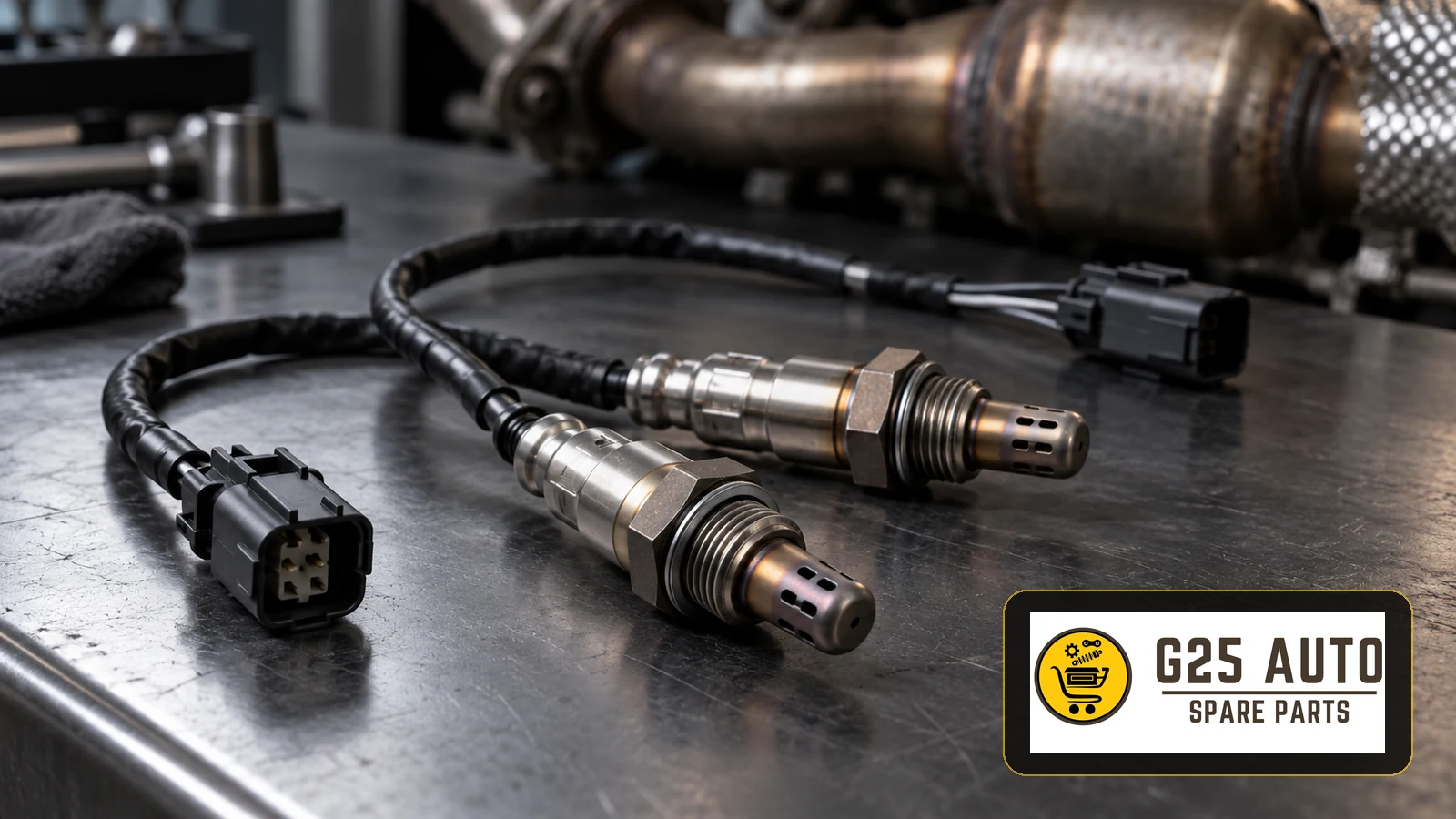
Short answer: A lambda sensor fault may trigger the engine warning light, increase fuel consumption, cause an uneven idle or affect exhaust emissions. These symptoms alone do not prove that the sensor is defective. Wiring, connectors, exhaust leaks, fuel pressure and engine combustion should be assessed together.
What is a lambda sensor?
A lambda sensor, also called an oxygen sensor, provides the engine control unit with information about oxygen in the exhaust gas. Depending on the system, the control unit uses this information to regulate the air-fuel mixture and monitor catalytic converter operation. Modern vehicles may have several sensors upstream and downstream of the catalytic converter.
The upstream sensor generally plays a more direct role in mixture control, while the downstream sensor helps monitor emission system efficiency. Two sensors may look alike yet differ in function, lead length, connector and calibration.
Symptoms of a lambda sensor fault
Engine warning light
The control unit may store a fault when the sensor signal, heater circuit or mixture correction falls outside the expected range. A fault code that names the sensor does not necessarily mean the component has failed: another system problem may be affecting its readings.
Increased fuel consumption
An inaccurate or slow-responding sensor may make mixture management more difficult, potentially increasing consumption. Tyre pressure, driving conditions, the air filter, ignition and injectors also affect consumption, so comparisons should be made under similar conditions.
Uneven idle and reduced performance
Mixture control problems may cause a fluctuating idle, weak throttle response or misfire-like symptoms. Similar symptoms can occur with spark plug, ignition coil, vacuum leak and fuel system faults.
Changes in emissions and smell
An unsuitable mixture may increase exhaust emissions and place additional stress on the catalytic converter. Symptoms such as a strong fuel smell call for prompt professional inspection.
Why do lambda sensors fail?
- Extended service and thermal cycling
- Contamination caused by oil or coolant entering the combustion chamber
- Deposits associated with unsuitable fuel or additives
- Heat damage to wiring and connectors near the exhaust
- Exhaust leaks and outside air entering the system, which can affect readings without proving sensor failure
- Incorrect installation torque or thread damage
- Prolonged operation with an excessively rich or lean mixture, which should be investigated as part of the wider system
How is the fault diagnosed?
- Read fault codes and review the recorded conditions before clearing them.
- Evaluate sensor response and fuel trims in live data using the applicable test criteria.
- Check the wiring, connector and heater circuit supply as specified for the vehicle.
- Look for exhaust leaks upstream of the sensor.
- Investigate other causes affecting the mixture, including vacuum leaks, ignition, injectors and fuel pressure.
- Follow the manufacturer’s applicable test procedure.
Replacing a sensor solely on the basis of a fault code can lead to unnecessary expense. In particular, lean-mixture and rich-mixture codes may have many causes beyond the sensor itself.
How do you choose the correct lambda sensor?
Before ordering, establish whether the sensor is upstream or downstream of the catalytic converter, its bank and position, lead length, connector shape and applicable OEM reference. Two sensors used on the same vehicle may share a thread size while having different electrical characteristics.
| Check | Why it matters |
|---|---|
| Vehicle identification number | Helps identify the engine and emissions variant when checked against applicable vehicle data |
| OEM number | Supports matching the required original reference using verified catalogue information |
| Sensor position | Distinguishes upstream and downstream applications |
| Connector and lead | Allows comparison of the electrical connection and required reach |
| Heater and signal type | Must match the application and control system requirements |
Universal and vehicle-specific sensors
A correctly matched vehicle-specific sensor is supplied for its intended application with the appropriate connector and lead. Universal products may require wiring connections. Incorrect connections, inadequate protection against water ingress or unsuitable wiring resistance may cause signal problems, making the manufacturer’s procedure and professional installation important. A universal sensor is not suitable for every vehicle.
What should you consider when choosing an aftermarket sensor?
Alongside reference compatibility, assess the manufacturer’s reliability, sensor technology, connector quality, lead heat resistance and the stated warranty and return terms. A very low price alone should not determine the choice: incorrect readings may affect engine management and emission control.
Frequently asked questions
Can a lambda sensor be cleaned?
Chemical or mechanical treatment of the sensitive surface may fail to provide a lasting solution and may damage the component. Cleaning without identifying the cause of contamination does not prevent the problem from recurring.
Can a faulty sensor damage the catalytic converter?
If it contributes to a persistently unsuitable mixture, additional stress on the catalytic converter may result. Catalytic converter problems have many possible causes, however, so the system should be assessed as a whole.
Will the warning light go out immediately after replacement?
Depending on the vehicle, code clearing and an appropriate drive cycle may be required under the manufacturer’s procedure. If the underlying fault remains, the warning light may return.
Conclusion
The lambda sensor is an important information source for engine management and emission control. Treat a fault code as the starting point for diagnosis. After confirming the fault, verify sensor position, connector, sensor type, vehicle identification and OEM reference together to select the correct component.
Note: This article provides general information. Diagnosis and installation should be carried out by a qualified professional using suitable equipment.