
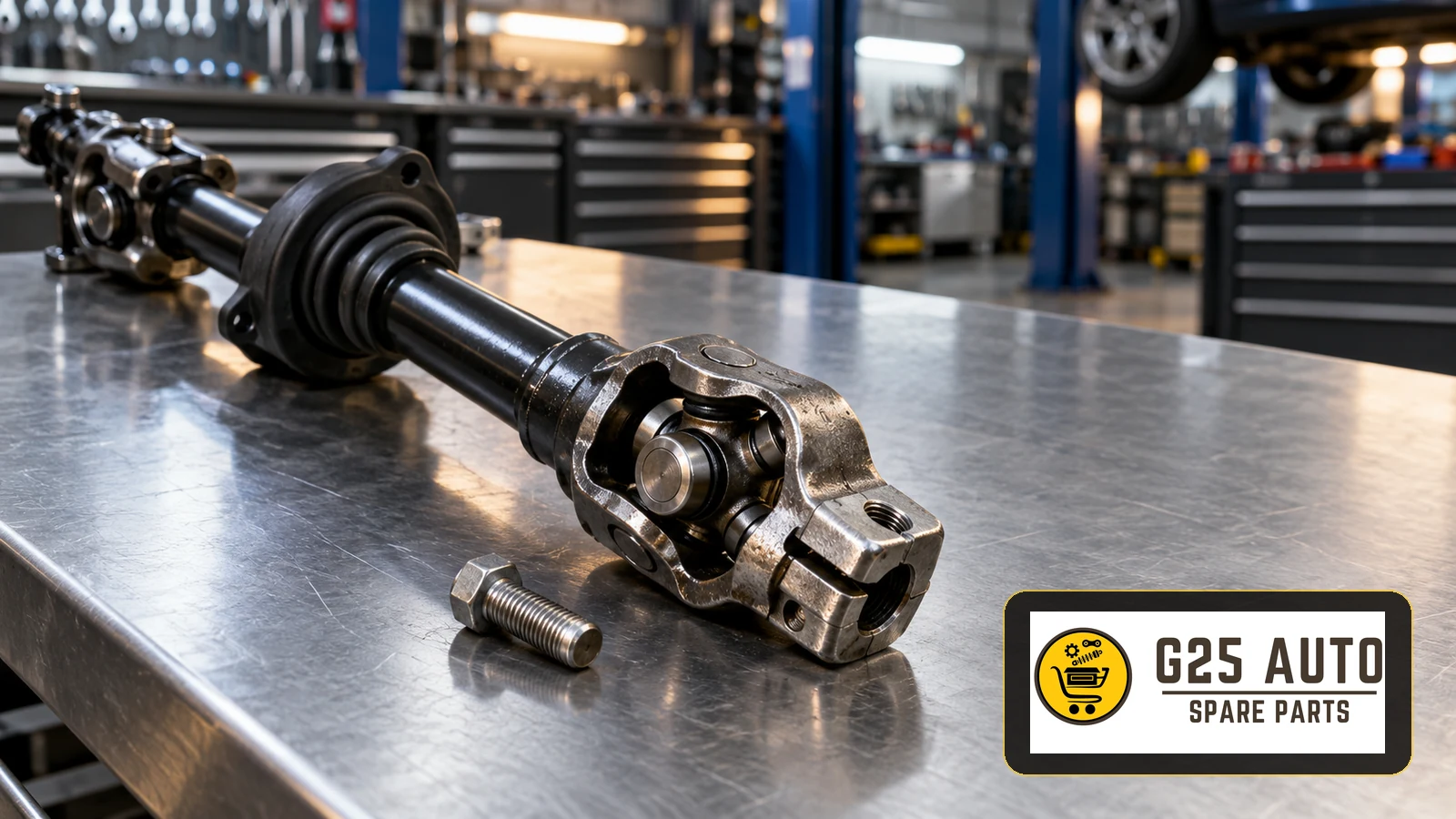
The intermediate steering shaft connects the steering column to the steering gear, with joints accommodating the angle between them. Its joints and fastening connections must be assessed together when there is steering play, stiffness or noise. For European and Balkan workshops and parts buyers, a sound repair starts with a confirmed diagnosis, exact application identification and the correct shaft and fastening specification.
Identify the connection before ordering parts
An intermediate shaft enquiry may concern a complete assembly, a separately serviceable joint or the fastening hardware. These are different order scopes. Ask the workshop to identify the affected connection and state what the vehicle manufacturer’s repair information permits it to replace.
A universal joint transfers rotation through an angle. The connection at its yoke may use a clamped splined interface with a retaining bolt. Do not assume that a similar-looking shaft has the correct ends, installed geometry or attachment arrangement. Nor should a buyer infer the assembly’s safety characteristics from its external appearance.
The pinch bolt is part of the connection
Fastener selection involves more than finding a bolt that fits through a hole. The specified bolt, mating threads, shaft seating and tightening method all matter. Obtain the applicable repair instructions before deciding whether hardware may be retained or must be renewed.
Hyundai’s intermediate shaft connection inspection bulletin, for a defined range of Sonata vehicles, separately checks joint bearing caps, shaft engagement, bolt position and thread damage. In the connections illustrated there, the bolt must pass through a groove in the shaft. That example shows why tightening alone cannot establish correct assembly. Its dimensions and tightening values must not be transferred to another application.
Separate the symptom from the repair decision
Record whether the complaint involves a knock, free movement, resistance or an intermittent change in steering feel. Note when it happens, whether temperature affects it and whether it followed steering, suspension or collision repair. Give the technician the observations without preselecting a replacement.
A noise near the shaft does not establish that its universal joint has failed. General Motors’ bulletin on cold-temperature steering effort and knocking addresses particular Encore and Trax applications. It considers water intrusion and corrosion at the steering gear input and includes a joint-to-boot clearance check. This is an application-specific example of looking at the surrounding system rather than treating every steering complaint as a shaft defect.
Request a written finding that names the defective connection or component and records the evidence. Ask the workshop to distinguish joint movement from movement at the shaft attachment, and to document any damaged fastener, thread or surrounding part. Inspection methods and acceptance limits should come from the relevant service information.
Suspected looseness, binding or an insecure steering connection requires prompt professional assessment. Where steering control may be compromised, keep the vehicle out of service and arrange recovery rather than a diagnostic drive. A quieter joint after an improvised adjustment is not evidence that the connection is safe.
Build a complete B2B application enquiry
For a distributor serving several European or Balkan markets, a model name and registration year are an incomplete enquiry. Supply the VIN, production details, steering configuration and left- or right-hand-drive layout. Add the affected shaft position, available installed references and clear photographs of the complete assembly and its connections.
Record known modifications and previous steering repairs. Ask the supplier to confirm the offered manufacturer’s reference against the actual application, including any production restrictions or superseded references. An old part number and a visual comparison support this process; neither independently guarantees fitment.
Confirm the contents of every quotation
Check whether the offer covers the complete shaft, joints, boots and required mounting hardware. Dorman’s intermediate shaft catalogue example lists included universal joints while stating that mounting hardware is not included. This illustrates a purchasing distinction, not a recommendation for another vehicle: an assembly description does not guarantee that every item needed for fitting is in the box.
Compare genuine and aftermarket quotations against the same confirmed application and repair scope. Request product documentation, traceable supply, stated warranty terms and technical support details. Obtain current commercial terms for the actual enquiry. Avoid assuming a universal price advantage, equal service life or approval based solely on a brand category or generic certificate.
Agree the installation and completion plan
Before releasing the order, have the workshop confirm the repair procedure, required tools and any replacement hardware. The job plan should cover shaft orientation, full engagement, the specified tightening method and the manufacturer’s precautions for disconnection and reconnection. Do not substitute a general bolt chart for the connection’s service specification.
Keep lubrication and adjustment decisions within the documented procedure. Spraying a joint or tightening a connection by feel should not replace diagnosis. Likewise, establish whether steering alignment, sensor checks or calibration are required for the particular vehicle and work performed; the presence of electric assistance alone does not define the completion procedure.
Retain the fitted reference, hardware details and workshop completion findings with the original complaint. Record whether the symptom was resolved and what checks supported vehicle release. An unresolved symptom needs a further diagnostic decision rather than another speculative parts order.
Workshop and purchasing checklist
- Record the steering complaint and any immediate vehicle-use restriction.
- Obtain a diagnosis identifying the affected joint or connection.
- Collect VIN, production, steering layout and installed-part evidence.
- Confirm the exact offered reference and application restrictions.
- Agree whether the repair needs a joint or complete shaft.
- Verify package contents and separately required fastening hardware.
- Confirm the applicable installation and final-check requirements.
- Keep fitted references and the release findings in the repair record.
Frequently asked questions
Does a knock prove the intermediate shaft is worn?
No. It is a symptom requiring diagnosis of the shaft, its attachments and the relevant surrounding system.
Can every pinch bolt be reused?
Follow the applicable repair instructions. Renew hardware designated for replacement and do not generalise one application’s rule to all steering connections.
Is tightening a loose bolt enough?
That decision requires inspection of engagement, threads and associated parts against the specified repair procedure. Tightening is not a substitute for assessing damage.
Is there a universal replacement mileage?
Use the vehicle’s maintenance and repair information, inspection findings and any applicable campaign requirements. A mileage figure alone does not establish the condition or repair scope.