
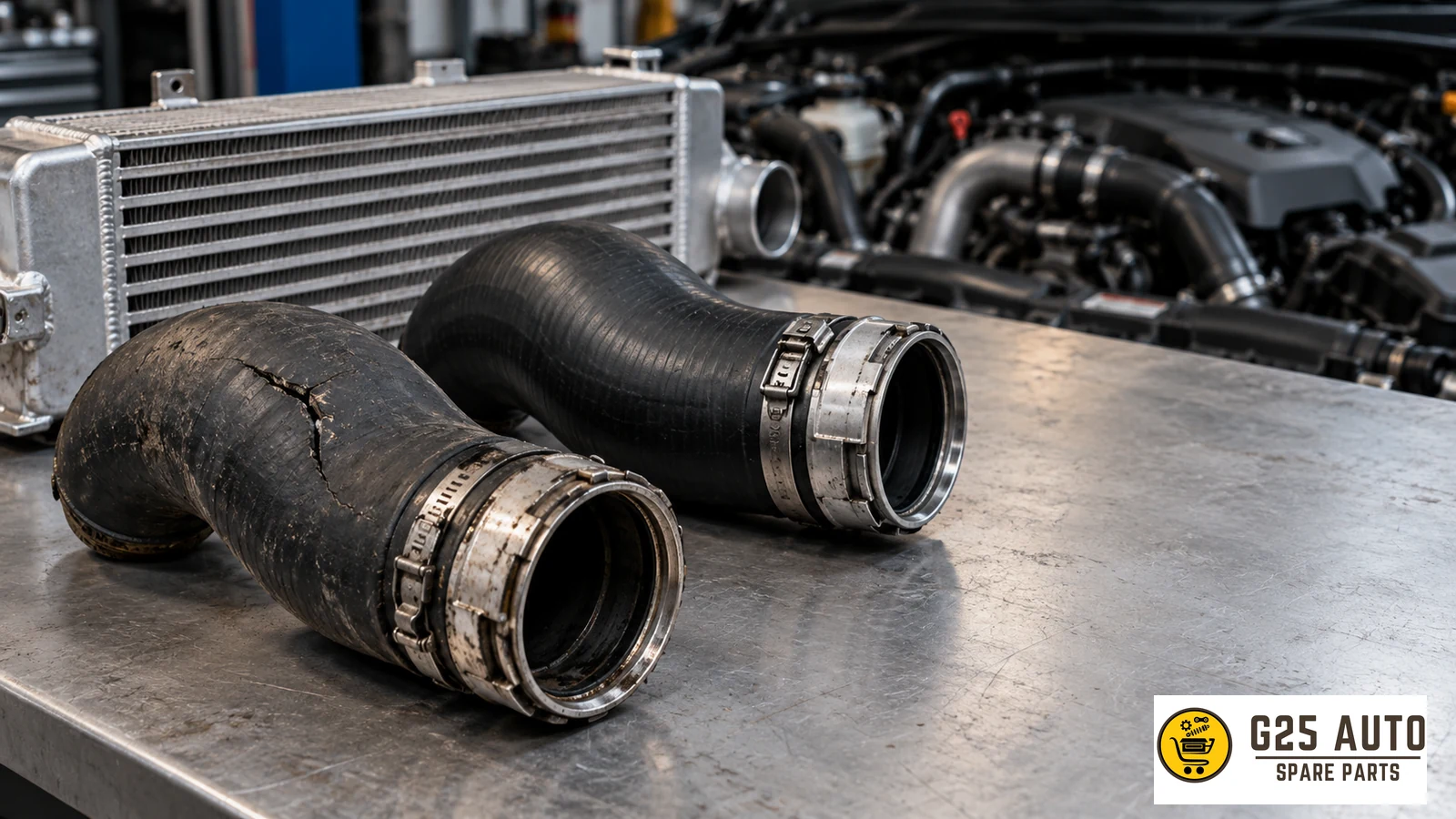
Intercooler and turbo hoses are essential components of turbocharged engines and directly affect performance. Wear or damage can lead to power loss, increased fuel consumption and, in some circumstances, engine damage. This guide covers fault symptoms, diagnosis and the information needed to select a replacement.
What Are Intercooler and Turbo Hoses?
A turbocharging system increases performance by supplying more air to the engine. Compressing that air also heats it. The intercooler cools the compressed air to support engine efficiency.
Turbo hoses are flexible connections carrying pressurised air between the turbocharger and intercooler, and between the intercooler and engine. They are commonly made from silicone or rubber-based materials and must withstand the temperature and pressure requirements of the application.
How the System Works
The turbocharger uses exhaust-gas energy to drive a compressor. The compressor raises air pressure, heating the air in the process. The hot air passes through the intercooler, where it cools. Cooler air is denser and can supply more oxygen for combustion, supporting engine performance.
Intercooler and Turbo Hose Fault Symptoms
Turbo hose problems often develop gradually, so recognising the early signs matters. The main symptoms to look for include:
Reduced Performance and Power
Cracks or loose connections allow pressurised air to escape. The engine may then fail to produce the expected power, particularly under load. The vehicle may feel less responsive during acceleration or when climbing hills.
Unusual Noises
A leaking hose can produce a whistling or hissing noise. This may become more noticeable during acceleration or as boost pressure rises. Rustling or blowing sounds from the engine bay can also indicate an air leak.
Warning Lights
On modern vehicles, sensor readings can alert the engine control unit to abnormal air-system conditions. A turbocharger or intake fault may illuminate the engine warning light. The light alone does not establish the diagnosis; fault codes must be read and assessed.
Increased Fuel Consumption
An air leak can affect engine management and fuel consumption, depending on the engine and control strategy. A driver may also use more throttle to compensate for reduced performance, increasing consumption.
Visible Signs
Inspecting the engine bay may reveal cracks, swelling, oil traces or loose clamps around a hose. Surface wear, discolouration or softening can also indicate that further assessment or replacement is needed.
Diagnostic Methods
Symptoms suggest a problem, but professional inspection is needed to establish the cause. The diagnostic process includes the following steps:
Visual Inspection
An experienced technician examines hose condition, clamp security and connection points throughout the engine bay. Suitable lighting can help reveal fine cracks that are otherwise difficult to see.
Pressure Testing
A suitable test tool pressurises the relevant air circuit to check for leaks, using the vehicle manufacturer’s procedure and test limits. This can reveal small leaks missed during visual inspection and help locate the fault.
Computer Diagnostics
Fault codes read from the vehicle help identify abnormal sensor signals and understand the problem. Boost-pressure values, air-mass readings and other engine-management data are assessed together.
Dynamic Testing
With the vehicle operating under appropriate test conditions, live boost pressure can be monitored and compared with the expected values for that application.
Intercooler and Turbo Hose Comparison
| Feature | Genuine Part | Aftermarket Part |
|---|---|---|
| Brand identification | Vehicle manufacturer’s branding | Independent manufacturer’s branding |
| Quality specifications | Check the specified vehicle application | Verify documented specifications for the application |
| Warranty coverage | Confirm the applicable supplier terms | Confirm the applicable manufacturer and supplier terms |
| Availability | Confirm for the specific order | Confirm for the specific order |
| Product range | Options depend on the vehicle application | Specifications and quality levels vary by manufacturer |
| Technical support | Check available vehicle-brand support | Check available manufacturer and supplier support |
Checklist for Selecting the Correct Part
Use the following checklist when sourcing an intercooler or turbo hose:
- Identify the vehicle fully: Collect its make, model, engine type, engine code and production year.
- Have the VIN ready: The vehicle identification number in the registration documents helps retrieve vehicle-specific catalogue information.
- Find the engine code: Check the relevant vehicle label or documentation.
- Record the OEM or part reference: Note or photograph the reference on the existing component.
- Check the production date: Different parts can be used within the same vehicle model, depending on its build date.
- Compare technical details: Check connection diameters, hose length and bend angles against the required application.
- Ask for quality documentation: Verify relevant documentation and its scope rather than assuming a certificate establishes part suitability.
- Check installation accessories: Establish whether clamps, seals and other mounting items are included.
- Clarify returns and warranty terms: Confirm the agreed conditions if the supplied part proves unsuitable.
- Seek expert advice: Ask an experienced technician or parts supplier when identification remains uncertain.
OEM References and the Importance of Verification
Selecting the correct component is a critical part of automotive parts sourcing. Even within one make and model, parts can differ according to engine type, equipment specification and production date.
What Is an OEM Part Reference?
An OEM, or Original Equipment Manufacturer, part reference identifies a component in the vehicle manufacturer’s parts system. It helps locate catalogue information about the component, its applications and relevant cross-references.
Verification Using the VIN
The VIN identifies the vehicle and supports searches in vehicle-specific parts catalogues. Professional suppliers use it alongside catalogue restrictions and other vehicle details to help identify a suitable component; it should not be treated as a guarantee on its own.
Engine Code and Production Date
The same vehicle model may have several engine variants, with different power outputs and turbocharging systems. The production date helps distinguish revisions and updates made during a model year.
Verify these details before placing a parts order and share them with the supplier.
Choosing Genuine or Aftermarket Parts
Whether to choose a genuine or aftermarket component is a common question in parts selection. Both options have features that need to be evaluated for the intended application.
Genuine Part Characteristics
Genuine parts carry the vehicle manufacturer’s branding and are specified for particular vehicle applications. For a vehicle still under warranty, check the actual warranty and service conditions before choosing a replacement.
Confirm the part reference and application even when sourcing a genuine component. Availability and commercial terms depend on the particular part and supplier.
Aftermarket Part Characteristics
Aftermarket parts come from independent manufacturers. A suitable replacement must meet the relevant application requirements; equivalent function and specifications should be verified from documentation.
The aftermarket includes products with different specifications and quality levels. Claims about shared factories, original-equipment supply or expected durability require evidence for the particular product.
Which Option Suits the Application?
For vehicles under warranty, first clarify the relevant replacement and service conditions. For older vehicles, consider the budget, operating conditions and required performance when comparing options.
High-performance or newer vehicles call for particular attention to the specified requirements of critical systems. For older vehicles in standard service, a documented, suitable aftermarket component may offer a practical option.
Whichever option is selected, verify its application and source it from a dependable supplier. For G25Auto B2B enquiries across Europe and the Balkans, provide the vehicle details and part reference so that the options can be assessed.
Installation and Maintenance Recommendations
Correct installation matters as much as selecting the right part. Replacing intercooler and turbo hoses requires technical knowledge and experience.
Why Professional Installation Matters
These hoses operate under pressure, and incorrect fitting can cause leaks, poor performance or further damage. Clamp security, correct hose positioning and checks of surrounding components require a professional approach.
Checks After Installation
After fitting, check all connections and carry out the leak-testing procedure specified for the vehicle. An appropriate road test can then help confirm correct system operation.
Routine Maintenance
Turbo hoses deteriorate over time. Visual inspection during routine servicing helps identify developing faults. Pay particular attention to clamp security and cracks in the hose surface.
Frequently Asked Questions
How often should an intercooler hose be replaced?
There is no universal replacement interval. Follow any vehicle-specific guidance and replace a hose when inspection confirms damage or deterioration requiring replacement. Harsh operating conditions can accelerate wear.
What happens if a turbo hose bursts?
A burst hose can cause sudden power loss and may trigger a reduced-power mode. Continued driving can cause further problems, so arrange prompt professional assessment rather than assuming the vehicle can safely continue in service.
Is silicone or rubber the better choice?
Suitability depends on the hose specification, construction and operating conditions. Neither material alone establishes temperature resistance or service life. Choose a hose that meets the requirements of the vehicle application and the intended use.
How long does intercooler hose replacement take?
The time depends on the vehicle and the hose location. Some hoses are readily accessible; others require surrounding components to be removed. The workshop should assess access before estimating the work.
Should only the damaged hose be replaced?
Usually the damaged hose is replaced, but the remaining hoses should also be inspected. On an older vehicle with several deteriorated hoses, replacing other affected components during the same repair may be practical.
Can an aftermarket hose affect warranty coverage?
Check the actual vehicle warranty conditions and the proposed component’s documentation before choosing a replacement. After warranty expiry, the hose still needs to meet the vehicle’s technical requirements; aftermarket branding alone does not establish suitability.
Conclusion
Intercooler and turbo hoses are important to the efficient operation of turbocharged engines. Reduced performance, unusual noises and visible damage should prompt professional inspection to establish the cause.
Take time to identify the correct replacement and collect complete vehicle information. The OEM reference, VIN, engine code and production date support accurate selection. Ordering from the model name alone increases the risk of a mismatch.
The choice between genuine and aftermarket parts depends on the vehicle’s condition, operating requirements and budget. In either case, the priority is a suitable component with documented specifications.
Professional installation, checks after fitting and routine inspections support reliable system operation and help detect further problems.
Working with dependable parts suppliers can make sourcing more efficient. Accurate information, an appropriate replacement and correct installation all contribute to dependable turbocharging-system performance.