
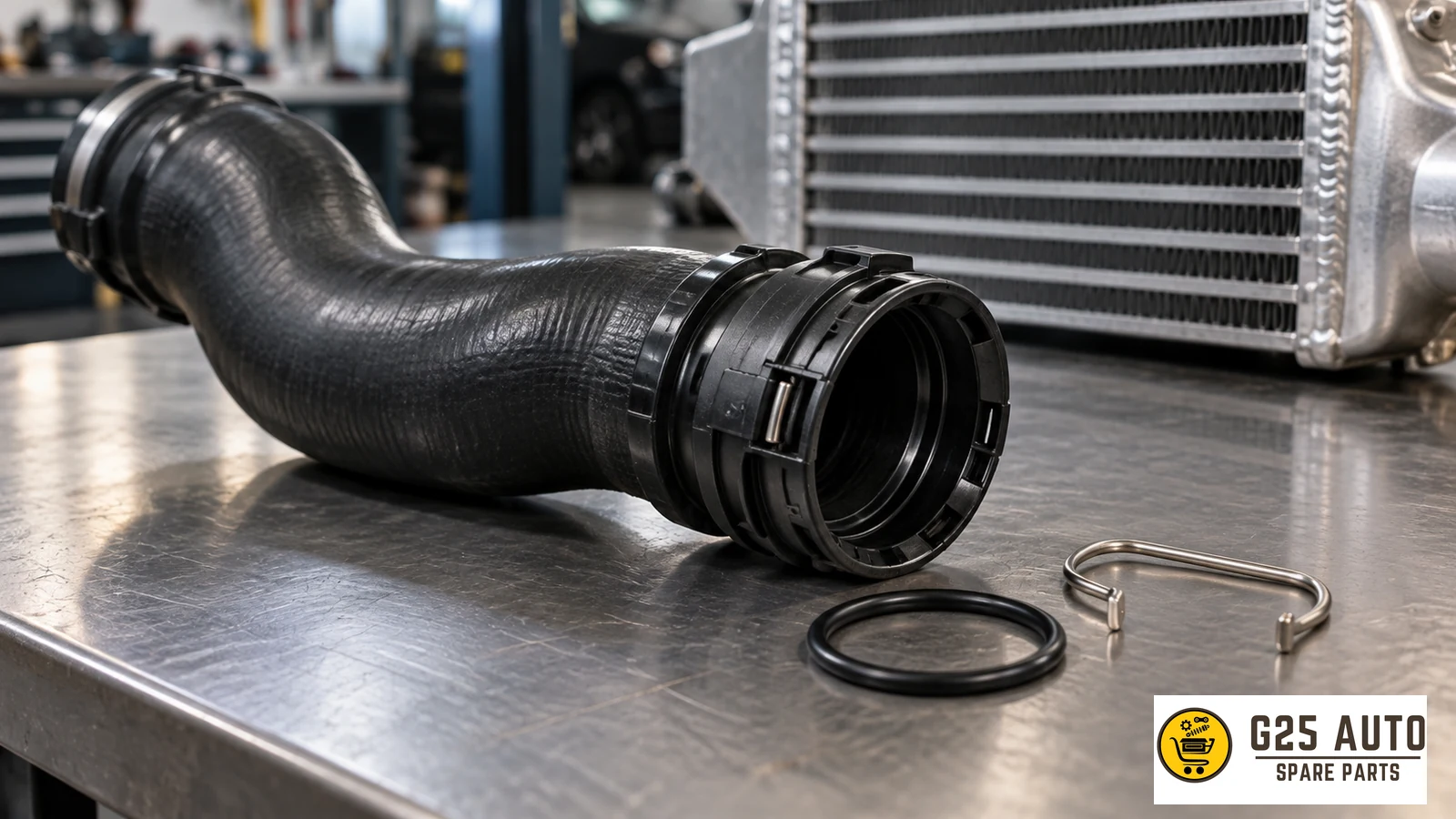
Intercooler hose seals and retaining clips are small but critical components that help keep the charge air system sealed and its hoses securely connected in turbocharged engines. Over time, they can wear, harden or break, potentially causing reduced engine performance, increased fuel consumption and further faults.
What Are Intercooler Hose Seals and Clips?
The intercooler cools the hot, compressed air supplied by the turbocharger, supporting engine performance. Hoses connect the intercooler to the turbocharger and engine. Seals and retaining clips secure these connections:
Seal: Typically made from a rubber compound selected for the application, the seal provides an airtight interface between the hose and its connection. It helps prevent pressurised air from escaping and maintains system efficiency.
Retaining clip: These metal or reinforced plastic components prevent hoses from separating from their connections. Depending on the connection design, retention may use a spring clip, screw-operated clamp or push-fit arrangement.
Fault Symptoms: When Should You Suspect a Problem?
Problems with intercooler hose seals and clips can produce several symptoms. Recognising them can help identify a small fault before it develops into a more serious problem:
Noises from the Engine Bay
A damaged seal or loose clip can allow pressurised air to escape, producing a whistling or hissing sound. This may become more noticeable under acceleration.
Loss of Power and Reduced Performance
An air leak can reduce the air reaching the engine. Drivers may notice weaker acceleration or difficulty maintaining performance uphill.
Engine Warning Light
An air leak can affect the readings from the mass air flow sensor (MAF) and manifold absolute pressure sensor (MAP), potentially triggering the engine warning light.
Increased Fuel Consumption
Reduced efficiency and changes in engine operation associated with an air leak may increase fuel consumption.
Loss of Boost Pressure
If the vehicle has a boost pressure display, readings may be lower than expected.
How Is the Fault Diagnosed?
Symptoms provide useful clues, but identifying the cause requires a systematic inspection:
Visual Inspection
Open the bonnet and carefully examine the intercooler hoses. Check accessible seals for cracks, tears or hardening. Inspect clips for breakage, distortion or looseness.
Pressure Testing
A workshop pressure test using suitable equipment can help locate charge air leaks. During the test, bubbles from an appropriate soap-and-water solution may reveal a leaking connection.
Electronic Diagnostics
An OBD-II scan should include checks for faults relating to boost pressure and air flow. Codes such as P0299, P0171 and P0174 may be relevant, depending on the vehicle and engine, but do not establish an intercooler hose leak on their own.
Manual Inspection
With the engine cold, gently check the hoses for flexibility. Hardened, cracked or otherwise damaged seals should be replaced.
What to Check When Selecting Replacement Parts
Choosing the correct intercooler hose seals and clips is essential. An unsuitable replacement can lead to another fault soon after installation:
Verification by OEM or Part Number
The original equipment part number is an important reference when identifying a replacement. Relevant information may be available in the manufacturer’s parts catalogue, vehicle documentation or markings on the existing component.
Vehicle Identification Number Check
Even within the same model, components can differ by production year, engine and market. Use the VIN alongside catalogue information to verify the required application.
Engine Code and Production Date
The engine code helps distinguish between engine variants. The production date also matters because manufacturers may introduce revised components within a model year.
Material Quality
Seal compounds and clip materials must suit the specified connection and operating conditions. Select the material required for the application rather than assuming that any silicone, rubber, steel or plastic replacement will be suitable. Poor-quality materials can deteriorate prematurely.
Aftermarket or Genuine Parts? Making an Informed Choice
Choosing between aftermarket and genuine parts is a common consideration during replacement. Each option has potential advantages and limitations:
Characteristics of Genuine Parts
Genuine parts are supplied under the vehicle manufacturer’s brand for specified applications. Their exact part number and any revisions still need to be checked. Their purchase cost may be higher.
Characteristics of Aftermarket Parts
Suitable aftermarket parts can offer an alternative when their specifications and application coverage are documented. Compare the supplier’s technical information, quality evidence and sourcing options rather than assuming equivalence with a genuine component.
Selection Criteria
Consider the vehicle’s warranty terms, the replacement brand’s documented quality and the overall cost. Check the applicable warranty conditions and any available product quality documentation before making a decision.
For European and Balkan B2B sourcing enquiries, provide G25Auto with the relevant vehicle and part references.
Installation and Maintenance Recommendations
Preparation Before Installation
Allow the engine to cool completely before replacement. Keep the work area clean and prepare the required tools. Clean the mating surfaces and remove oil and dirt residues before assembly.
Correct Installation Techniques
Avoid overstretching or twisting seals during installation. Use the appropriate tool to fit the clips and confirm that they are fully seated. Check every connection after assembly.
Routine Maintenance
Visually inspect intercooler hoses and connections as part of the vehicle’s prescribed maintenance routine. After cleaning the engine bay, confirm that the clips remain correctly positioned.
Comparison Table: Seal and Clip Types
| Feature | Rubber seal | Silicone seal | Spring clip | Screw-operated clamp |
|---|---|---|---|---|
| Temperature resistance | Compound-specific | Compound-specific | Check specification | Check specification |
| Flexibility | Compound-dependent | Compound-dependent | Design-specific retention | Adjustable where specified |
| Service life | Condition-dependent | Condition-dependent | Condition-dependent | Condition-dependent |
| Ease of installation | Connection-dependent | Connection-dependent | Correct seating required | Correct tightening required |
| Cost considerations | Compare specified options | Compare specified options | Compare specified options | Compare specified options |
Replacement Checklist
- ☐ Record the VIN and engine code
- ☐ Identify the existing component’s OEM or part number
- ☐ Check the vehicle’s production date
- ☐ Visually inspect all intercooler hoses
- ☐ Check the condition of each clip
- ☐ Request available product quality documentation from the supplier
- ☐ Obtain the warranty terms in writing
- ☐ Clean the mating surfaces before installation
- ☐ Arrange a pressure test after assembly
- ☐ Recheck the connections after initial use as specified in the installation instructions
- ☐ Record the replacement date and mileage
Common Mistakes and Solutions
Incorrect Clamping or Retention
Incorrectly fitted clips or clamps can damage a seal or fail to retain the connection securely. Follow the manufacturer’s fitting procedure and any applicable tightening torque for screw-operated connections.
Neglecting Surface Cleaning
Installing new components on oily or dirty surfaces, or over old seal residue, can lead to premature failure. Clean the connection before assembly.
Using Poor-Quality Parts
Components of uncertain quality may fail prematurely and result in repeat work. Prefer products with traceable specifications and relevant quality documentation.
Frequently Asked Questions
How often should an intercooler hose seal be replaced?
Replacement depends on operating conditions and the applicable maintenance guidance. Replace seals showing hardening, cracking or deformation rather than relying on a universal mileage interval.
Must all clips be replaced when changing a seal?
Replace clips that are broken, cracked, distorted or have lost their spring action. Reuse an undamaged clip only where the manufacturer’s instructions permit it.
Is a silicone seal better than a rubber seal?
Temperature resistance and service life depend on the particular compound and application. Select the specified material for the connection and operating conditions rather than assuming silicone is always preferable.
How long should you wait after replacing a seal?
Return the vehicle to service after the installation checks required by the manufacturer. Recheck connections after initial use where the fitting instructions call for it; there is no universal waiting period or recheck mileage.
Can an air leak cause engine damage?
A leak can reduce performance, increase fuel consumption and affect sensor readings. Depending on the fault, continued operation may also place additional demands on the turbocharger and contribute to damage. Do not assume that a small leak is harmless.
Conclusion and Recommendations
Intercooler hose seals and retaining clips are small components with an important role in efficient turbocharged engine operation. Regular checks and timely replacement help maintain performance and reduce the risk of further problems.
Recognising symptoms supports early intervention, but diagnosis requires professional inspection and testing. Verify replacement parts using the relevant part number, VIN and engine code together with application data.
The choice between genuine and aftermarket parts depends on the purchasing requirements. In either case, select a component with documented suitability and quality, clear warranty terms and the correct installation procedure.
Follow up with the prescribed checks after installation to maintain the system’s condition. Seek professional assistance whenever the cause of a fault or the suitability of a replacement is uncertain.