
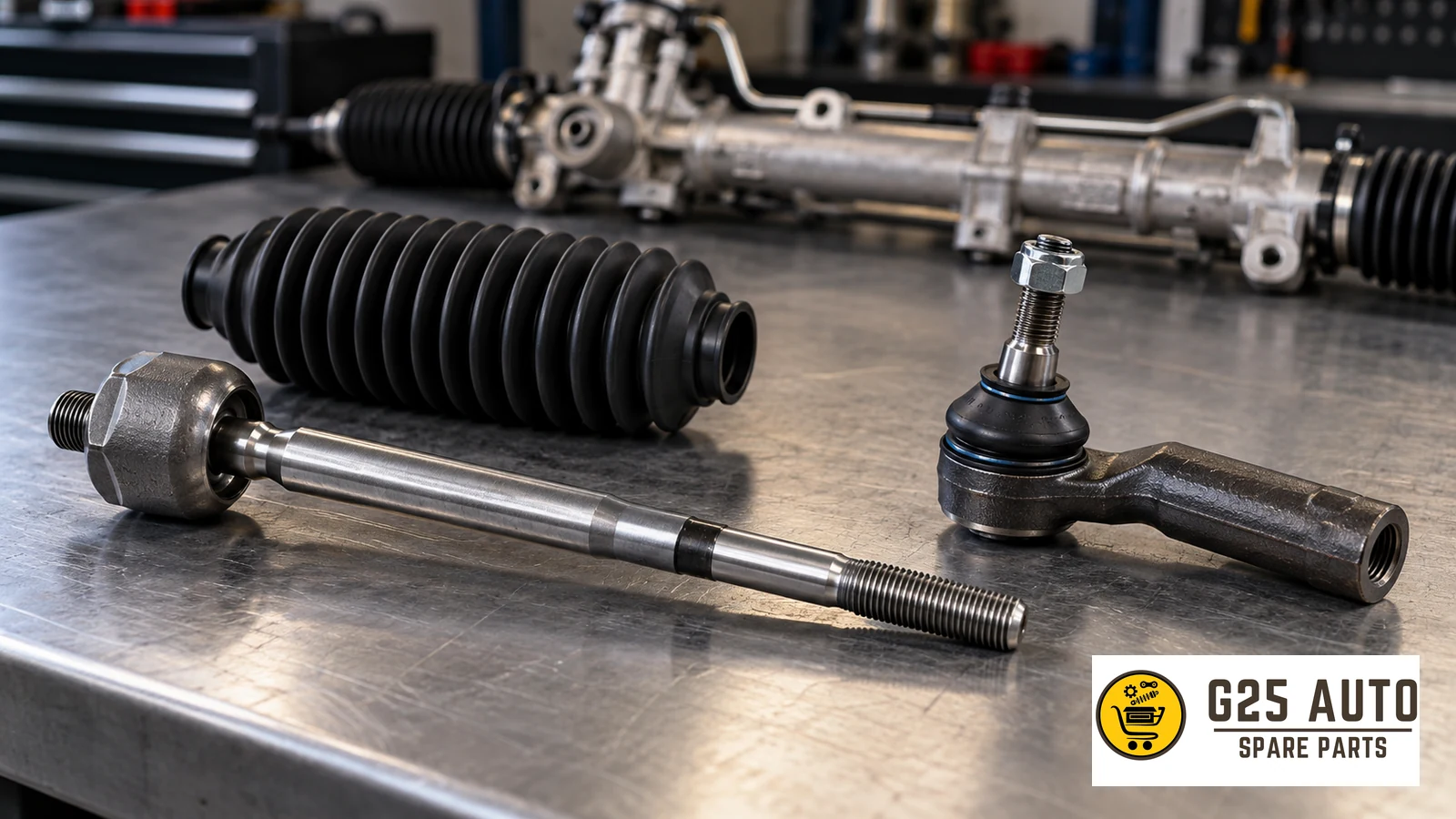
Inner tie rods and the adjoining steering links are key parts of a vehicle’s steering system, transmitting steering movement to the wheels. In brief, the inner tie rod connects the steering rack to the outer section, which transfers movement to the steering knuckle so the wheel can turn. Both are subject to wear and need regular inspection, with replacement arranged promptly when a fault is confirmed.
What Are Inner Tie Rods and Steering Links?
Understanding their individual roles helps explain how the steering system works. The inner tie rod sits at the end of the steering rack and is usually protected by a rubber bellows. Its articulated joint allows movement while transmitting the rack’s steering input towards the wheel.
The outer link connects the inner tie rod to the steering knuckle through its joint. It must transmit steering input while accommodating suspension movement. Component names and the way these parts are supplied can vary between vehicle applications.
Their Roles in the Steering System
These components form part of the mechanical connection between the steering wheel and the road wheels. The sequence is:
- The steering wheel is turned.
- The steering gear converts the input into movement of the steering linkage.
- The inner tie rod transmits this movement to the outer section.
- The outer link transfers movement to the steering knuckle.
- The road wheels turn in the intended direction.
Symptoms of Inner Tie Rod and Steering Link Faults
Problems with these parts often develop gradually and become more noticeable over time. Detecting wear early can help prevent further damage.
Signs You May Notice While Driving
The following symptoms can indicate a problem in the steering linkage:
- Excessive steering play, with delayed wheel response when the steering wheel is turned.
- The vehicle wandering on a straight road or becoming difficult to hold on course.
- Clicking, squeaking or knocking when steering.
- Unusual noises during cornering or parking manoeuvres.
- Steering vibration or shaking, particularly at higher speeds.
- Uneven tyre wear, including wear concentrated along one edge.
Signs Found During Visual Inspection
During routine checks, look for:
- Tears, cracks or grease leakage around the steering rack bellows.
- Visible bending or deformation of the steering link.
- Excessive movement or looseness at connection points.
- A damaged dust boot, which can allow grease loss and contamination that accelerate wear.
The Difference Between Symptoms and a Confirmed Diagnosis
The symptoms above suggest possible faults, but a definite diagnosis requires professional inspection. Steering play can also result from steering rack faults, worn bushes or ball joints, or other suspension problems.
A diagnostic inspection may involve:
- Raising and securely supporting the vehicle using suitable workshop equipment.
- Moving the wheels by hand to check for play.
- Testing each joint individually.
- Observing the linkage as the steering wheel is turned.
- Using appropriate specialist measuring equipment where required.
If symptoms appear, arrange a prompt inspection by a qualified workshop to establish the fault and assess whether the vehicle is safe to use.
Comparing Inner Tie Rods and Outer Steering Links
| Feature | Inner tie rod | Outer steering link |
|---|---|---|
| Location | At the steering rack outlet, usually inside the bellows | Between the inner tie rod and steering knuckle |
| Construction | Articulated joint with a rod section | Rod section with an outer joint; arrangement varies |
| Protection | Protected by the steering rack bellows | Usually exposed, with the joint protected by a dust boot |
| Wear rate | Depends on operating conditions and joint protection | Depends on operating conditions, contamination and impact damage |
| Replacement difficulty | Access and tool requirements depend on the steering rack design | Access and removal procedure depend on the vehicle design |
| Fault patterns | Bellows damage can contribute to contamination and wear | Rough roads and impacts can contribute to damage |
Checklist: Routine Maintenance and Inspection
Use the following checklist to help identify steering linkage problems early:
During Routine Checks at the Specified Service Intervals
- ☐ Visually inspect the inner tie rod bellows for tears or cracks.
- ☐ Look for grease leakage around the steering joints.
- ☐ Check the tyres for uneven wear.
- ☐ Note any steering play or vibration.
During a Detailed Workshop Inspection
- ☐ Have the securely raised vehicle checked for wheel play.
- ☐ Have all steering and suspension connections professionally inspected.
- ☐ Check wheel alignment and adjust it where required.
- ☐ Arrange prompt replacement of damaged bellows and inspection of the protected joint.
Situations Requiring Prompt Inspection
- ☐ After an impact with a kerb or a severe pothole.
- ☐ When unusual steering noises begin.
- ☐ When the vehicle no longer tracks correctly.
- ☐ When a technician identifies a concern during tyre replacement.
Choosing the Correct Part: What to Check
Correct part selection matters when replacing an inner tie rod or steering link. An incorrect part can waste time and money and create a safety risk.
Verification Using OE References and Part Numbers
Vehicle manufacturers identify components using part references. When selecting inner tie rods and steering links, check:
- OE part reference: Identify the relevant original part reference and include it in the order enquiry.
- Vehicle identification number: The VIN helps distinguish vehicle variants and changes within a model year.
- Engine code: Some model ranges use different steering arrangements depending on the vehicle configuration.
- Production date: Changes can occur within the same model year, so the build date may be relevant.
Vehicles of the same make and model built at different points in a year may use different steering parts. Make, model and year alone may therefore be insufficient.
Choosing Between Original and Aftermarket Parts
The replacement parts market offers vehicle manufacturer branded parts and aftermarket alternatives. Both options have points to assess before ordering.
Original Parts
Potential advantages:
- Parts supplied to the vehicle manufacturer’s specification.
- Application information linked to the manufacturer’s catalogue, subject to verification.
- Warranty terms that can be checked for the specific supply.
- Parts used within the manufacturer’s service network.
Points to assess:
- Purchase cost compared with other suitable options.
- The actual supply lead time quoted for the order.
- Availability for older vehicle applications.
Aftermarket Parts
Potential advantages:
- A range of price options to compare.
- A broad choice of manufacturers and product ranges.
- Alternative supply options, with availability checked individually.
- Products with documented specifications that can be assessed against the application requirements.
Points requiring attention:
- Product quality can vary between manufacturers.
- Purchase through a reliable supplier.
- Check application and compatibility information carefully.
- Review relevant product quality documentation rather than assuming a general certificate proves suitability.
A Balanced Assessment
The choice depends on vehicle use, budget and purchasing requirements. Workshops and fleet buyers should assess each original or aftermarket option against the intended application and available product documentation.
Whichever option is selected, verify the part references and use a reliable supplier. For G25Auto B2B enquiries across Europe and the Balkans, provide the relevant vehicle details and part references so the requested option can be checked.
Installation and Replacement
Replacing inner tie rods and steering links requires mechanical knowledge and suitable tools. The work should be carried out by a qualified workshop.
General Stages
- Raise and securely support the vehicle.
- Remove the relevant wheel.
- Record the positions of existing components before removal.
- Release the outer link and inner tie rod connections as required.
- Remove the damaged components.
- Install the replacement parts and tighten the connections using a torque wrench to the specified settings.
- Refit the wheel.
- Check and adjust wheel alignment after replacement.
Post-replacement wheel alignment is an essential part of the work. Incorrect alignment can cause rapid tyre wear and affect vehicle handling.
Frequently Asked Questions
When should inner tie rods and steering links be replaced?
There is no single mileage interval for every vehicle. Wear depends on operating conditions, road surfaces and maintenance. Symptoms require prompt inspection, and confirmed faults should be addressed without delay.
Is replacing just one side sufficient?
If only one side is faulty, replacement may be limited to that side where appropriate. Both sides should be inspected because they may have experienced similar use. The replacement scope should follow their condition and the applicable repair guidance.
Can a vehicle be driven with a faulty steering link?
Driving with a confirmed steering linkage fault is not recommended. It can affect steering control and present a serious accident risk. Further wear may also affect other steering or suspension components.
Why is wheel alignment important?
Alignment after steering linkage replacement establishes the correct wheel angles. Incorrect settings can lead to uneven tyre wear and affect handling, fuel consumption and driving comfort.
How important is a torn bellows?
The bellows protects the inner joint from dirt and water and helps retain lubrication around the protected assembly. A tear needs prompt attention because contamination and grease loss can accelerate joint wear.
Are aftermarket parts safe?
An aftermarket part must meet the requirements of the specific application. Choose the correct part reference, a reputable manufacturer and a reliable supplier, and assess the available product documentation rather than relying on a blanket quality claim.
Conclusion
Inner tie rods and steering links play a central role in steering and vehicle safety. Regular inspection, early attention to symptoms and correct part selection help manage both safety and repair costs.
Before ordering replacements, consider the OE references, VIN, engine code and production date. Original and aftermarket options should be compared using application information and documented product quality, with the correct reference supplied to a reliable supplier.
Complete the repair with a professional wheel alignment check and any necessary adjustment. Correct installation and alignment support tyre life and predictable handling. Steering components deserve careful selection and properly executed repair work.