
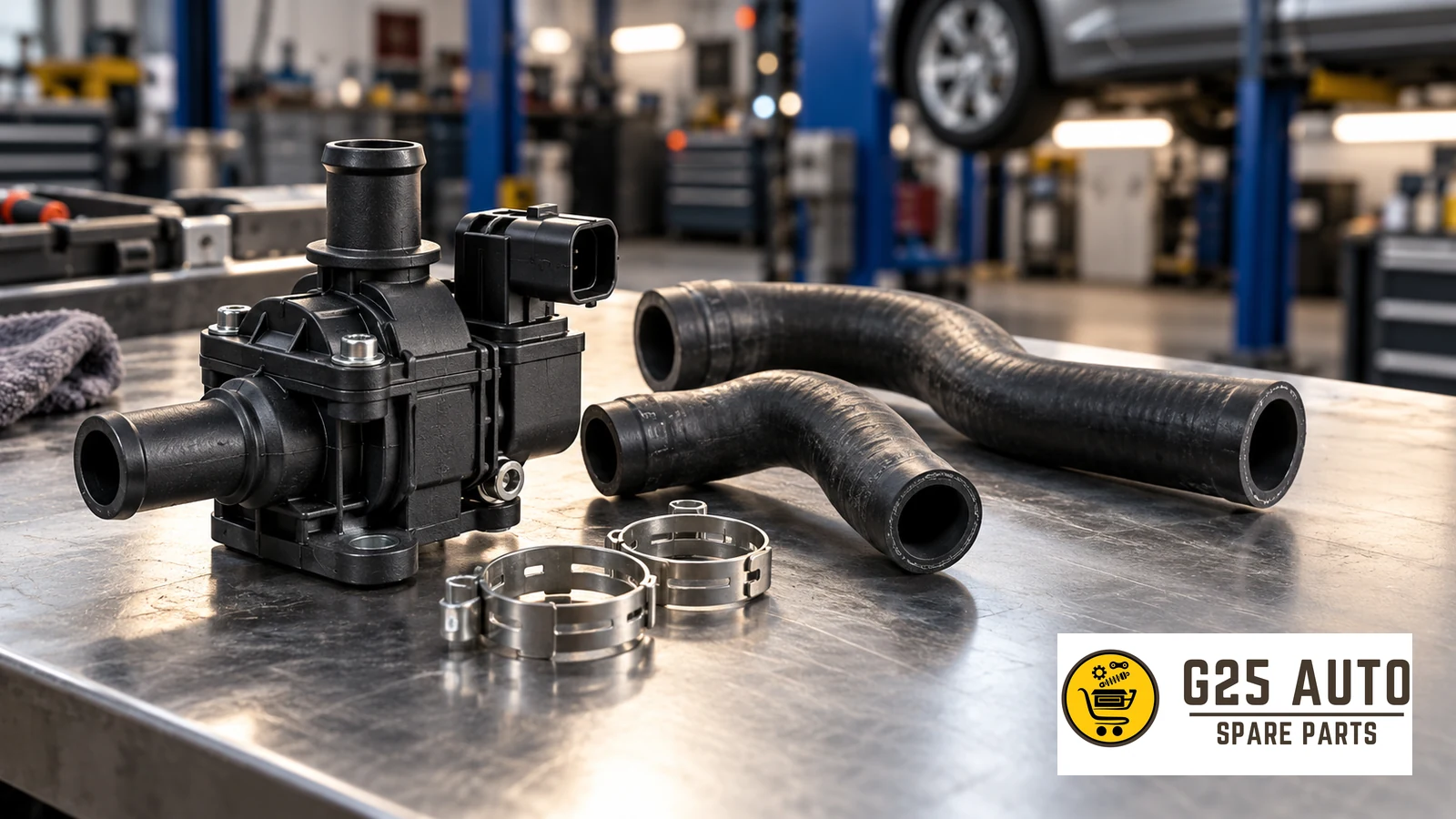
The heater coolant control valve regulates the flow of hot coolant from the engine cooling system to the heater core, helping control cabin temperature. Connecting hoses provide flexible links between the valve, engine and heater core. Correct operation of this system is particularly important for comfort during winter.
What Is a Heater Coolant Control Valve and How Does It Work?
On vehicles equipped with one, the heater coolant control valve forms part of the climate control system. It regulates the hot coolant circulating from the engine cooling system to the heater core. When the cabin temperature setting changes, the valve opens, closes or takes an intermediate position to control coolant flow, depending on the system design.
The operating principle is straightforward: when more heat is requested, the valve allows more hot coolant to reach the heater core. The blower sends air through the heated core into the cabin. When less heat is needed, the valve reduces or closes the flow, according to the vehicle’s control strategy.
Valve Types and Control Mechanisms
Heater coolant control valves can be grouped into three main categories:
- Mechanical cable-operated valves: Found on some older vehicles, these are operated mechanically by a cable connected to the temperature control.
- Vacuum-operated valves: These use a vacuum signal to open or close and are found on various older vehicle designs.
- Electrically operated valves: These use electrical actuation, such as a servo motor, managed by the vehicle’s control electronics.
Why Connecting Hoses Matter
Heater hoses are flexible pipes carrying hot coolant from the engine to the heater core and back. They are made from suitable rubber compounds because they operate under heat and cooling-system pressure.
A suitable heater hose should provide the following characteristics:
- Heat resistance appropriate to the vehicle’s specified operating conditions
- A suitable rubber compound, such as EPDM or an approved silicone formulation, where specified
- A sound internal surface that supports coolant flow and resists deterioration
- Flexibility combined with resistance to collapse
- Material construction compatible with the specified coolant and operating environment
Fault Symptoms and Diagnosis
Common Fault Symptoms
The following symptoms may indicate a problem with the heater valve, hoses or another part of the heating and cooling system:
- Insufficient cabin heat or no heat at all
- Cabin temperature cannot be controlled and remains too hot or too cold
- A higher-than-normal engine temperature reading
- Sweet-smelling vapour from the engine compartment
- Wet upholstery or floor mats when the heater is operating
- A recurring drop in expansion-tank coolant level
- Visible leaks at heater connections
- Unusual hissing sounds while the engine is running
Checks Needed for a Reliable Diagnosis
These symptoms can have several causes, so professional inspection is needed to identify the fault. A technician may carry out the following checks:
- Cooling-system pressure testing for leaks
- Electrical checks of the heater valve on electrically controlled systems
- Thermostat operation testing
- Coolant flow direction and flow checks
- Hose flexibility and hardness inspection
- Leak checks at connection points
- Heater-core blockage checks
- Climate-control module fault-code reading, where supported
Important: Similar symptoms do not establish the cause. Have the system professionally diagnosed if there is any doubt, particularly to avoid serious problems such as engine overheating.
Choosing Original or Aftermarket Parts
When a heater coolant control valve or connecting hose needs replacement, the main choices are original equipment parts and aftermarket alternatives.
Characteristics of Original Parts
- Supplied or approved through the vehicle manufacturer’s parts programme
- Fitment still needs confirmation against the vehicle and part specification
- May have a higher purchase cost, depending on the application
- Warranty requirements should be checked before making a selection
- Availability depends on the particular part and supply channel
Characteristics of Aftermarket Parts
- Produced by independent manufacturers for specified vehicle applications
- Performance should be assessed against the required specification rather than assumed equivalent
- May offer a cost advantage, depending on the product
- Provide alternative product ranges and supply options; availability needs confirmation
- Some products use different materials or designs, which should be checked for suitability
Comparison Table
| Characteristic | Original Part | Suitable Aftermarket Part |
|---|---|---|
| Compatibility | Confirm the correct vehicle application | Check application and technical specifications |
| Cost | Depends on the part and supplier | Depends on the product and supplier |
| Availability | Confirm for the required part | Confirm for the required part |
| Warranty Terms | Check the applicable manufacturer’s terms | Check the applicable brand and supplier terms |
| Quality | Specified for the original application | Assess the manufacturer’s specification and documentation |
Checklist for Selecting the Correct Part
Correct identification is essential when sourcing a heater coolant control valve or hose. Use the following steps to support the selection:
Part Verification Checklist
- ☐ Prepare the vehicle details: Make, model, year and engine information.
- ☐ Record the vehicle identification number (VIN): Use it to support a catalogue application check.
- ☐ Identify the engine code: Different engines in the same model may use different parts.
- ☐ Check the production date: Design changes may occur within a model year, including during a facelift.
- ☐ Record the existing part’s reference number: Note the number marked on the installed part where available.
- ☐ Identify the heating system: Manual climate control, automatic climate control, dual-zone system or another configuration.
- ☐ Check the connector on an electric valve: Compare the connector shape and electrical connection arrangement.
- ☐ Measure hose diameters: Record inlet and outlet diameters in millimetres.
- ☐ Note hose length and shape: Straight, angled or specially moulded.
Why Original References and Part Numbers Matter
Incorrect part selection is a common problem in automotive sourcing. Even within the same make and model, parts can differ by year, engine and equipment level. The following identification details therefore matter:
Original Part Reference: A manufacturer’s part reference helps identify the intended application. Record the number on the existing component and check it against current catalogue information; the number alone does not guarantee compatibility.
Vehicle Identification Number (VIN): The VIN identifies the vehicle and supports access to relevant production and configuration information in suitable catalogues. Parts specialists can use it to narrow down the application, together with the other vehicle details.
Engine Code: Different engines within one model may require different heater-system configurations. The engine code, found in vehicle documentation or on the relevant identification marking, helps establish the correct application.
Production Date: Manufacturers can change designs within a model year. Vehicles of the same model year may therefore have different valve arrangements. Check the production date rather than relying only on the first registration date.
What to Check When Sourcing Aftermarket Parts
If choosing aftermarket parts, work with a reliable supplier and compare the available technical information. For G25Auto B2B sourcing across Europe and the Balkans, confirm the required application and product documentation before ordering.
How to Assess Aftermarket Brands
- Check relevant quality documentation and verify its scope rather than relying on a certification label alone
- Consider manufacturers with a documented original-equipment supply background where relevant
- Review the actual warranty terms offered
- Consider the company’s experience in the sector
- Look for suppliers that provide technical support and clear customer service
Heater Hose Replacement and Maintenance
When Should Hoses Be Replaced?
Heater hoses deteriorate over time in the demanding engine-compartment environment. Assess replacement when any of the following conditions are found:
- Cracks or splits in the hose surface
- Excessive hardening or brittleness
- Excessive softening or swelling
- Leaks at the connections
- Oil, fuel or chemical contamination on the hose
- Age-related deterioration identified during preventive maintenance, following the vehicle’s guidance
- Visible deposits or signs of restriction
Maintenance and Inspection Recommendations
- Inspect hoses visually during routine maintenance, following the vehicle’s service guidance
- Check hose flexibility by hand only with the engine cold
- Check clamp security; excessive tightening can also cause damage
- Replace coolant according to the vehicle’s requirements; contaminated coolant can damage the system
- Keep the engine compartment clean because oil and chemicals can degrade rubber
- Have heater operation checked before winter
Frequently Asked Questions
Can a Vehicle Be Driven with a Faulty Heater Valve?
This depends on the fault and the cooling-system design. A valve fault may affect cabin heating, while coolant loss or disrupted circulation can create more serious problems. Do not assume that a short journey is safe; have the fault assessed promptly and stop if coolant loss or overheating occurs.
What Should I Do If a Heater Hose Bursts?
Pull over safely and stop the engine. Continuing to run it can cause overheating and serious damage. Recovery to a workshop is the safest option. Do not simply refill the system and continue driving with the fault unresolved.
Can I Replace the Heater Valve Myself?
A simple valve may be within the ability of someone with suitable mechanical experience, but electrically controlled systems may require additional procedures. The cooling system needs correct draining, refilling and bleeding. Seek professional help if you lack the necessary experience.
Can an Aftermarket Hose Last Longer Than an Original One?
Different manufacturers may use different rubber formulations, but this does not establish longer service life. Durability depends on the product, its suitability and operating conditions; a general claim of superiority is not justified.
How Often Should Heater Hoses Be Inspected?
Follow the vehicle’s maintenance guidance and request a visual hose inspection during servicing. A thorough check before winter is also useful; inspection needs depend on condition and operating history.
If Only One Hose Is Damaged, Should the Others Be Replaced?
Not automatically. Hoses may have been installed together and exposed to similar conditions, so inspect the remaining hoses when one deteriorates. Replacing other worn hoses at the same time may avoid repeated dismantling, but the decision should follow their condition and the repair requirements.
Conclusion and Recommendations
The heater coolant control valve and connecting hoses matter for cabin comfort and cooling-system integrity. Correct operation is especially valuable in cold weather, while neglected leaks or cooling faults can lead to serious engine damage.
Recognising symptoms early and arranging timely repairs can help reduce risk and avoid further costs. A seemingly minor heater-hose leak can develop into coolant loss and engine overheating.
Original and aftermarket replacement parts each require assessment. Consider the vehicle’s age, warranty conditions, usage and repair budget. Either category can be appropriate when the selected product meets the application’s requirements.
Above all, verify the actual part. Cross-check the original reference, VIN, engine code and production date against the relevant catalogue and specifications. An incorrect part wastes time and can create additional costs.
Suitable parts and regular maintenance support reliable heater operation. Seek professional advice when needed and keep up with inspections: preventive maintenance and early diagnosis remain practical priorities.
For professional automotive parts sourcing, choose suppliers that provide clear product information and suitable selection support. G25Auto’s European and Balkan B2B context calls for careful comparison of original and aftermarket options and confirmation of the required application.