
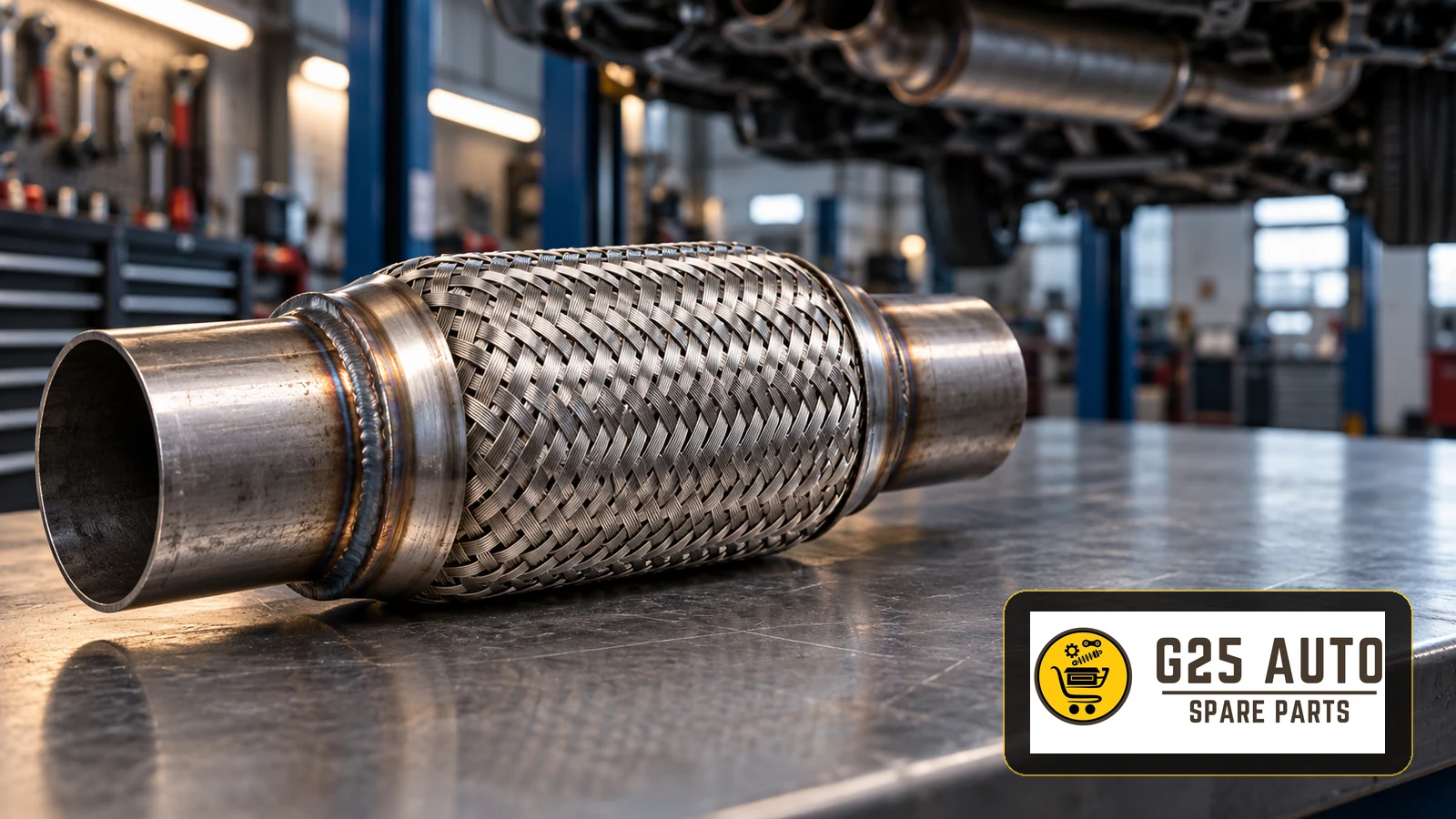
Exhaust flexible joints and flex pipes accommodate engine movement and vibration, helping reduce strain on the exhaust pipework. Increased exhaust noise, vibration or metallic rattling can indicate damage, although these symptoms require inspection. When selecting a replacement, check the vehicle identification, engine type, production details and relevant part references.
What are exhaust flexible joints and flex pipes?
A flexible exhaust joint uses a bellows structure, often protected by metal braid, to accommodate movement between connected exhaust sections. Flex pipe serves the same general purpose. Its construction, length and position depend on the vehicle and exhaust design.
How flexible joints and flex pipes work
The engine produces vibration and moves during operation. A flexible section accommodates this movement and reduces the loads transmitted to rigid pipework. Worn engine mounts can allow excessive movement, so their condition matters when investigating repeated flex pipe damage.
Failure symptoms: when is replacement needed?
Symptoms can help identify a problem, but do not establish its cause without inspection.
Common signs of damage
- Louder exhaust noise: particularly when engine speed rises.
- Metallic rubbing or rattling: sometimes noticeable as the throttle is applied or released.
- Increased vibration: felt through the steering wheel or vehicle body.
- Exhaust odour: fumes entering the cabin may indicate a leak and require prompt attention.
- Visible damage: torn bellows, separated braid, corrosion or deformation.
- Changed fuel consumption: this can accompany some exhaust faults, but has many possible causes.
Checks needed for diagnosis
A qualified workshop should inspect the complete exhaust system using suitable equipment:
- Visually inspect the system with the vehicle safely supported.
- Look for cracks, tears and deformation in the flexible section.
- Check the condition of the outer metal braid.
- Test the connections and flexible section for leaks.
- Assess abnormal movement and vibration during an appropriate operational check.
Original equipment or aftermarket: comparing the options
Both routes require application checks. General labels do not establish fitment, service life or warranty coverage.
| Factor | Original equipment | Aftermarket replacement |
|---|---|---|
| Fitment | Check the correct vehicle application. | Verify the application and reference information. |
| Materials | Review the product specification. | Review the supplier’s documented specification. |
| Warranty | Check the written terms. | Check the written terms and exclusions. |
| Availability | Confirm for the required item. | Confirm for the required item. |
| Service life | Depends on operating and installation conditions. | Depends on operating and installation conditions. |
| Documentation | Request relevant product information. | Request relevant product information. |
Recommendations for selection
- Review the product specification and applicable documentation.
- Use an established supplier.
- Cross-check part references against the vehicle application.
- Clarify warranty conditions, including installation requirements.
- Request technical documentation before ordering.
Why part references and verification matter
An incorrectly selected flexible section can cause installation problems and premature damage. Reference matching should be considered alongside the vehicle configuration and replacement specification.
What is an OEM part reference?
An OEM reference identifies a part within the manufacturer’s catalogue. It helps narrow the selection, but a reference alone should not be treated as a fitment guarantee.
Checklist for identifying the correct part
- Record the vehicle make, model, engine capacity and production year.
- Provide the vehicle identification number (VIN).
- Confirm the engine code from reliable vehicle information.
- Record any legible reference on the existing component.
- Check the production date for changes within a model range.
- Confirm engine output and fuel type.
- Include relevant equipment or vehicle variant details.
Why VIN and engine code matter
Exhaust configurations can differ within the same model according to engine, production period and destination market. VIN and engine information help identify the applicable configuration, including for European and Balkan B2B orders.
Installation and maintenance recommendations
Correct installation is as important as selecting the replacement.
Professional installation
- Renew gaskets and sealing elements where required by the repair instructions.
- Tighten fasteners to the applicable manufacturer’s specification.
- Install the flexible section without excessive tension.
- Check for unintended contact with surrounding components.
- Carry out an appropriate leak check after installation.
Maintenance for continued service
- Include the exhaust system in regular visual inspections.
- Assess corrosion and follow the component’s maintenance instructions.
- Have the engine mounts checked.
- Avoid impacts from deep potholes and obstacles where possible.
Frequently asked questions
How long does an exhaust flexible joint last?
There is no universal mileage interval. Operating conditions, corrosion, installation and engine movement affect its condition.
Does a damaged flex pipe affect vehicle use?
A leak can increase noise and allow fumes to escape. Performance effects depend on the fault and system. Arrange professional assessment, especially if fumes enter the cabin.
Can I replace the flexible joint myself?
The repair requires suitable equipment, safe vehicle support and the correct installation method. Professional installation is advisable where these requirements cannot be met.
Is an aftermarket warranty comparable to an original part warranty?
Terms vary. Obtain the duration, coverage and exclusions in writing before purchase.
Can a rusty flexible joint be cleaned?
Surface corrosion should be distinguished from structural damage. Cleaning cannot repair holes or restore a damaged bellows.
Pre-purchase checklist
- Has the vehicle application been checked using the VIN?
- Have the engine code and production details been confirmed?
- Have the relevant part references been cross-checked?
- Is the necessary product documentation available?
- Are warranty coverage and exclusions clear?
- Has the supplier been assessed?
- Are required gaskets and sealing materials included or ordered separately?
- Are return and exchange conditions documented?
- Is technical support available for the supplied item?
- Is the packaging intact and the supplied item correctly identified?
Conclusions and recommendations
Recognising damage early, checking vehicle and part information, and installing the replacement correctly help protect exhaust system operation. For G25Auto B2B enquiries, provide the VIN, engine and production details together with available part references so the proposed replacement can be reviewed before ordering.