
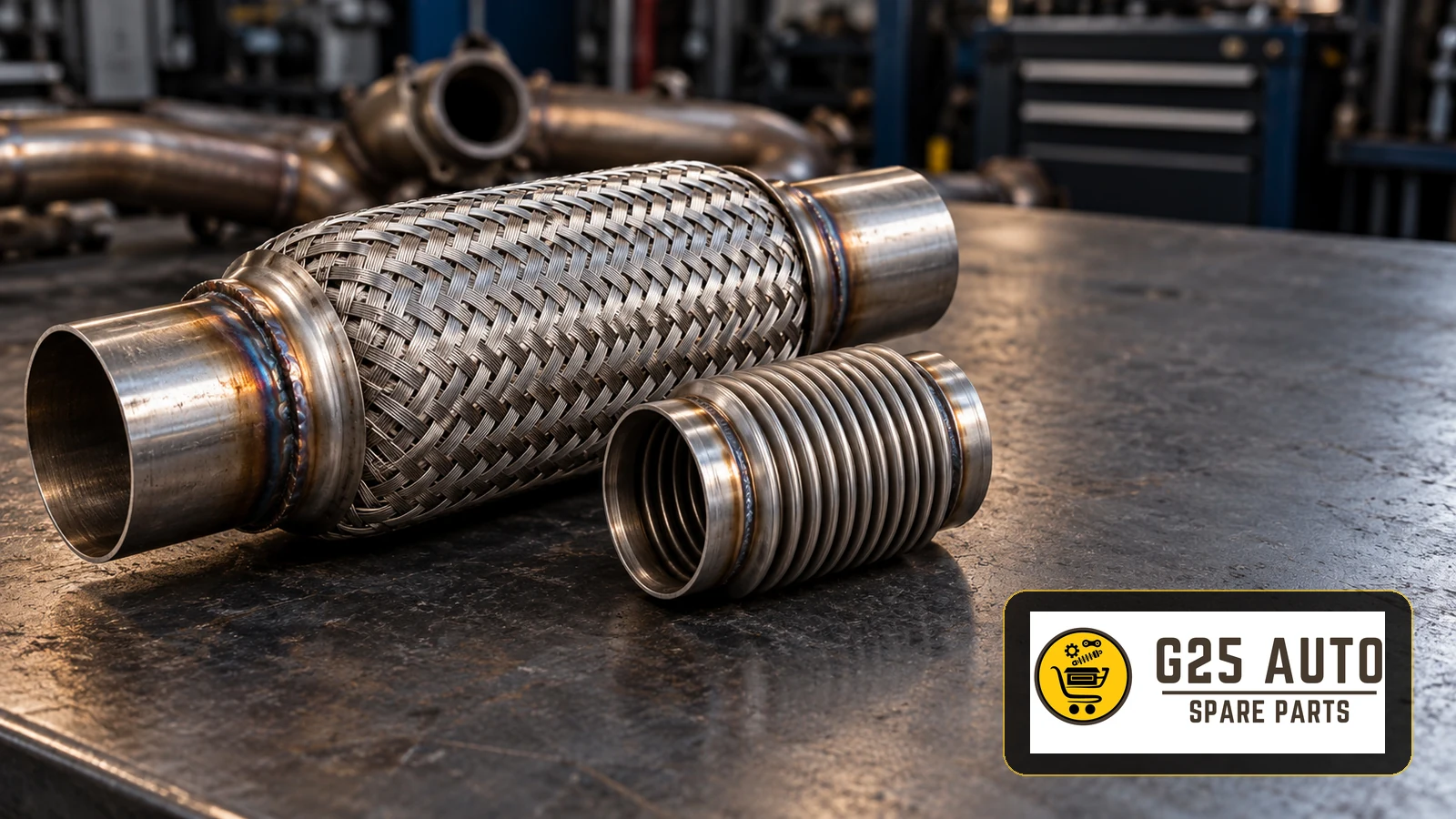
Exhaust flex pipes and flexible joints accommodate vibration and movement between the engine and fixed exhaust supports. This flexibility helps reduce stress and the risk of cracks in the system.
What Are Exhaust Flex Pipes and Flexible Joints?
Flexible exhaust sections can use corrugated metal construction, sometimes covered by woven wire reinforcement. Their shared purpose is to absorb movement and reduce stress on the exhaust assembly.
Engine vibration affects the manifold, catalytic converter, silencer and rear pipework. Without suitable flexibility, welds and flanges can suffer fatigue damage.
Functions of Flex Pipes and Flexible Joints
Vibration Absorption
Engine mounts reduce movement; flexible exhaust sections accommodate some remaining vibration.
Allowing Thermal Expansion
Hot exhaust metal expands. Flexible joints help accommodate this movement.
Installation Tolerance
Flexibility accommodates limited movement within the intended design; it should not compensate for incorrect alignment.
Reducing Noise and Vibration
Flexible construction can reduce vibration transmitted through the exhaust system into the cabin.
Fault Symptoms
These symptoms require professional investigation and do not confirm a faulty flexible section by themselves.
Common Symptoms
- Unusual exhaust noise: rattling, clattering or metallic rubbing.
- Exhaust smell: particularly noticeable during stopping and starting.
- Visible leakage: escaping exhaust near the flexible section.
- Increased vibration: felt through the steering wheel or pedals.
- Reduced power: may accompany an exhaust problem, without identifying its cause.
- Increased fuel consumption: another possible, nonspecific symptom.
- Engine warning light: requires diagnosis; a leak may affect sensor readings.
Checks Needed for Diagnosis
A workshop inspection may include:
- Inspecting the underside exhaust system with the vehicle safely supported.
- Checking flexible sections for cracks, holes and wear.
- Examining welds.
- Testing flange connections for leaks.
- Assessing vibration under appropriate workshop conditions.
- Analysing exhaust gases where necessary.
Note: Catalytic converter faults, manifold gasket leaks, damaged engine mounts and silencer damage can produce similar symptoms.
Original and Aftermarket Parts Compared
| Factor | Original part | Aftermarket part |
|---|---|---|
| Manufacturer | Vehicle manufacturer or its supplier | Independent manufacturer |
| Fitment | Confirm the exact application | Confirm the exact application |
| Quality requirements | Review product specifications | Review product specifications and relevant documentation |
| Availability | Ask the supplier | Ask the supplier |
| Warranty | Check applicable terms | Check applicable terms |
| Cost | Varies | Varies |
| Range | Application dependent | Designs and specifications vary |
Checklist for Choosing the Correct Part
European and Balkan workshops and trade buyers can use the following checks.
Technical Verification
- Record the vehicle identification number (VIN).
- Identify the engine code.
- Check the production date.
- Record any existing original or OEM part reference.
- Identify the exhaust layout and fuel type.
- Confirm pipe diameter and section length.
Before Ordering
- Assess supplier reliability.
- Review relevant product documentation.
- Read warranty terms.
- Confirm the returns policy.
- Ask which gaskets, clamps or bolts the installation requires.
On Receipt
- Check packaging and the accessible part for damage.
- Compare the supplied part number with the order.
- Inspect manufacturer and product markings.
- Retain invoices and warranty documents.
Why VIN, Engine Code and OEM References Matter
Make and model alone may be insufficient. Exhaust systems can differ by engine, production period and equipment.
Vehicle Identification Number (VIN)
The VIN supports vehicle identification and catalogue checks; it does not independently guarantee fitment.
Engine Code
Different engines within one model can have different manifolds, pipe diameters and connections. Include the engine code when checking an application.
OEM or Original Part Reference
An existing reference can help identify a replacement. Confirm any alternative against application data and physical specifications.
Production Date
Mid-year revisions can affect exhaust components. The production date helps distinguish these changes.
Choosing Original or Aftermarket
There is no universal answer; suitability depends on the application and requirements.
When Might an Original Part Be Preferred?
Review applicable warranty terms. Original specification may also matter for classic vehicles, authenticity or particular performance applications.
When Can an Aftermarket Part Be Considered?
A suitable aftermarket part may be an option when its construction, application and documentation meet the vehicle’s requirements. Certification alone does not establish fitment or service life.
A Mixed Approach
Purchasing decisions may combine original and aftermarket parts according to vehicle use, requirements and budget.
What to Consider When Sourcing Parts
Compare suppliers carefully when purchasing flexible exhaust sections.
Useful Supplier Capabilities
- A relevant product range.
- Technical support.
- Clear returns and warranty terms.
- Application guidance.
- Vehicle identification and engine-code checks.
- Identifiable products with relevant documentation.
Installation and Maintenance Advice
Professional Installation
Incorrect installation can cause leaks, premature failure or damage elsewhere. Use a qualified workshop.
Regular Inspection
Follow the applicable inspection schedule. Road salt and moisture can contribute to corrosion; early detection helps limit damage.
Remember Associated Parts
Check which gaskets, clamps and fasteners require replacement under the installation instructions.
Frequently Asked Questions
How Long Does a Flex Pipe Last?
Service life varies with use, road conditions, construction and installation. Inspect its condition rather than relying on a universal mileage.
How Does a Faulty Flexible Joint Become Noticeable?
Metallic noise, exhaust smell or visible cracking can prompt inspection; none confirms the cause alone.
Can Only the Flexible Section Be Replaced?
A local repair may be possible. Damage to surrounding welds or pipework can require more extensive work.
Does an Aftermarket Flex Pipe Affect Performance?
Suitability depends on the correct diameter, length, flexibility and application, rather than the original or aftermarket label alone.
Does Replacement Affect Vehicle Registration?
Check requirements in the destination market; registration and emissions obligations should not be assumed identical across countries.
Is Stainless Steel Better?
Corrosion resistance is useful, but material choice must match the application. Material name alone does not establish durability.
Do Diesel and Petrol Vehicles Differ?
Exhaust conditions and designs differ. Identify the engine and fuel type when ordering.
Can Parts Be Ordered Reliably Online?
Assess the supplier’s references, technical support and vehicle-identification process before ordering.
Conclusion
Flexible exhaust sections accommodate vibration and thermal movement. Inspect symptoms professionally, confirm vehicle and part details, compare documented options and arrange correct installation. These checks reduce selection errors without guaranteeing fitment or service life.