
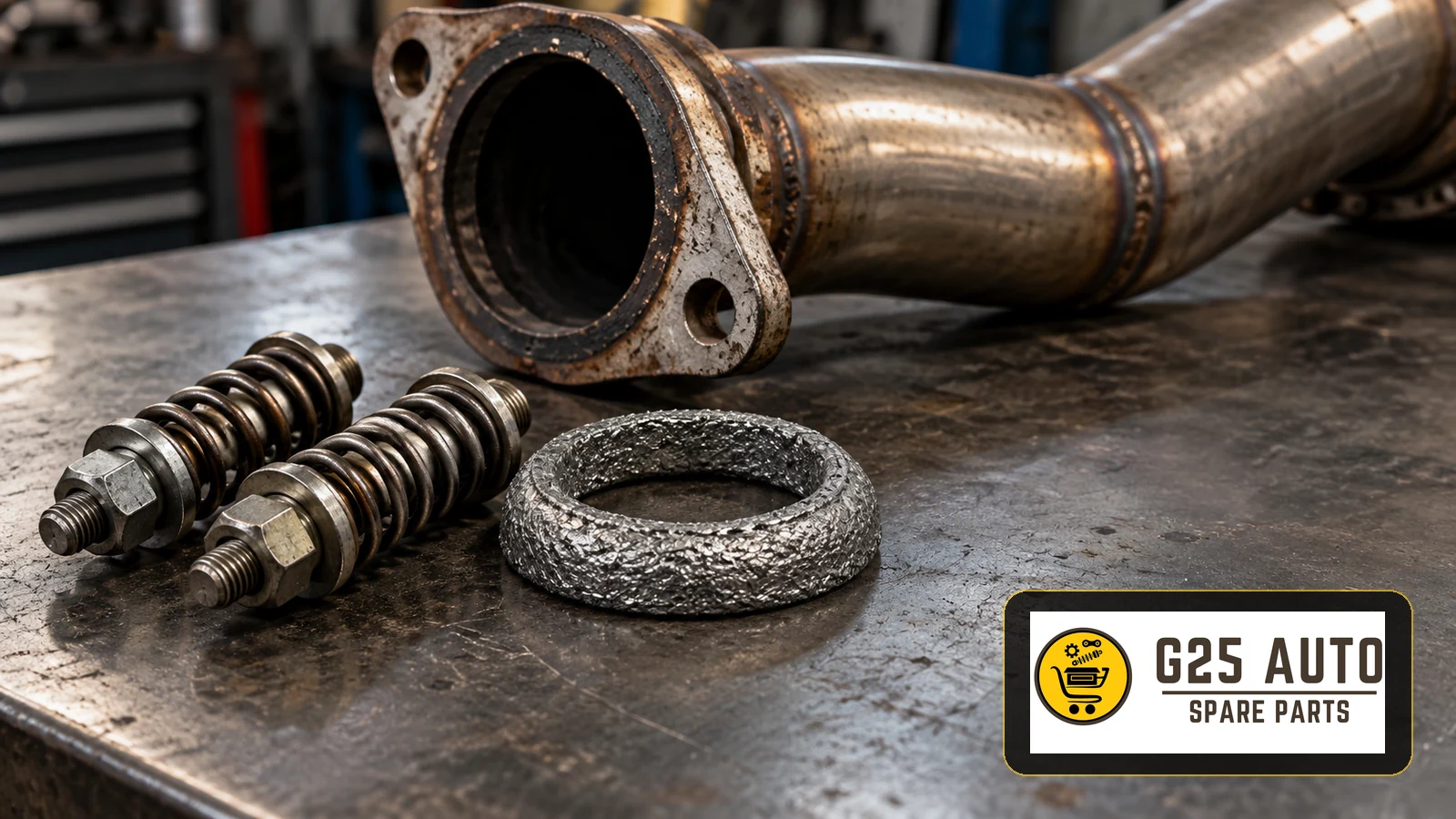
Exhaust flange spring bolts and ring gaskets secure and seal joints in an exhaust system. Where specified, the spring-loaded fastening arrangement accommodates thermal movement and vibration while maintaining pressure on the joint.
What are exhaust flange spring bolts and ring gaskets?
The exhaust system carries combustion gases away from the engine and includes components for noise reduction and emissions control. Flanges connect different sections. A spring bolt is a fastening component used in certain flange joint designs.
A helical spring around the bolt allows movement as the exhaust heats and cools. Its loading helps maintain the joint; the correct spring and fastening arrangement depend on the application.
The ring gasket sits between the mating surfaces to restrict gas leakage. Materials can include graphite, reinforced graphite or other heat-resistant constructions, according to the joint specification.
Failure symptoms and problems
Bolts, springs and gaskets can deteriorate through wear, damage or corrosion. Early inspection helps identify joint problems.
Observable symptoms
- Leak noise: ticking, crackling or blowing, sometimes more noticeable during cold starting.
- Reduced performance: investigate alongside other possible causes.
- Increased fuel consumption: this is not specific evidence of a flange fault.
- Exhaust smell: unusual odours inside or around the vehicle require assessment.
- Vibration: increased exhaust movement or noise.
- Visible soot: dark deposits around the connection.
Checks for a diagnosis
Professional inspection may include:
- Examining the exhaust with the vehicle safely supported on a workshop lift.
- Visually inspecting flange joints.
- Checking fastener condition and looseness.
- Testing the gasket area for leakage using an appropriate workshop method.
- Using thermal imaging where suitable equipment and procedures are available.
- Considering relevant emissions test results alongside the physical inspection.
Important: these symptoms do not establish that a spring bolt or gasket is faulty. A technician must assess the cause.
Choosing original equipment or aftermarket parts
Both routes require application checks. For European and Balkan B2B buyers, compare documented specifications and commercial terms.
Comparison table
| Factor | Original equipment part | Aftermarket part |
|---|---|---|
| Fitment | Check the listed vehicle application. | Verify the application and cross-reference. |
| Cost | Request the current quotation. | Compare quotations for the required specification. |
| Availability | Confirm with the supplying channel. | Confirm with the distributor. |
| Quality | Review the part specification. | Review manufacturer and material documentation. |
| Warranty | Check the applicable written terms. | Check the applicable written terms. |
| Range | Select the correct application and revision. | Check each offered variant against the application. |
What to check when selecting aftermarket parts
- Manufacturer documentation: examine relevant quality evidence without treating a general certificate as proof of fitment.
- Bolt material: confirm suitability for the specified thermal and corrosion conditions.
- Gasket material: match the required construction and heat resistance.
- Spring condition: check that the specified spring arrangement is intact.
- Workshop feedback: consider relevant experience alongside application data.
How to identify the correct part
An unsuitable bolt or gasket can cause assembly problems, early failure or leakage.
Information needed for application checks
OEM or part reference: record the existing reference and verify it against the catalogue. A reference alone does not guarantee compatibility.
Vehicle identification number (VIN): provide the VIN for a vehicle-specific catalogue check.
Engine code: different engines within one model range may use different exhaust arrangements.
Production date: changes within a model year may affect the required revision.
Part selection checklist
- Prepare the vehicle make, model and production year.
- Record the VIN.
- Identify the engine code.
- Check the existing OEM or part reference.
- Identify the flange location: front pipe, intermediate pipe or converter connection.
- Establish the required bolt and gasket quantities.
- Request a quotation from a reliable supplier.
- Confirm return and warranty terms.
- Arrange professional installation where required.
Installation and maintenance recommendations
Professional installation
Replacement requires suitable tools and technical knowledge. Key checks include:
- Follow the specified tightening procedure and torque, where given.
- Position the gasket correctly.
- Check that flange faces are clean and serviceable.
- Remove old gasket residue appropriately.
- Follow the prescribed tightening sequence; use a cross-pattern only where specified.
Maintenance and inspection
- Include exhaust joints in scheduled servicing.
- Investigate unusual exhaust noises promptly.
- Assess corrosion exposure after salted-road use.
- Inspect flange connections during other exhaust repairs.
Frequently asked questions
How often should exhaust flange spring bolts be replaced?
There is no universal replacement interval. Assess condition during servicing and exhaust repairs, and follow application-specific replacement instructions.
Is replacing only the gasket enough?
It may be appropriate if the bolts and springs remain serviceable and reuse is permitted. Check corrosion, spring condition and the required fastening procedure before deciding.
Can an ordinary bolt replace a spring bolt?
Do not substitute an ordinary bolt where a spring-loaded arrangement is specified. The connection relies on its intended fastening design.
Which gasket material is best?
Reinforced graphite is one possible construction. Choose the material specified for the joint rather than assuming one material suits every application.
What happens if the flange joint loosens?
Leakage, increased noise and movement can result. Escaping exhaust gases and stress around the flange require prompt professional attention.
Do all flange connections use the same bolts and gaskets?
No. Manifold, front-pipe, converter and intermediate connections may require different designs and sizes. Check each location separately.
Conclusion
Spring bolts and ring gaskets are small components with an important sealing role. Inspect their condition and replace them when required by the repair instructions or findings.
Use the part reference, VIN, engine code and production date together to verify selection. Compare original equipment and aftermarket options using application documentation. A reliable supplier and professional assessment support an appropriate repair; symptoms alone are insufficient for diagnosis.