
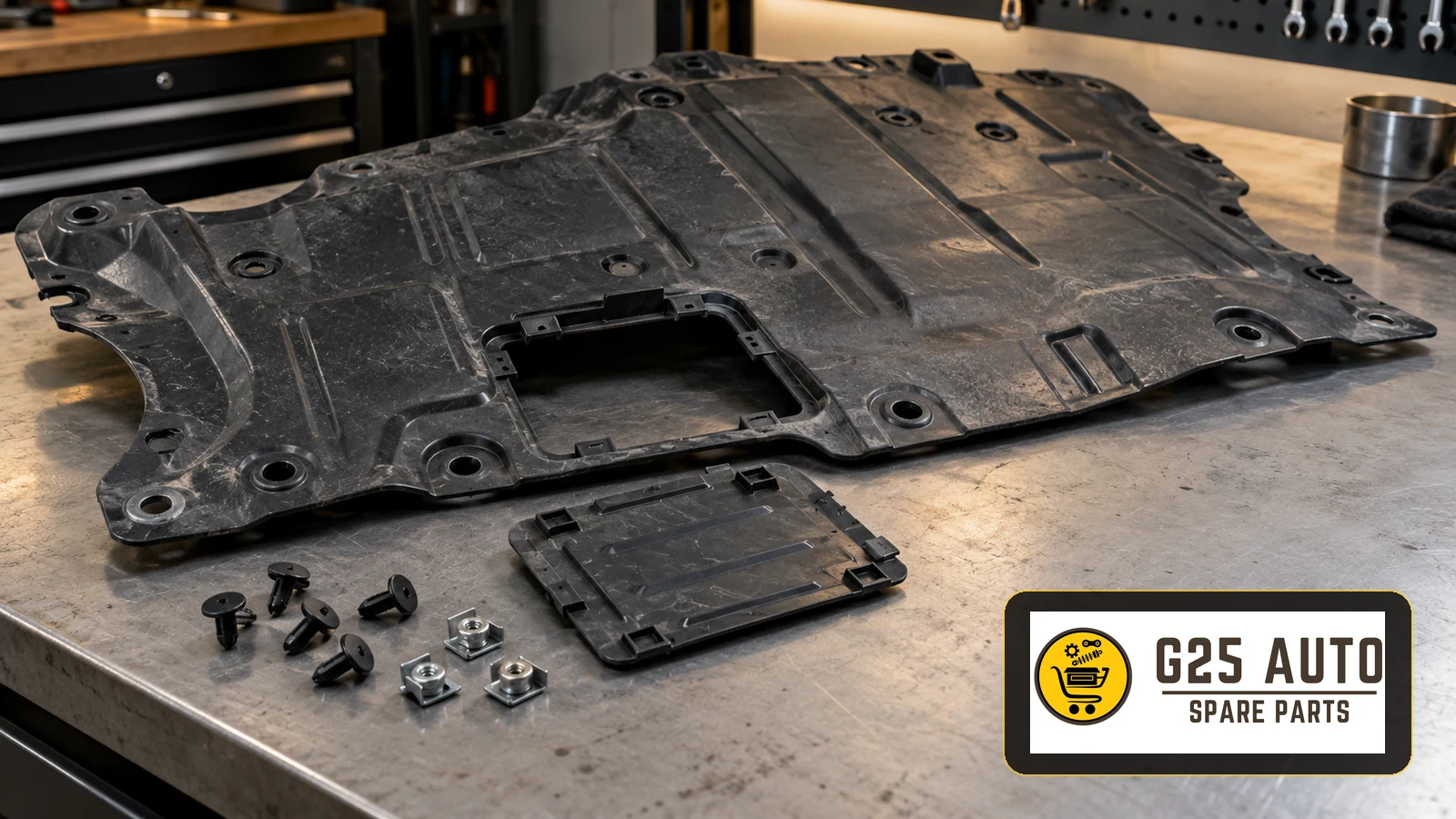
The engine undertray service hatch and its retaining clips help protect the engine compartment from road debris, mud and water from below. Briefly: the service hatch is the removable section of the undertray used for maintenance access, particularly oil servicing and inspection. Retaining clips are the plastic or metal fasteners securing the hatch and main panel to their mounting points. Missing or damaged components can leave the assembly loose and reduce its protection.
The Engine Undertray System and Its Components
An undertray system can consist of several parts. The main panel covers the underside of the engine compartment, while a service hatch may provide access around the sump or oil filter. Where this arrangement is fitted, suitable routine work can be carried out without removing the entire panel.
Functions of the Service Hatch
Depending on the vehicle design, the service hatch has several functions:
- Providing access during an oil change.
- Allowing access to the oil filter where the layout permits.
- Enabling inspections without removing the complete undertray.
- Forming a protective assembly together with the main panel.
- Maintaining the intended underside profile associated with the vehicle’s airflow design.
Why Retaining Clips Matter
Retaining clips are small components that are easily overlooked, but they keep the undertray and hatch in position. Different vehicles use different arrangements, including push retainers, expanding clips, pin retainers and screw-and-clip combinations. These types are not interchangeable simply because they look similar.
Fault Symptoms and Possible Problems
Problems with the service hatch or its clips may show up through several signs. These observations warrant inspection; they do not establish a diagnosis on their own.
Observable Symptoms
- Visible changes: hanging, missing or broken components beneath the vehicle.
- Noise: rattling, knocking or scraping from underneath while driving.
- Airflow noise: unusual noise around the undertray at higher speeds.
- Vibration: abnormal vibration at particular speeds or on particular surfaces.
- Visible damage: impact marks, cracks or torn sections.
- Contamination: more dirt or mud than usual around the engine compartment.
Further Signs Requiring Attention
- Unusual water accumulation around the engine compartment.
- Road debris reaching areas normally covered by the panel.
- Parts detaching from beneath the vehicle, including during braking.
- A hatch that no longer sits correctly after an oil change.
- Clips working loose or breaking.
Methods for Confirming the Fault
These symptoms can indicate a problem, but a professional inspection is needed to identify the cause. A workshop assessment should include the following checks.
Professional Inspection Steps
Visual inspection: with the vehicle safely raised, a technician examines the undertray and hatch for cracks, deformation, missing clips and installation problems.
Mounting-point inspection: each clip and attachment point is checked individually. The assessment includes the retainers, their receiving holes or brackets, and the specified tightening requirements wherever threaded fasteners are used.
Material condition: plastic or composite parts are inspected for cracking, looseness and signs of ageing such as changes in appearance. The condition of the component determines what further action is needed.
Functional check: the hatch opening and closing arrangement and the installation and removal of its retainers are checked to assess whether the parts function correctly.
Selecting the Correct Part and Checking Compatibility
Correct selection matters for undertray components. An unsuitable part can create fitting problems, repeated failures or a loose assembly.
Verification by OEM or Part Number
Use the relevant manufacturer’s part information to identify the required panel, hatch or retainer. To establish the correct reference:
- Check the vehicle’s original parts catalogue.
- Read any identification on the existing component.
- Ask an authorised service provider to confirm the part reference.
- Use the vehicle identification number when searching an appropriate parts catalogue.
Verification by Vehicle Identification Number
The vehicle identification number, or VIN, helps identify the vehicle in the parts catalogue. Relevant vehicle details to confirm include:
- Production year.
- Engine type.
- Body version.
- Production location where relevant to the application.
- Equipment specification.
Even within the same model, different production dates or engine versions may use different undertray systems. Check the actual vehicle application rather than relying on the model name alone.
Engine Code and Production Date
Confirm the engine code from the vehicle information available for the application. Undertrays can differ between engine versions within a model range. Production changes can also affect the required parts, so a shared model year does not by itself establish compatibility.
Comparing Original and Aftermarket Parts
When purchasing undertrays and clips, both original and aftermarket options may be available. Assess the particular part rather than assuming that either category guarantees a specific result.
| Feature | Original part | Aftermarket part |
|---|---|---|
| Compatibility | Confirm the correct vehicle reference and revision. | Confirm the listed application and mounting arrangement. |
| Quality specification | Check the specification of the selected original component. | Check the specification supplied by the manufacturer. |
| Cost | Obtain a current quotation. | Compare the quotation for the verified alternative. |
| Availability | Confirm availability for the specific reference. | Confirm availability for the specific alternative. |
| Warranty | Read the applicable terms. | Read the applicable terms. |
| Range of options | Check the applicable catalogue options. | Check the alternatives offered for the application. |
Points to Check When Choosing an Aftermarket Part
- Manufacturer reliability: assess the manufacturer’s established identity and product information.
- Material quality: check the stated material and its suitability for the application.
- Supporting documentation: examine what any certificates actually cover; a general quality document does not establish vehicle fitment.
- Warranty terms: check the coverage and duration offered for the product.
- Installation: select the correct component and confirm that the stated fit does not require unapproved modifications.
Retaining Clip Types and Selection
Common Clip Types
Push retainers: some designs lock through a central pin. Follow the installation and release method for the particular retainer.
Expanding clips: these use an expanding mechanism to retain the assembly. Their removal method depends on the design.
Screw-and-clip combinations: these combine a threaded fastener with a retaining component at the specified mounting location.
Metal hooked clips: these are used where the vehicle’s attachment design calls for them. Material alone does not establish a universal service-life advantage.
Selecting the Correct Clip
Always check the original part reference and application. Similar-looking retainers may differ in dimensions, retention characteristics and installation method. For a kit, verify that it contains the types and quantities required at the vehicle’s mounting points.
Engine Undertray Maintenance Checklist
Inspection can help identify loose or damaged parts. Use the vehicle’s service requirements and the component’s condition to determine timing; the following checklist is not a universal calendar interval.
Routine Visual Checks
- Inspect the visible underside where it can be viewed safely.
- Look for hanging or detached sections.
- Note unusual noises.
- Check that visible clips remain in place.
- Look for visible cracks or breaks.
Detailed Checks with the Vehicle Safely Raised
- Inspect the complete undertray assembly.
- Check each mounting point.
- Check how the service hatch opens and closes.
- Check that the retainers are secure.
- Look for deterioration in the panel material.
- Inspect for water and dirt accumulation.
Comprehensive Professional Inspection
- Have the assembly inspected in the workshop.
- Assess all fasteners.
- Replace clips where their condition or the applicable instructions require it.
- Assess the overall condition of the undertray and hatch.
- Determine whether any preventive replacement is justified by the inspection.
Installation and Maintenance Tips
Points to Consider During Installation
Fitting the undertray and service hatch requires attention to the attachment arrangement:
- Ensure that mounting points are clean and undamaged.
- Confirm the correct clip type and size before installation.
- Seat each retainer fully using its specified method.
- Avoid overtightening threaded attachments, which can damage plastic components.
- Check all mounting points after installation.
- Assess any abnormal noise or vibration during the workshop’s appropriate final checks.
Common Installation Errors
Incorrect clips: similar-looking retainers can be confused. Use the type specified for each position.
Missing attachments: leaving required mounting points unsecured can allow the assembly to loosen and become damaged.
Excessive force: forcing plastic components can crack or break them.
Misalignment: an incorrectly aligned hatch or panel can place strain on its retainers and lead to repeated problems.
Frequently Asked Questions
How often should an engine undertray service hatch be replaced?
Replacement depends on damage, deterioration and the applicable service requirements. Inspect its condition rather than assuming a fixed replacement age.
What happens when retaining clips break?
Broken clips can allow the undertray to loosen, make noise or detach. Inspect the complete mounting arrangement and replace damaged or missing retainers as required; the number visibly broken does not by itself determine the full repair.
Are aftermarket clips as durable as original clips?
Durability depends on the particular product, material and application. Do not infer equivalent performance from appearance, price or the aftermarket label alone. Check the manufacturer’s information and the vehicle fitment.
Can a vehicle be driven without its engine undertray?
The panel forms part of the vehicle’s intended underside arrangement, with protection and airflow functions depending on the design. Have a missing or damaged undertray assessed for the particular vehicle rather than assuming that removal is acceptable.
Is opening the service hatch sufficient for an oil change?
It depends on the vehicle’s layout and service procedure. The hatch may provide the required access, while other work can require removal of the complete panel.
Can I replace the clips myself?
Correct clip identification, inspection of every mounting point and safe access beneath the vehicle are essential. Professional assistance is advisable where these requirements cannot be met or the attachment method is unclear.
Conclusion
The service hatch and retaining clips form part of the engine undertray assembly. Although small, the retainers matter to secure attachment, while the hatch provides the access intended by the vehicle design.
Inspect the assembly and investigate early signs of trouble. When replacement is required, check the OEM or part reference, VIN, engine code and production date. Incorrect selection can result in fitting problems and recurring faults.
Evaluate original and aftermarket options using the actual product information and application. Professional installation helps ensure that the panel, hatch and fasteners are assessed together. Include the undertray in the vehicle’s maintenance checks so that damage and loose attachments receive attention.