
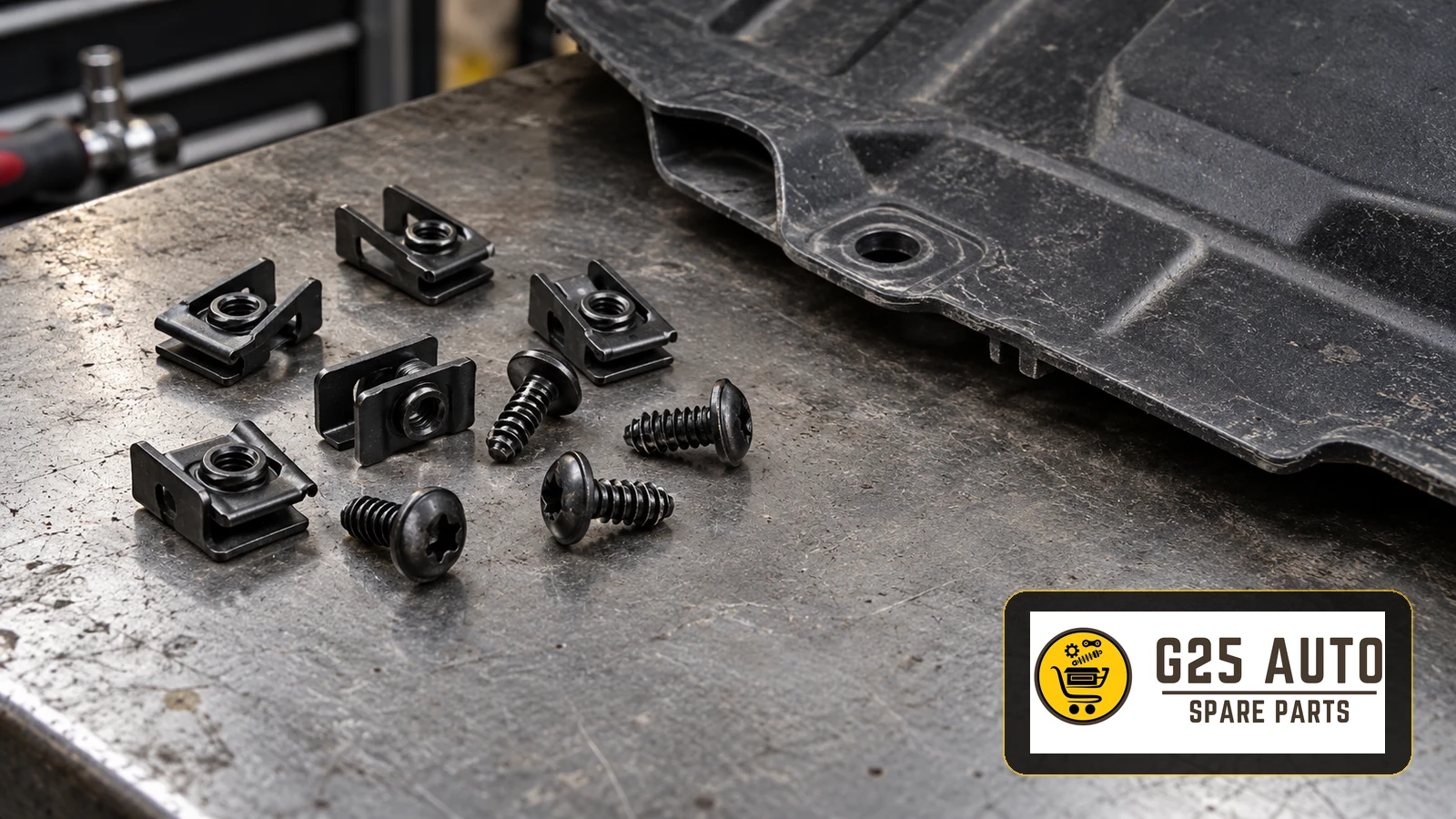
Engine undertray threaded metal clips and screws are fasteners used to secure the protective panel beneath a vehicle. Their location and design depend on the vehicle and panel. Correctly selected, intact fasteners help keep the undertray seated at its intended mounting points.
Why Engine Undertray Fasteners Matter
The engine undertray helps shield the underside of the engine compartment from stones, grit, water and mud. To perform its intended role, the panel needs sound mounting points and correctly installed fasteners. Threaded metal clips and screws are part of that mounting system.
Fasteners can wear, corrode or break. Rough roads, off-road use and prolonged service can expose them to damage. Missing or damaged clips and screws can allow the panel to loosen; a badly secured panel may detach.
Fault Symptoms: When Is Replacement Needed?
Possible signs of a problem with the undertray mounting hardware include:
- Rattling or squeaking from beneath the vehicle.
- Unusual noise over speed bumps or when cornering.
- An undertray that visibly hangs down or appears distorted.
- A panel that does not sit properly or has gaps at its mounting points.
- Loose or visibly missing screws.
- Broken or deformed clips.
- Corrosion that prevents a screw from tightening or being removed normally.
Checks Needed to Establish the Cause
These symptoms do not necessarily originate from the undertray fasteners. A professional inspection is needed to establish the cause:
- Raise and support the vehicle safely for a detailed underside inspection.
- Inspect every mounting point individually.
- Check the condition of the clips, their spring action where applicable, and the threads.
- Check screw security against the applicable fastening instructions.
- Inspect the vehicle-side mounting points for damage.
- Examine the undertray itself for distortion.
OEM Part References and Verification
Undertray hardware varies with vehicle model, engine and production version. The following information helps identify and verify the correct replacement:
Information Required
- Vehicle identification number (VIN): helps establish the vehicle configuration for catalogue checks.
- OEM part reference: the original equipment manufacturer’s part number, where available.
- Engine code: relevant where mounting hardware differs between engine versions.
- Production date: changes can occur with model revisions and facelifts.
- Equipment specification: particular equipment versions may use different components.
Vehicle documents, identification labels and workshop information systems may provide these details. Verify the catalogue application before ordering: an incorrect fastener can waste time and require a replacement order.
Comparing Original Equipment and Aftermarket Parts
| Feature | Original equipment part | Aftermarket part |
|---|---|---|
| Compatibility | Verify the exact part reference and vehicle application. | Verify the supplier’s application and relevant part-reference match. |
| Material quality | Check the specified construction for the selected part. | Construction varies; assess the documented specification. |
| Availability | Confirm with the supplier. | Confirm with the supplier. |
| Warranty | Check the applicable terms. | Check the applicable supplier and manufacturer terms. |
| Price | Obtain a current quotation. | Compare current quotations for verified suitable parts. |
| Choice | Select the reference specified for the application. | Different offerings require individual compatibility and quality checks. |
What to Check When Choosing an Aftermarket Part
Aftermarket fasteners do not all have the same specification. Assess a proposed replacement on its documented suitability and construction rather than assuming that appearance or price establishes equivalence.
Quality Checklist
- The manufacturer’s experience and traceable references.
- Relevant quality documentation and the actual scope of any certification.
- The material specification and its suitability for the intended mounting point.
- Warranty duration and conditions.
- The clarity of the installation instructions.
- Available user feedback, assessed as background information rather than proof of compatibility.
- Clear return and exchange terms.
- Availability of technical support.
Clip Types and Their Features
Undertray mounting systems use different fastener designs. Identify the actual mechanism before choosing a replacement; a push fastener, a turn-lock fixing and a threaded clip are not automatically interchangeable.
Push-Type Clips
Push-type fasteners are inserted into a mounting hole and retained by their particular locking arrangement. Check the actual design and material rather than assuming that every push-type fixing contains a metal threaded section.
Twist-Lock Clips
Some turn-lock fasteners are inserted and rotated to engage. Follow the instructions for the particular fixing; the mechanism alone does not establish that it provides greater grip or vibration resistance than another design.
Combined Clip-and-Screw Systems
Some vehicles use a clip together with a screw. Both components must match the mounting arrangement. Check that the clip is seated correctly and that the screw engages as intended.
Installation and Replacement
Replacing undertray clips and screws requires care. Professional installation is recommended. The following preparation and inspection outline must be read alongside the vehicle-specific procedure.
Preparation Before Installation
- Park on a level, firm surface.
- Apply the parking brake and select the appropriate secure transmission position.
- Raise and support the vehicle using suitable equipment and the vehicle’s specified lifting points.
- Clean the working area and provide adequate lighting.
- Prepare the required tools, such as the appropriate screwdriver, pliers and torque wrench where specified.
Removal Steps
- Identify all the fasteners securing the panel.
- Support the undertray and release the clips and screws in the sequence specified for the vehicle.
- Carefully remove broken or damaged fasteners.
- Clean the mounting points and inspect for corrosion.
Installing the New Parts
- Check that the new clips and screws are the correct type.
- Position the fasteners at the mounting points without forcing them.
- Ensure that the panel sits correctly.
- Follow the prescribed fastening sequence.
- Use the applicable tightening specification; values vary by vehicle and fixing.
- Make a final check of all mounting points.
Maintenance and Service-Life Considerations
Routine attention can help identify undertray mounting problems before the panel becomes insecure:
- Include the fasteners in relevant service inspections.
- Have accumulated road salt and contamination addressed using a suitable cleaning method.
- Inspect the mounting points after off-road use.
- Use corrosion-protection products only where compatible with the materials and service instructions.
- Investigate loose screws and restore security according to the specified procedure.
- Replace damaged clips promptly.
Sourcing Parts and Choosing a Supplier
Purchasing Checklist
- Have the VIN available.
- Record the existing part’s OEM reference where identifiable.
- Compare price and documented quality between suppliers.
- Review the warranty terms in detail.
- Check the return policy.
- Confirm shipping arrangements and delivery estimates.
- Ask whether installation instructions are supplied.
Frequently Asked Questions
What happens if an engine undertray clip breaks?
The panel can become loose at that mounting point. It may move or make noise while driving, and an inadequately secured panel can detach. Have a broken clip and the surrounding mounting point checked promptly.
Must all clips and screws be replaced together?
There is no universal requirement. Inspect the remaining fasteners and follow the vehicle’s instructions on reuse and replacement. Similar age alone does not establish that every fastener needs replacement.
Can a plastic clip replace a threaded metal clip?
Do not substitute a different design or material without confirming that it is approved for that mounting point. Use the specified fastener arrangement.
Why does tightening torque matter?
Insufficient tightening can leave a fixing insecure, while excessive tightening can damage the screw or mounting point. Follow the specification applicable to the particular fixing rather than using a generic value.
Can an aftermarket part affect the vehicle warranty?
This depends on the relevant warranty terms and the circumstances of the replacement. Check the terms with the responsible warranty provider rather than assuming that a small fastener cannot affect a claim.
How often should the fasteners be checked?
Follow the vehicle’s service and inspection guidance, with attention to demanding operating conditions. Investigate unusual underbody noise promptly; a universal mileage interval is not appropriate for every vehicle.
Conclusion
Engine undertray clips and screws are small components with an important role in keeping the protective panel secured. Inspection, replacement of damaged hardware and correct part selection all contribute to maintaining the mounting system.
Verify the vehicle configuration, OEM reference where available, engine version and production details when selecting replacements. Compare original equipment and aftermarket options using documented compatibility, material information and applicable warranty terms.
Installation requires suitable knowledge and equipment. Seek professional help if needed, and follow the vehicle-specific procedure so that the undertray is correctly seated and secured.