
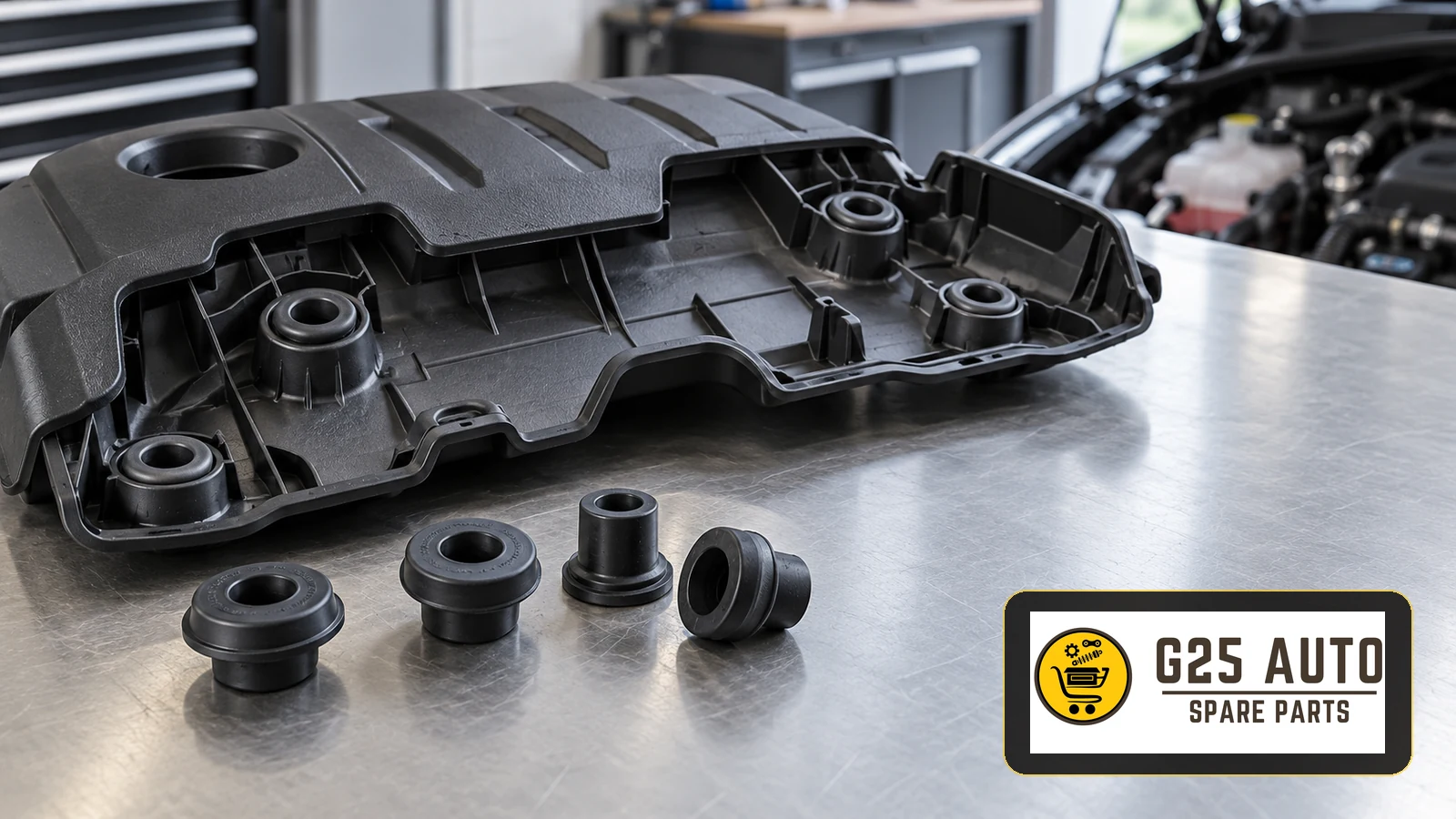
Rubber mounts and mounting bushes for the plastic engine top cover help absorb vibration at its attachment points. Wear, hardening or breakage can allow noise and cover movement and may contribute to damage to the plastic cover.
What Are Engine Top Cover Mounts and Bushes?
The plastic engine top cover sits above the engine and often carries the vehicle manufacturer’s logo. Its appearance and noise-reduction function depend on the design.
Rubber mounts and mounting bushes are used where this plastic cover attaches to the engine. Their main functions include:
- Reducing the engine vibration transmitted to the plastic cover
- Limiting direct contact and wear between plastic and metal
- Allowing flexibility for movement associated with thermal expansion
- Providing a secure connection when correctly fitted
- Helping control noise and vibration at the cover
Fault Symptoms
Problems with engine top cover mounts and bushes can produce several signs. Recognising them helps arrange an inspection before damage develops.
Common Symptoms
- Rattling and tapping: Plastic noises around the cover when engine speed changes or during acceleration
- Unusual under-bonnet noises: Vibration-related sounds heard while the engine runs
- Visible wear: Cracks, breakage or crushing around the cover or its mounting points
- Cover movement: Looseness or movement of the top cover
- Oil traces: Oil beneath the cover requires separate investigation; it does not establish a fault in a cover mount
- Visual changes: Hardening, discolouration or deterioration of rubber mounts
Interpreting the Symptoms
These symptoms do not necessarily mean that the cover mounts or bushes are faulty. Similar noises may come from engine support mounts, exhaust hangers or bonnet hinges. A professional inspection is needed to establish the cause.
Inspection and Diagnosis
The following checks help assess the condition of the engine top cover mounts and bushes.
Visual Inspection Checklist
- Switch off the engine and allow it to cool before opening the bonnet and inspecting components
- Inspect the engine top cover and its attachment points
- Check rubber mounts for cracks, tears or deformation
- Assess whether the mounts have hardened, following the relevant inspection guidance
- Check whether mounting bushes have become displaced
- Compare the cover’s seating and clearance at its attachment points with the intended arrangement
- Look for damage to bolts and fixing points
- Check beneath the cover for oil accumulation or leakage requiring investigation
Functional Check
Excessive cover vibration or movement during operation can indicate a mounting problem. Any running-engine observation should be performed safely by a professional, keeping clear of moving and hot components.
Original and Aftermarket Parts Compared
Original and aftermarket engine top cover mounts and bushes are available. Assess the specific product and application rather than assuming that either category guarantees suitability.
| Feature | Original Part | Aftermarket Part |
|---|---|---|
| Compatibility | Verify the correct original reference and vehicle application | Verify the cross-reference and documented vehicle application |
| Material quality | Check the specified product requirements | Check the manufacturer’s documented material and performance information |
| Price | Confirm the current quotation | Confirm the current quotation |
| Supply time | Confirm availability with the supplier | Confirm availability with the supplier |
| Warranty | Check the applicable manufacturer and supplier terms | Check the applicable manufacturer and supplier terms |
| Range | Application-specific references | Application coverage varies by manufacturer |
What to Check When Choosing Aftermarket Parts
Consider the following points when assessing an aftermarket option:
- The manufacturer’s experience and traceable references
- Documented material quality and durability testing
- Customer feedback and reported use, assessed alongside technical documentation
- The seller’s warranty conditions
- Return and exchange policies
Choose a traceable supplier and verify the relevant product information before ordering.
Identifying the Correct Part
The most important step is identifying a part suitable for the vehicle. Incorrect selection can cause fitting problems and premature failure.
Part Verification Checklist
- OEM or part reference: Record the original reference from the existing part or relevant vehicle documentation where available
- VIN: Use the vehicle identification number to verify the exact application
- Engine code: Establish the engine variant, as cover arrangements can differ within one model
- Production date: Check the production year and, where relevant, month for specification changes
- Equipment level: Check whether the equipment package affects the cover used
- Market differences: Confirm the applicable market specification where versions differ
Why Is This Detail Necessary?
Engine compartments can vary with engine options, power variants and production years even within the same make and model. The vehicle’s make and model alone may therefore be insufficient for correct selection.
Small dimensional differences in rubber mounts and bushes can cause fitting problems. Confirm the application with the supplier or manufacturer rather than relying on appearance alone.
Installation and Replacement
Replacing engine top cover mounts and bushes requires suitable mechanical knowledge and the procedure for the particular cover arrangement.
General Installation Steps
Depending on the design, professional replacement generally involves:
- Allowing the engine to cool completely
- Disconnecting any cover connections where fitted and required by the procedure
- Removing fixing bolts where used
- Removing the old mounts and bushes
- Positioning the replacement components correctly
- Securing the cover, using specified torque where bolted fixings are present
- Checking the connections
- Performing a safe operational check
Points Requiring Attention
- Plastic components can be brittle; avoid excessive force
- Use specified bolt torque, as overtightening can damage plastic
- Observe the correct orientation of rubber mounts
- Inspect any associated sealing components where fitted, following the relevant procedure
- Check all connections after installation
Service Life and Maintenance
The service life of engine top cover mounts and bushes depends on their condition and operating environment. Several factors can affect deterioration.
Factors Affecting Service Life
- Operating conditions: Repeated stop-start operation and demanding use affect the environment around the engine
- Climate: Extreme heat or cold can affect rubber components
- Engine condition: Excessive engine vibration can place additional stress on cover mounts
- Maintenance: Regular inspection helps identify deterioration and related engine problems
- Material quality: Rubber formulation and suitability affect durability
Maintenance Recommendations
- Carry out periodic visual inspections
- Avoid directing high-pressure cleaning water at the mounts
- Keep the engine compartment clean and investigate oil and dirt accumulation
- Arrange assessment and replacement where hardening impairs the component’s function
- Do not postpone investigation of rough running or excessive engine vibration
Frequently Asked Questions
How Often Should Engine Top Cover Mounts Be Replaced?
There is no single replacement interval for every application. Follow the vehicle guidance and assess wear, cracking and loss of function when deciding whether replacement is necessary.
Must the Entire Cover Be Replaced Instead of Just the Mount?
Mounts and bushes may be replaceable separately where the design allows it. Inspect the cover for cracks and other damage before deciding which components are needed.
Can Aftermarket Mounts Affect the Vehicle Warranty?
If the vehicle remains under warranty, check the applicable conditions with the relevant service provider. Verify the suitability of the chosen replacement rather than assuming that its supply category establishes compatibility.
Should All Mounts Be Replaced Together?
If one mount is faulty, inspect the others because they may have similar age and exposure. Whether to replace several together depends on their condition and the applicable service guidance.
Are Small Cracks in a Rubber Mount Important?
Small surface cracks may develop further. Have the condition assessed and plan replacement where deterioration affects secure attachment or function.
Can I Replace the Mounts Myself?
Correct installation requires appropriate knowledge and tools. Incorrect fitting can cause damage or unsafe attachment. Seek professional assistance if the procedure or condition is uncertain.
Conclusions and Recommendations
Rubber mounts and mounting bushes for the plastic engine top cover are small components whose deterioration can result in noise and possible damage.
The key maintenance and replacement points are:
- Take symptoms seriously and arrange assessment before problems develop
- Use the original reference, VIN and engine information to identify the correct application
- Assess documented quality when comparing original and aftermarket parts
- Use a professional installer or follow the appropriate procedure with suitable care
- Carry out periodic checks to identify deterioration early
A traceable source and verified application information support correct procurement. Regular inspection, suitable replacement components and correct installation help maintain the intended cover attachment.
If a fault symptom appears, consult a qualified workshop so that the cause can be diagnosed before replacement decisions are made.