
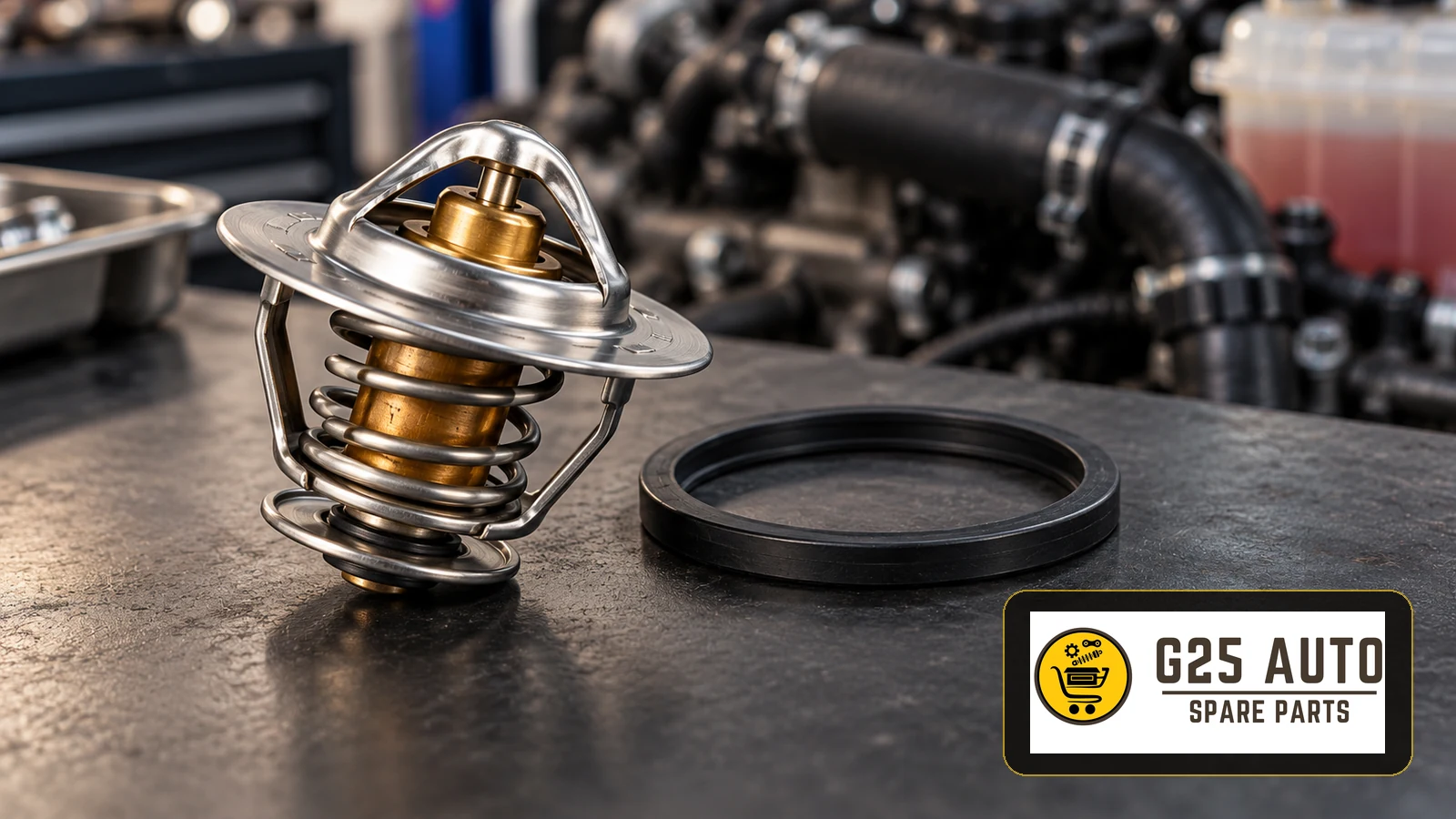
An engine thermostat is a small but important part of the cooling system that helps the engine reach its intended operating temperature. It regulates coolant flow between the engine and radiator. A faulty thermostat can affect engine performance and fuel consumption, and cooling system faults can lead to serious engine damage.
Engine Thermostat Functions and Operating Principle
The thermostat helps regulate the cooling system. During a cold start, a conventional thermostat restricts coolant flow to the radiator, helping the engine warm up and reach its specified operating temperature.
When the specified temperature is reached, the wax-like material inside the thermostat expands and opens the valve. Coolant can then flow through the radiator, release heat and return to the engine. As temperature falls, the thermostat partially or fully closes to help maintain the temperature balance.
Main Thermostat Components
A conventional engine thermostat has the following main components:
- Thermal element: A capsule containing temperature-sensitive wax.
- Valve mechanism: The valve that controls coolant flow.
- Spring: The spring used to hold the valve closed.
- Housing: The metal or plastic casing that holds the components.
- Sealing surfaces: Surfaces designed to provide a leak-tight connection.
Symptoms of Engine Thermostat Faults
Thermostat faults may produce recognisable symptoms. These symptoms are not a definite diagnosis, however, and require professional assessment.
Possible Signs of a Thermostat Fault
- Unusually slow engine warm-up: A temperature gauge that does not reach its normal position, particularly in winter, may indicate a thermostat stuck open.
- Engine overheating: A gauge entering the red zone may be associated with a thermostat stuck closed.
- Insufficient cabin heating: Cabin heating may be reduced when the engine does not warm up adequately.
- Increased fuel consumption: An engine running too cold may use more fuel.
- Engine warning light: Coolant temperature abnormalities can produce fault codes on some vehicles.
- Radiator hose temperature differences: Uneven hose temperatures may warrant checking thermostat operation, but do not establish the cause alone.
- Reduced performance: Engine efficiency may suffer outside the intended operating temperature range.
A Definite Diagnosis Requires Professional Checks
The symptoms above can suggest a thermostat fault. A professional workshop can assess the cooling system using checks appropriate to the vehicle, including:
- Cooling system pressure testing.
- Measuring thermostat opening temperature with suitable test equipment.
- Checking engine temperature sensor data with a diagnostic scanner.
- Inspecting the radiator and hoses.
- Checking water pump operation.
- Checking coolant level and condition.
When Thermostat Replacement Matters
An engine thermostat does not have a universal replacement mileage. Replacement should follow a confirmed fault and the vehicle manufacturer’s maintenance or repair requirements. General mileage or age suggestions cannot replace guidance for the specific vehicle.
Risks of Driving with a Faulty Thermostat
Continuing to drive with a cooling system fault can have serious consequences. Depending on the fault and operating conditions, these may include:
- Damage to the engine block or cylinder head from overheating.
- Cylinder head gasket damage.
- Deterioration of engine oil performance.
- Increased emissions.
- Damage affecting the exhaust after-treatment system.
- Reduced engine service life over time.
Original and Aftermarket Engine Thermostats Compared
Once thermostat replacement is required, original and aftermarket options may be available. Compare the actual application and product documentation rather than assuming that either category guarantees fit, quality or durability.
Comparison Table
| Feature | Original thermostat | Aftermarket thermostat |
|---|---|---|
| Vehicle compatibility | Confirm the correct vehicle manufacturer’s reference. | Confirm the listed application and reference cross-match. |
| Quality standards | Check the specifications of the identified product. | Check product evidence; a general certification alone does not prove compatibility. |
| Warranty | Check the applicable warranty terms. | Terms depend on the product and supplier. |
| Supply | Confirm availability for the required reference. | Confirm availability for the verified alternative. |
| Opening temperature | Verify the specification required by the vehicle. | Verify that the specified application requirements are met. |
| Durability | Do not assume a universal service life. | Do not assume equal durability without product-specific evidence. |
Which Option Suits Your Needs?
Either option needs to meet the vehicle’s requirements. When making a selection, consider:
- Vehicle age and value: These may influence purchasing preferences.
- Budget: Compare the actual offers for compatible products.
- Brand reliability: Evaluate the identified product and its supporting information.
- Warranty conditions: Check any requirements that apply to the vehicle and repair.
Checklist for Selecting the Correct Thermostat
Identifying the correct thermostat before purchase is important. An unsuitable part can interfere with cooling system operation and may contribute to engine damage.
Before You Buy
- Have the vehicle identification number, or VIN, ready.
- Identify the engine code, using the vehicle documentation or engine identification details.
- Establish the production year and month; changes can occur within the same model.
- Record the part reference on the existing thermostat.
- Check the specified opening temperature for the application.
- Ask whether gaskets and sealing components are included.
- Check whether the thermostat housing also requires replacement.
- Ask the supplier to document compatibility.
- Check the product’s warranty period and conditions.
- Ask whether installation instructions are available in a language the installer understands.
Why Part References and Compatibility Checks Matter
Correct part identification is the critical step in selecting an engine thermostat. Different engine versions, production years or equipment levels within the same vehicle model can require different thermostats.
Why Is the Original Part Reference Important?
The original equipment part reference identifies the manufacturer’s part. It provides a starting point for:
- Finding a listed aftermarket alternative with the required specifications.
- Reducing the risk of ordering the wrong component.
- Comparing alternatives offered by different suppliers.
- Checking compatibility before installation rather than assuming a cross-reference guarantees it.
Verification with the VIN and Engine Code
The VIN identifies the vehicle. Used with the relevant vehicle records or catalogue, it can help establish:
- The vehicle’s equipment specification.
- Its production details.
- Engine and transmission information.
- Relevant factory-installed equipment.
The engine code identifies the engine type more precisely. Engines with the same displacement but different outputs may use different thermostats.
Points to Check During Thermostat Replacement
Thermostat replacement requires mechanical knowledge. Professional workshop installation is recommended.
Checks During the Replacement Process
- Allow the cooling system to cool completely: Working on a hot system carries a burn risk.
- Drain coolant correctly: Use suitable collection and disposal methods.
- Clean sealing surfaces: Old gasket residue can contribute to leakage.
- Use the required new seals: Follow the specified sealing requirements for the repair.
- Install the thermostat in the correct orientation: Follow the application-specific fitting instructions.
- Tighten fasteners correctly: Use the specified tightening requirements to avoid damage or leakage.
- Use the specified coolant: Follow the vehicle manufacturer’s coolant specification.
- Bleed the system: Follow the vehicle’s procedure to remove trapped air.
Choosing a Reliable Aftermarket Thermostat Supplier
Working with a reliable supplier is an important part of buying replacement components.
Features of a Reliable Supplier
Look for a supplier that:
- Provides detailed application information.
- Identifies original references and corresponding aftermarket references.
- Supports verification using the VIN and engine code.
- Explains product warranty conditions clearly.
- Provides access to customer feedback.
- States return and exchange policies clearly.
- Offers technical support or advice.
Frequently Asked Questions
How long does an engine thermostat last?
Service life depends on operating conditions, maintenance and coolant condition. No fixed mileage can be guaranteed for every thermostat.
Can I test a thermostat myself?
Observing whether a removed thermostat opens is not enough to confirm its opening temperature or sealing performance. Proper assessment requires suitable equipment and the applicable test procedure.
Is replacing only the thermostat enough?
The gasket or sealing ring generally also needs attention. Coolant renewal and housing replacement depend on the condition of the system and the vehicle’s repair requirements.
Is an aftermarket thermostat as durable as an original part?
Durability cannot be established from the original or aftermarket label alone. Check the identified product, its application, supporting quality information and supplier. Do not treat a general certification as proof of equal service life.
Can I fit a thermostat with a different opening temperature?
Use the specification required by the vehicle manufacturer. An unsuitable opening temperature can interfere with engine temperature regulation and engine management.
Can I remove the thermostat and drive without it?
Removing the thermostat is not a repair for a cooling system fault. It changes the intended temperature regulation and can affect warm-up, fuel consumption and emissions. Restore the system to the correct specification.
Conclusion
Despite its small size, the thermostat plays an important role in maintaining the engine’s intended operating temperature, supporting efficient operation and helping protect the engine.
Have possible thermostat fault symptoms checked promptly. They require diagnosis rather than an automatic replacement decision; an incorrect diagnosis can lead to unnecessary parts and expense.
Before choosing an original or aftermarket replacement, verify the VIN, engine code and original part reference. Purchasing without these checks increases the risk of incompatibility. Consider the vehicle’s requirements, your budget and the documented qualities of the product.
Select the correct specification from a reliable supplier and have the installation and related cooling system work carried out correctly.