
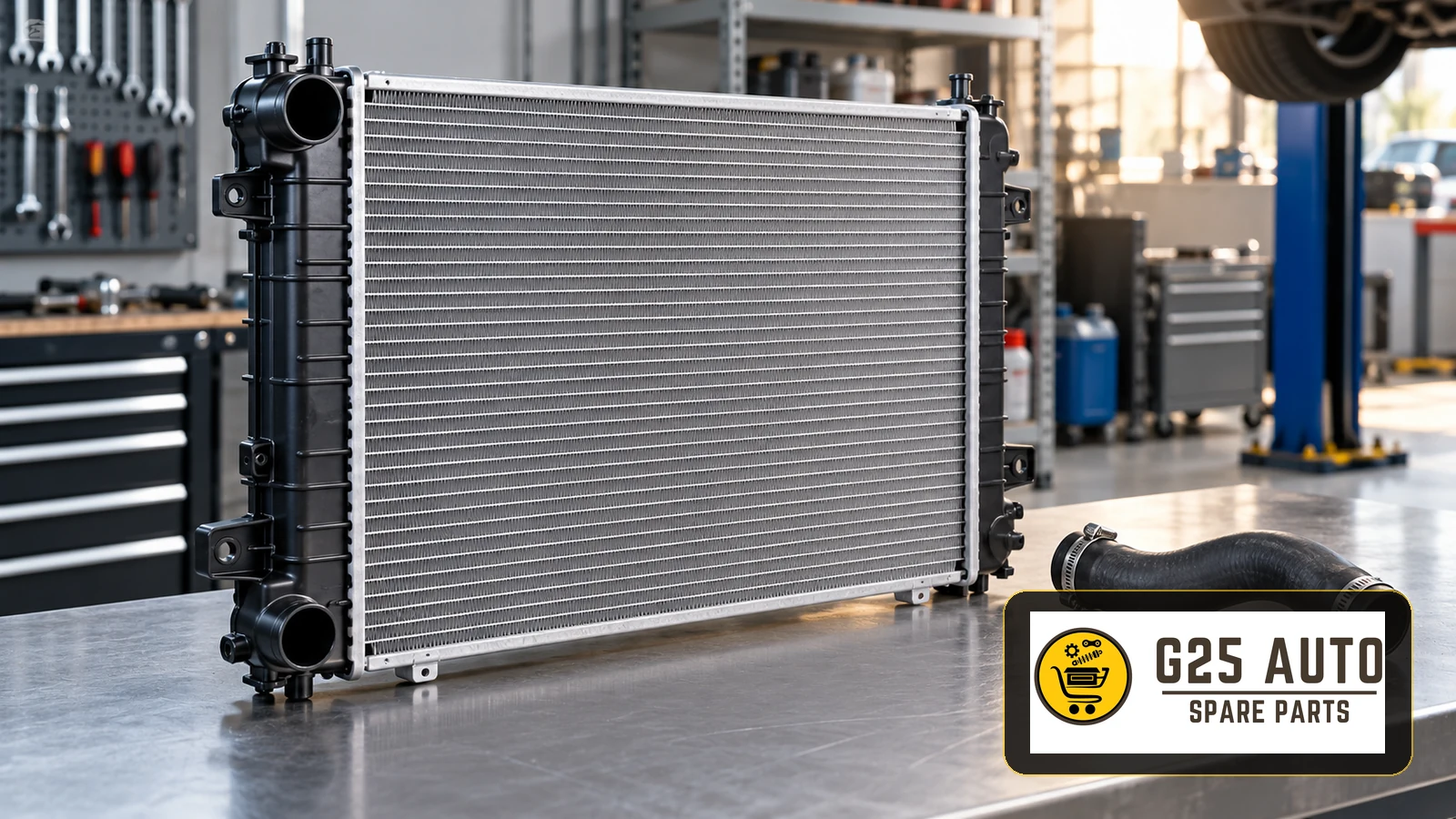
The engine radiator is a critical part of the cooling system, helping the engine stay within its intended operating temperature range. Coolant passes through its tubes while the fins transfer heat to the surrounding airflow. A radiator that does not work properly can contribute to overheating, head-gasket failure and engine damage.
What Is an Engine Radiator and How Does It Work?
The radiator is a heat exchanger that cools the fluid circulating through the engine before it returns. The water pump moves coolant through the engine block and cylinder head to absorb heat, then through the radiator to release it.
Radiators commonly use aluminium or copper-brass construction. Aluminium is widely used in modern vehicles, while copper-brass designs are common in older applications. The assembly contains tanks connected by tubes, with fins increasing the surface area available for heat transfer. Tank arrangement depends on the design.
Symptoms of Radiator Problems
Recognising symptoms early can help limit further damage. However, symptoms alone do not confirm a radiator fault; professional diagnosis is needed.
Common Symptoms
- Higher-than-normal engine temperature: A gauge approaching the red zone or a warning lamp may indicate a cooling-system problem.
- Repeated coolant loss from the expansion tank: Frequently needing to add coolant may indicate a leak.
- Fluid around the radiator or beneath the engine: Coolant stains where the vehicle is parked can indicate leakage.
- Physical damage to the fins: Fins bent by an impact or stones can restrict airflow.
- Internal blockage: Rust, mineral deposits or sediment can reduce cooling efficiency.
- A sweet smell while the engine is running: Evaporating coolant can produce a characteristic smell.
- Steam from beneath the bonnet: Overheating and boiling coolant may produce steam.
Symptoms Versus a Confirmed Diagnosis
These signs do not identify the radiator as the cause on their own. A faulty thermostat, damaged water pump, fan problems, leaking hoses or a failed head gasket can cause similar symptoms. Diagnosis may involve:
- Pressure-testing the cooling system.
- Inspecting the radiator internally where accessible.
- Checking coolant colour and condition.
- Examining the fins and tanks carefully for leaks.
- Testing the system components individually.
Arrange professional diagnosis when these symptoms appear.
Causes of Radiator Failure
Physical Damage
Collisions, kerb impacts, stones and road debris can damage a radiator. Its usual position near the front of the vehicle leaves it exposed to impacts.
Corrosion and Rust
Unsuitable coolant or neglected maintenance can contribute to internal corrosion. Systems using only water may be particularly vulnerable. Using the specified antifreeze mixture helps protect against corrosion.
Blockage
Mineral deposits, rust and sediment can accumulate in radiator tubes over time, restricting coolant flow and reducing cooling efficiency.
Seal and Connection Leaks
Seals between the tanks and core can deteriorate and leak. Hose connections are another potential leakage point.
Choosing an Original or Aftermarket Radiator
Replacement options include original equipment and aftermarket parts. Both require an assessment of their suitability for the particular vehicle.
Original Equipment Radiators
Original equipment radiators are supplied to the vehicle manufacturer’s specifications for the relevant application.
Potential advantages:
- A specification intended for the identified vehicle application.
- Manufacturer warranty coverage may apply.
- Defined quality requirements.
- A design intended to fit without additional modification when correctly selected.
Points to consider:
- Compare the actual quoted price.
- Check availability and lead time for the particular model.
- Confirm whether the part remains available for an older vehicle.
Aftermarket Radiators
Aftermarket radiators are replacement alternatives offered outside the vehicle manufacturer’s original parts range.
Potential advantages:
- A range of purchasing options.
- Additional sources of supply.
- A choice of product specifications to assess.
- Alternative products for some older models.
Points to consider:
- Quality requirements and consistency can vary by brand.
- Compatibility needs careful checking.
- Supplier reliability matters.
Checking Radiator Compatibility
The selected radiator must match the vehicle application. An unsuitable unit can cause installation problems, inadequate cooling or early failure.
Compatibility Checks
| Check | Description | Why it matters |
|---|---|---|
| Vehicle identification number (VIN) | The vehicle’s identification number | Helps identify the build and equipment specification |
| Engine code | Identifies the engine variant | Different engines may have different cooling requirements |
| Production date | Month and year of manufacture | Helps distinguish production changes |
| Original equipment or part reference | The reference on the original part | Supports application matching; it is not an unconditional guarantee |
| Cooling configuration | Transmission type and any integrated transmission cooler | The replacement must match the vehicle’s cooling arrangement |
| Air conditioning | Whether the vehicle has air conditioning | The applicable radiator may differ with equipment |
Why These Details Matter
Vehicles of the same make and model can use different radiators according to engine, equipment and production period. Petrol and diesel versions, manual and automatic transmissions, or different engine outputs may require different units.
Incorrect selection can lead to:
- Incompatible mounting brackets.
- Hose connections in the wrong positions.
- Insufficient cooling capacity.
- Contact between the fan and radiator.
- A missing transmission-cooler connection where the vehicle requires one.
Radiator Purchasing Checklist
Before ordering, work through the following checks:
- Identify the vehicle’s VIN.
- Identify the engine code.
- Establish the production date.
- Check the original radiator’s part reference.
- Confirm whether the transmission is manual or automatic.
- Confirm the air-conditioning specification.
- Provide these details to the supplier.
- Confirm that the offered radiator matches the vehicle application.
- Ask about warranty coverage.
- Check return and exchange conditions.
- Ask which additional hoses, clamps, seals or other parts are required.
- Arrange professional installation.
Radiator Maintenance and Service Life
Regular maintenance can help extend service life and reduce the risk of unexpected failures.
Recommended Maintenance Checks
- Coolant checks: Check level and condition as directed by the vehicle manufacturer.
- Coolant replacement: Follow the manufacturer’s interval and procedure for coolant renewal and any required system cleaning.
- External cleaning: Dirt, insects and road debris on the fins can restrict airflow.
- Hose inspection: Check for cracking, swelling and hardening.
- Leak inspection: Inspect the radiator and its connections periodically.
- Correct antifreeze: Use coolant that meets the vehicle manufacturer’s specification.
Comparing Original and Aftermarket Parts
| Feature | Original equipment radiator | Aftermarket radiator |
|---|---|---|
| Compatibility | Confirm the correct application | Confirm the correct application and specification |
| Price | Check the current quotation | Compare the actual offer |
| Availability | Check model-specific supply | Check supplier stock and lead time |
| Quality consistency | Assess the specified product requirements | Assess the brand and product evidence |
| Warranty | Check manufacturer terms | Check brand and supplier terms |
| Installation | Requires correct selection | Requires correct selection and verified mounting details |
| Older vehicles | Availability may be limited | Alternative applications may be available |
Frequently Asked Questions
How long does radiator replacement take?
The time depends on the vehicle model and access to the radiator. Ask the workshop for an estimate for the specific vehicle.
Can you continue driving with a radiator fault?
Overheating can cause serious engine damage. Where a radiator fault is suspected, arrange professional assessment and recovery rather than continuing to drive an overheating vehicle.
How many kilometres will a radiator last?
Service life varies with operating conditions, maintenance and use. A universal mileage or age limit cannot establish the condition of an individual radiator.
Does radiator cleaning work?
Flushing may help with some light deposits or form part of the prescribed maintenance procedure. Severe blockage, damage or leakage needs assessment to determine whether replacement is required.
What is the difference between aluminium and copper radiators?
Aluminium designs are generally lighter and common in modern vehicles. Copper-brass designs are generally heavier and have different heat-transfer and repair characteristics. The vehicle specification determines which construction is appropriate.
Can an aftermarket radiator be as good as an original part?
Suitability depends on the particular product’s specification, quality and compatibility. Assess product evidence and the supplier rather than assuming equivalent performance from the category alone.
Conclusion
The radiator is an essential engine-cooling component. Faults can contribute to serious damage, making maintenance and early diagnosis important. Arrange professional diagnosis promptly when cooling-system symptoms appear.
When replacement is necessary, assess original and aftermarket options against the vehicle’s requirements. Accurate VIN, engine code, production date and part-reference information helps identify a suitable unit.
A reliable supplier can support the selection process. Correct coolant and regular maintenance can help reduce unexpected failures and repair costs.
The cooling system works as a whole: the thermostat, water pump, fan and hoses matter alongside the radiator. Regular checks and the required maintenance support dependable operation.