
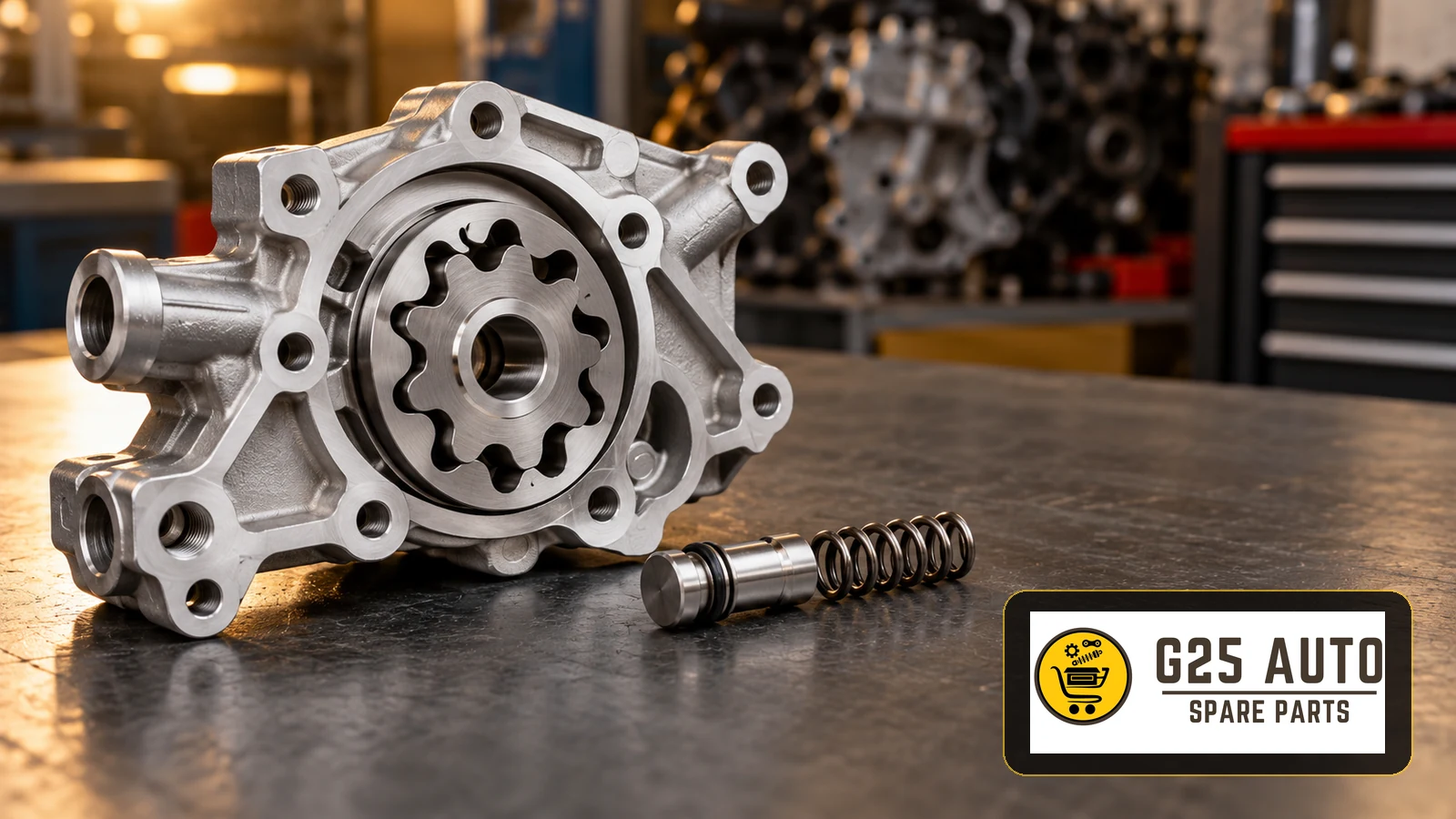
The engine oil pump is a vital component that circulates oil to the engine’s moving parts. The pressure regulator is the valve mechanism in the lubrication system that helps keep oil pressure within its specified range. Together, these components support lubrication and help limit engine wear.
A disruption to the lubrication system can cause serious engine damage. Understanding how the oil pump and pressure regulator work, recognising fault symptoms and knowing when replacement is necessary is therefore important.
What Is an Engine Oil Pump and How Does It Work?
An engine oil pump is a mechanical device, often driven by the crankshaft, that draws oil from the sump and delivers it through the engine’s oil passages. It supplies the lubrication system serving critical areas such as crankshaft bearings, connecting-rod bearings, piston pins, the camshaft, cylinder head and turbocharger, where fitted.
Two common pump designs are:
- Gear oil pumps: Meshing gears rotate to draw in and move oil. This is a widely used pump arrangement.
- Rotor oil pumps: Oil moves through changing spaces between the inner and outer rotors. Noise and packaging characteristics depend on the particular design.
The Role of the Pressure Regulator
Pump operation changes with engine speed, and oil pressure can rise as speed increases. Excessive pressure can contribute to leakage, seal damage and unnecessary energy consumption. The pressure regulator helps control this pressure.
A pressure regulator commonly uses a spring-loaded valve in the pump housing or engine lubrication circuit. When pressure exceeds its calibrated threshold, the valve opens to divert oil through the system’s return path. The routing and specified working pressure depend on the engine, and the regulator must match that application.
Symptoms of Oil Pump and Pressure Regulator Faults
A lubrication-system problem can produce several symptoms. None of these alone establishes a diagnosis; professional checks are necessary:
Common Fault Symptoms
- Oil warning light on the dashboard: A pressure warning, including one that persists at idle or low speed, may indicate a lubrication-system fault. It does not identify the pump as the cause by itself.
- Engine noise: Insufficient lubrication can contribute to metal contact, knocking or ticking inside the engine.
- Low oil-pressure readings: A mechanical pressure gauge may show readings below the engine’s specified values.
- Loss of performance: Inadequate lubrication can increase friction and may accompany reduced engine performance.
- Engine overheating: Oil also helps carry heat away, so insufficient lubrication can contribute to rising temperatures.
- Increased oil loss: Excessive pressure may place stress on seals and contribute to leaks.
Checks Needed for a Diagnosis
These symptoms can have several causes. A professional diagnosis may include the following checks, following the engine’s service instructions:
- Measure oil pressure with a mechanical gauge at the engine speeds and conditions specified by the manufacturer.
- Check the engine oil level and condition.
- Check for an obstructed or unsuitable oil filter.
- Investigate internal bearing wear where the diagnostic findings justify further inspection.
- Where serviceable and required, inspect the pressure-regulator spring and valve movement against the specified criteria.
- Where removal is justified, check pump clearances, housing wear and the suction side against the engine’s specifications.
Comparing Original and Aftermarket Oil Pumps
| Feature | Original Part | Aftermarket Part |
|---|---|---|
| Price | Check the current quotation. | Compare the current quotation for the correct application. |
| Compatibility | Verify the exact vehicle and engine application. | Verify the manufacturer’s application and part-number cross-reference. |
| Quality | Check the documented specification. | Assess the manufacturer’s documented specification; equivalence cannot be assumed. |
| Warranty | Check the applicable supplier terms. | Check the applicable manufacturer’s and supplier’s terms. |
| Availability | Confirm availability for the required part. | Confirm availability for the required part. |
| Service life | No universal service-life promise applies. | Comparable life cannot be assumed from the part category alone. |
What to Check When Selecting a Replacement
An oil pump is a critical engine component, so replacement selection requires care. Products differ, and choosing the wrong part can have serious consequences.
The key rule: Obtain the vehicle identification number, engine code and production date before ordering. Vehicles sold under the same model name can have different engines and may require different oil pumps.
An OEM part number is a useful reference, but it must be checked against the vehicle application. Service records, the existing component and reliable parts information can help identify it. For an aftermarket replacement, check the manufacturer’s documented cross-reference rather than relying on a similar appearance.
Oil Pump and Pressure Regulator Replacement Checklist
Important checks during replacement include:
- Confirm the correct part using the VIN, engine code and production details.
- Check the OEM reference and verify the replacement’s documented application.
- Renew the oil and filter as required by the repair and engine service instructions.
- Confirm that the pressure-regulator spring and valve meet the specified requirements.
- Fit the new gaskets and O-rings required by the installation instructions.
- Check that the oil pickup pipe and strainer are clean and undamaged.
- Check the pump for binding using the inspection procedure permitted for that design before the first start.
- Verify oil-pressure build-up during commissioning according to the engine-specific procedure; do not assume a universal time limit.
- Measure oil pressure under the specified operating conditions to verify system operation.
- Check for oil leaks and perform a road test only when the repair checks confirm that it is safe.
Selecting the Correct Part
Finding the correct replacement is a major challenge in parts sourcing. Compatibility is particularly important for internal engine components, including oil pumps and other lubrication-system parts.
Use technical support where necessary and verify the application with the VIN and engine code. Do not order solely by model name and year, because variants within the same model can require different parts.
Should I Choose an Original or Aftermarket Part?
There is no single answer for every vehicle. The decision depends on the documented requirements, budget and vehicle condition:
Factors when considering an original part:
- Review the applicable warranty and repair terms for a vehicle still under warranty.
- Check the specific requirements of a high-performance or luxury application.
- Consider the intended period of vehicle ownership.
- Check whether the verified original part fits the available budget.
Factors when considering an aftermarket part:
- Consider the vehicle’s warranty status and applicable repair requirements.
- Compare costs within the available budget after confirming suitability.
- Check whether a manufacturer provides reliable application and specification information.
- Confirm actual lead times if the original part is difficult to obtain.
In either case, the selected part must meet the application’s requirements. Price or brand category alone does not demonstrate quality or compatibility. Assess the supplier and supporting documentation before purchasing.
Tips for Protecting Oil Pump Service Life
An oil pump can be a durable component, but poor maintenance and unsuitable operating conditions can shorten its life:
- Maintain engine oil and filter changes within the manufacturer’s specified intervals.
- Use oil with the specified viscosity and approvals for the engine.
- Keep the oil level within the specified range, avoiding both underfilling and overfilling.
- Avoid placing a cold engine under heavy load; follow the vehicle’s operating guidance.
- If the oil-pressure warning appears while running, stop safely, shut down the engine and do not keep running it to investigate.
- For a vehicle left unused for a long period, follow its storage and recommissioning instructions rather than assuming periodic starting is appropriate.
Frequently Asked Questions
Can an oil pump fault cause engine damage?
Yes. A complete loss of oil circulation can cause serious engine damage rapidly. If the oil-pressure warning appears while the engine is running, stop safely and shut down the engine. Do not continue driving with an unresolved pressure warning.
Can the pressure regulator be replaced separately?
Some regulators are integrated into the oil pump, while others can be serviced separately. The answer depends on the engine design and available service parts.
How long does oil pump replacement take?
Access varies considerably between engine designs. Some pumps are relatively accessible, while others require removal of the timing cover and additional components. Obtain an application-specific labour estimate rather than relying on a universal duration.
Which other parts should be checked during replacement?
Follow the repair instructions for oil and filter renewal. Check the pickup-pipe seal, pump gaskets and, where relevant, timing-belt components, replacing parts as required by their condition and the specified procedure.
Should an oil pump be replaced simply because mileage is high?
Mileage alone does not establish that a pump needs replacement. Its condition, diagnostic findings and engine-specific maintenance instructions matter. Relevant major service work may provide an opportunity to inspect it where appropriate.
Conclusion
The engine oil pump and pressure regulator play essential roles in lubrication. Understanding their functions, recognising warning symptoms and selecting the correct replacement support reliable engine operation.
Take time to verify replacement parts using the VIN and engine code. Original and aftermarket options should both be assessed against the application’s documented requirements. Base the decision on suitability and evidence, alongside cost.
Regular maintenance and the specified oil help protect the lubrication system, but cannot guarantee fault-free operation. Arrange a professional inspection promptly if warning signs appear, so that a developing problem can be addressed before further damage occurs.