
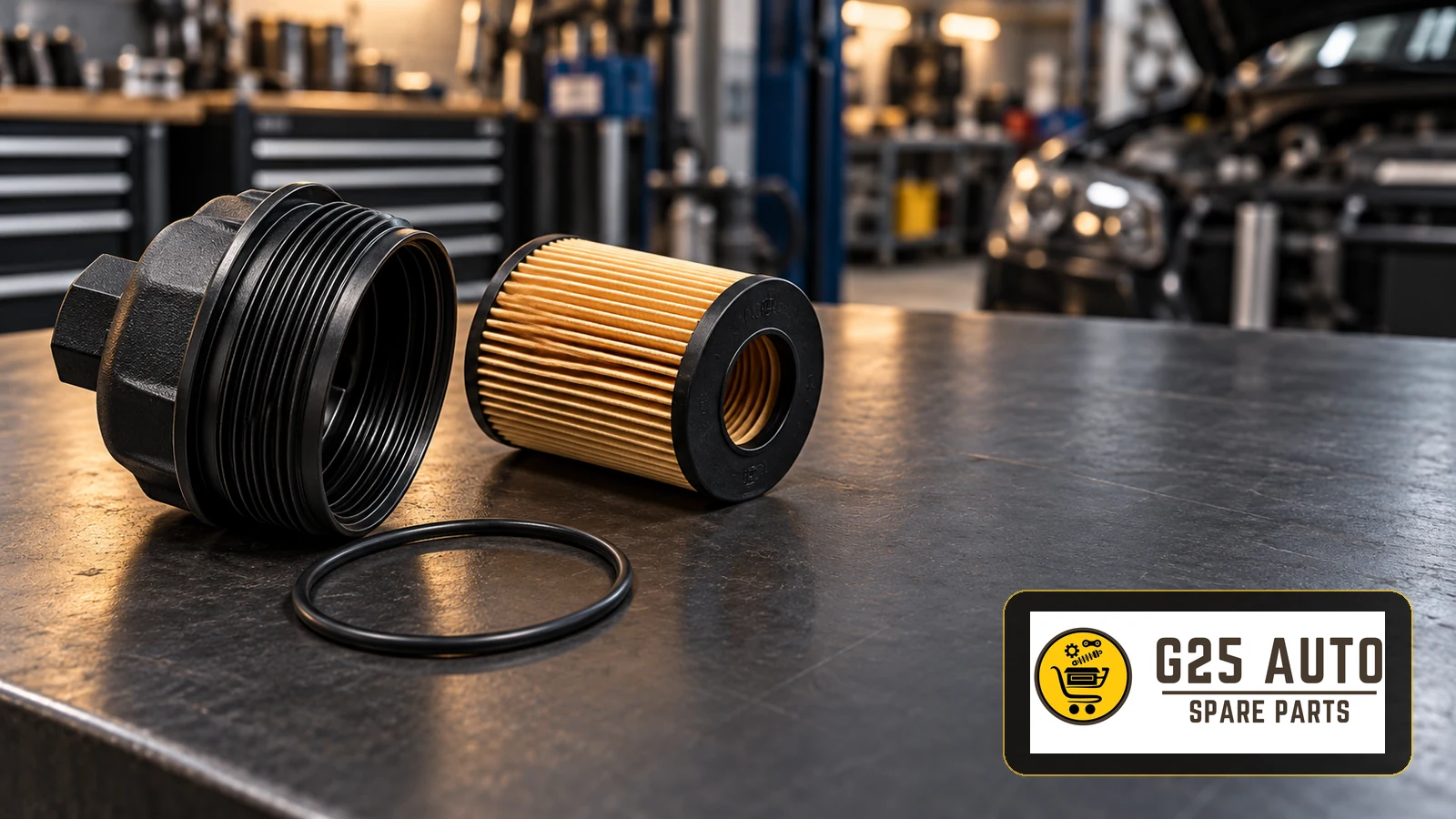
The engine oil filter housing cap and its O-ring seal are important components of the engine lubrication system. They can deteriorate and may need replacement. To choose the correct parts, verify the OEM part reference against the vehicle identification number, engine type and production information.
What Is an Engine Oil Filter Housing Cap?
The oil filter housing cap closes the filter housing and helps maintain a sealed lubrication system. Cartridge filter systems are common in modern vehicles and may use plastic or metal housing caps.
The cap retains the filter assembly as designed and works with an O-ring to seal the system under operating conditions. Housing designs vary; check the specific assembly for any integrated connections or additional features.
The O-Ring Seal and Its Importance
The O-ring is an elastomer sealing element used at the relevant joint in the oil filter assembly. The cap seal and any seal between the housing and engine are application-specific parts. Its material must meet the manufacturer’s requirements for engine oil, operating temperature and pressure.
Follow the filter and vehicle manufacturer’s instructions for renewing the O-ring during filter replacement. Reusing a deteriorated seal can cause leakage. Check whether the selected filter kit includes the correct replacement seal.
O-Ring Material Types
O-rings are available in different materials, whose suitability must be verified for the specific application:
- NBR (nitrile rubber): Check the specified compound and its oil resistance.
- EPDM: Do not assume suitability for engine oil from temperature resistance alone; use only the specified seal material.
- Viton/FKM: Verify the particular compound’s chemical and temperature suitability.
- Silicone: Application and compound specifications must be checked.
Fault Symptoms
Signs that may indicate a problem with the filter housing cap or O-ring include:
- Oil leakage or drips beneath the engine
- Oil traces around the filter
- A rapid reduction in engine oil level
- An illuminated oil pressure warning light
- A smell of burning oil from the engine compartment
- Oil collecting around the filter cap
- Visible cracks or deformation in the cap
Important: These signs do not establish a diagnosis. Other faults can produce similar symptoms. A professional workshop should inspect the system to identify the cause.
Checks Needed for a Confirmed Diagnosis
After symptoms have been observed, the diagnostic inspection should cover:
- Cleaning the engine and filter area for inspection
- Locating the leak under the operating conditions permitted by the manufacturer’s diagnostic procedure
- Removing and visually inspecting the filter cap according to the service instructions
- Checking the O-ring for cracks, hardening or deformation
- Checking the cap for cracks and other damage
- Inspecting the filter housing and mating surfaces
- Checking the specified tightening procedure and applying the manufacturer’s torque value during correct installation
Comparing Original and Aftermarket Parts
| Feature | Original Part | Aftermarket Part |
|---|---|---|
| Manufacturer warranty | Check the applicable vehicle manufacturer or supplier terms | Terms vary by manufacturer and supplier |
| Compatibility | Confirm the exact vehicle and part application | Verify the documented cross-reference and application |
| Availability | Confirm current availability with the supplier | Confirm current availability with the supplier |
| Range | Options follow the relevant original specifications | Different product specifications and ranges may be offered |
| Quality control | Check the applicable product documentation | Check manufacturer documentation and the scope of any certification |
Checklist for Selecting the Correct Parts
Use this checklist when selecting an oil filter housing cap and O-ring:
- Prepare the vehicle identification number (VIN).
- Identify the engine code from the relevant vehicle records or identification label.
- Establish the production year and month.
- Identify the OEM part reference from the existing part or an authorised parts source.
- Verify that reference against the product being purchased.
- For an aftermarket product, check the application table.
- Check any stated certification, such as ISO or TÜV, and its scope.
- Confirm whether the correct O-ring is included in the kit.
- Ensure the applicable installation instructions and tightening torque are available.
- Check the seller’s return and exchange policy.
Why Is Verification So Important?
Even within the same vehicle model, filter systems can differ by production year, engine type and equipment. Petrol and diesel versions of a model may, for example, use different filter caps.
Verifying the OEM Part Reference
The OEM reference identifies the relevant part in the vehicle manufacturer’s parts information. It can help you:
- Identify the part listed for the vehicle application
- Check cross-references in aftermarket application tables
- Reduce the risk of ordering an incorrect part
- Compare the same referenced part across suppliers
Checking the Vehicle Identification Number
The VIN identifies the vehicle. Where supported by the manufacturer’s records, it can help confirm:
- The vehicle’s production information
- The engine and transmission identification
- Factory equipment
- Relevant production revisions
VIN-based verification is particularly important around model-year changes and revisions made during production.
Aftermarket or Original?
The choice depends on the buyer’s requirements and the documented suitability of the available parts:
Reasons to Consider an Original Part
- Check any applicable vehicle warranty requirements.
- Use the vehicle manufacturer’s application information to verify fit.
- Check conformity with the manufacturer’s relevant specification.
- Confirm future availability with the supplier.
Reasons to Consider an Aftermarket Part
- A broader product range may be available.
- Availability can be checked across alternative suppliers.
- Different price and product options may be offered.
- Alternatives may have documented conformity with the required specification.
When selecting aftermarket parts, check the manufacturer’s documentation and relevant certification. Brand reputation or certification alone does not establish compatibility or performance equivalent to the original part.
Installation and Maintenance Recommendations
When replacing the filter housing cap and O-ring, observe the applicable service instructions:
- Clean the mating surfaces using a clean cloth as directed.
- Lubricate the new O-ring with the specified lubricant only where the installation instructions require it.
- Avoid twisting the O-ring when placing it in its specified position.
- Engage the cap by hand as instructed before using the specified tightening tool.
- Follow the manufacturer’s tightening torque.
- Avoid overtightening, which can damage a plastic cap.
- Check for leakage after installation using the prescribed procedure.
- Perform any subsequent inspection specified by the manufacturer; do not apply a universal distance-based retightening rule.
Frequently Asked Questions
Should the O-ring be replaced at every oil change?
Follow the vehicle and filter manufacturer’s seal replacement instructions. Reusing a damaged or deteriorated O-ring can cause leakage.
Is a plastic or metal cap better?
Choose the cap specified for the vehicle’s original housing design. Material alone does not establish suitability or equal performance.
How quickly can a leak develop?
A damaged O-ring may leak immediately, while deterioration can lead to a gradually developing leak. Timing alone cannot identify the cause.
Can a cracked cap be repaired?
A cracked or broken cap should be replaced. An attempted repair may fail to restore the required seal and can risk engine damage.
Which vehicles use this system?
Cartridge filter systems are used in many modern vehicles. Consult the manufacturer’s information to identify the system fitted to the specific vehicle.
What happens if the wrong O-ring is fitted?
An incorrect size or material can cause leakage, oil loss and engine damage. Use the seal with the correct application-specific specification.
Parts Sourcing and Selecting a Reliable Supplier
Reliable sourcing matters for oil filter housing caps and O-rings. When evaluating a supplier, check:
- Relevant industry experience and references
- OEM references in the product information
- Documented application information and any stated compatibility terms
- Clear return and exchange policies
- Customer service and technical support availability
- Access to relevant product and certification documentation
Quality Standards and Certifications
Documentation mentioned for oil filter system components may include:
- ISO 9001: Quality management system certification; verify the certified organisation and scope.
- ISO/TS 16949: An automotive quality standard reference; check the actual documentation and its validity.
- TÜV certification: Verify the particular test or approval and the product covered.
- OE approval: Verify the stated original equipment manufacturer’s approval for the relevant application.
Management system certification is not by itself evidence that an individual product has been tested for a particular vehicle or meets every required specification.
Conclusion
The engine oil filter housing cap and its O-ring contribute to sealing the lubrication system. Correct maintenance and part selection help address leakage risks and avoid damage associated with oil loss.
Verify the OEM part reference, VIN, engine type and production information before ordering. Whether choosing an original or aftermarket part, use documented application information and a reliable supplier.
If symptoms appear, have a professional workshop establish the cause. Prompt assessment can help prevent further damage.
Reliable sourcing, relevant documentation, correct installation and regular inspections support the continued operation of the vehicle’s lubrication system.