
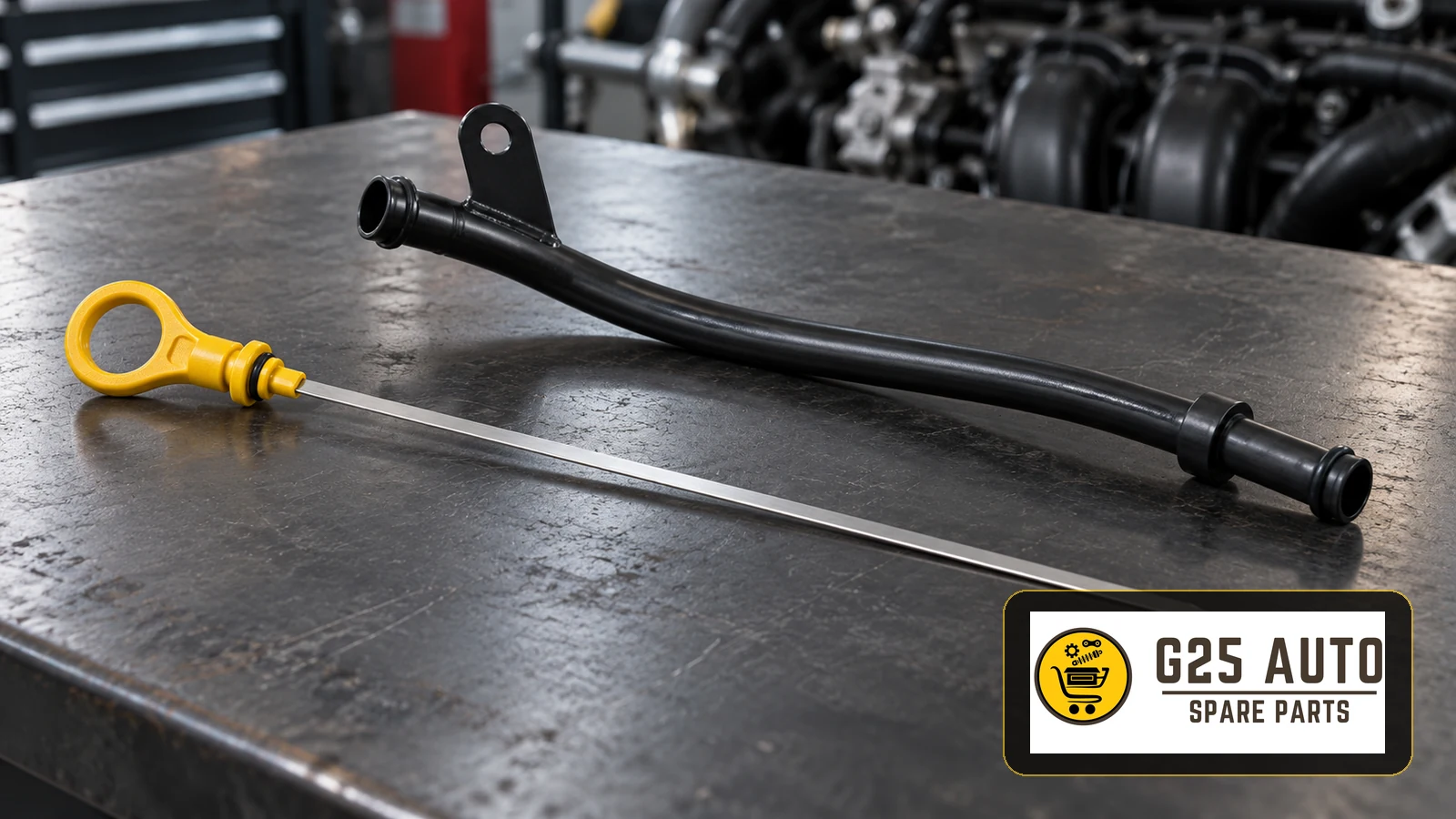
The engine oil dipstick and its guide tube form a simple but important system for measuring the oil level in your engine. A damaged dipstick or cracked guide tube can cause incorrect level readings, air leakage into the engine where the design allows it, or oil leaks. Problems may become apparent when the dipstick is difficult to withdraw, does not move freely, or oil leaks from the guide tube.
What Are the Engine Oil Dipstick and Guide Tube?
An engine oil dipstick is a metal or plastic measuring rod used to check the engine oil level. The guide tube is a channel, usually made of plastic or metal, that guides the rod down into the engine.
The dipstick system has two main components:
- Dipstick: A measuring rod with minimum and maximum oil level marks.
- Guide tube: The tube system that guides the dipstick towards the oil sump.
Symptoms of Dipstick and Guide Tube Faults
Several symptoms may appear when these parts have a problem. Remember that these observations do not establish a diagnosis:
Possible Symptoms
- Difficulty inserting or removing the dipstick
- The dipstick failing to seat fully
- An oil smell under the bonnet
- Traces of oil leakage around the dipstick
- A whistling or air leakage sound while the engine is running
- A broken or bent dipstick
- Visible cracks or breakage in the guide tube
- Incorrect oil level readings
The Diagnostic Process
These symptoms may indicate a dipstick or guide tube problem, but a professional inspection is needed to identify the cause. Engine design, materials and mounting arrangements vary between vehicles. Visual inspection, appropriate leak testing and a system check at a qualified workshop can help establish the diagnosis.
Dipstick System Checklist
Regular checks can help identify problems early:
Periodic Inspection Checklist
- Check whether the dipstick comes out of its housing freely.
- Inspect the rod for breakage, bending or deformation.
- Check the guide tube for cracks or damage.
- Look for oil leakage around the dipstick.
- Check the condition of the seal or O-ring on the dipstick, where fitted.
- Listen for air leakage around the dipstick area while the engine is running, keeping clear of moving or hot parts.
- Observe whether oil level readings are consistent when taken under the specified checking conditions.
- Check the guide tube connection to the engine.
Comparing Original and Aftermarket Parts
| Feature | Original Part | Aftermarket Alternative |
|---|---|---|
| Material quality | Check the original part specification. | Check the alternative manufacturer’s documented specification. |
| Fitment | Verify the part listed for the vehicle. | Verify the specific application; brand reputation alone does not prove fitment. |
| Supply time | Confirm the current order lead time. | Confirm current availability. |
| Cost | Obtain a current quotation. | Compare a current quotation for a verified replacement. |
| Warranty | Check the applicable manufacturer’s terms. | Check the seller’s or manufacturer’s applicable terms. |
| Durability | Assess evidence for the particular part. | Comparable performance requires evidence for the particular alternative. |
What to Check When Choosing a Part
Choosing the correct part is important when replacing an engine oil dipstick or guide tube. An incorrect part can cause installation problems, oil leaks or air leakage, depending on the engine design.
OEM Part Number and Verification
The OEM (Original Equipment Manufacturer) part number on the existing component is a useful starting point for ordering. Where present, it may be stamped onto the part or printed on a label. Check the number against the vehicle application; the number alone should not be treated as an unconditional guarantee of fitment.
Verification Using the VIN
The Vehicle Identification Number (VIN) identifies the vehicle and can be used with the appropriate vehicle records or parts catalogue. For vehicles using a 17-character VIN, the relevant records can help establish:
- The vehicle’s production year and date
- Engine type and code
- Equipment level
- Production version
This information helps identify the correct replacement for the vehicle.
Engine Code and Production Date
Vehicles of the same model may use different engine types. Check the engine code in the vehicle documentation or at the location specified for that engine. The production date also matters because manufacturers may change component designs over time. A model name alone does not establish which guide tube design is required.
Aftermarket or Original: Which Option to Consider?
Both original and aftermarket parts can be considered. Assess the particular replacement and your requirements:
Situations in Which an Original Part May Be Considered
- The vehicle is under warranty and the applicable terms need checking.
- The vehicle is a specialised or rare model.
- A verified original application is the purchasing priority.
- Originality is relevant to the vehicle’s value.
Situations in Which an Aftermarket Part May Be Considered
- Cost is an important factor.
- A documented, suitable aftermarket option has been identified.
- A suitable part is needed promptly and availability has been confirmed.
- The vehicle is outside its warranty period.
Either option should be assessed on its own merits. What matters is obtaining a correctly verified part from a reliable supplier.
Replacement and Installation
Dipstick and guide tube replacement can be straightforward, but on some vehicles the tube is mounted in a position that requires more extensive dismantling.
General Replacement Stages
Depending on the vehicle’s repair procedure, professional replacement may involve the following stages:
- Removing the old dipstick
- Checking the guide tube mounting points
- Removing the damaged guide tube if necessary
- Verifying the new components
- Replacing the seal or O-ring where required
- Installing the new guide tube
- Inserting the new dipstick
- Checking for leaks
- Checking operation
Finding the Required Parts
When looking for an engine oil dipstick, guide tube or other replacement parts, use a supplier that can help verify the application. Compare original and aftermarket options using the relevant vehicle and component information.
When ordering a part:
- Have the vehicle’s VIN available.
- Identify the engine code.
- Record the OEM number on the existing component, where present.
- Provide the production year and equipment level.
Frequently Asked Questions
How often should the dipstick be checked?
Follow the vehicle manufacturer’s oil level checking schedule and method. The condition of the dipstick itself can be visually inspected during each check. A universal fuel-stop or monthly schedule is not suitable for every vehicle.
Can a vehicle be driven with a broken dipstick?
A broken dipstick may prevent a reliable oil level check and should be assessed promptly. If broken pieces have fallen into the engine, there may be a risk of serious damage. Do not assume that driving a short distance is safe; obtain vehicle-specific advice.
Is an oil leak from the guide tube normal?
No. A leak needs investigation. It may indicate guide tube damage, a seal problem or incorrect installation.
Is there a difference between plastic and metal dipsticks?
Both materials are used in dipstick designs. Durability depends on the particular component and application, so material alone is not enough to judge suitability. Use the design specified for the vehicle.
How long does guide tube replacement take?
It depends on the vehicle and access. Some tubes are readily accessible, while others require removal of additional components. Obtain an estimate for the particular vehicle rather than relying on a universal replacement time.
Can a dipstick from a different vehicle model be fitted?
Only use a dipstick and guide tube verified for the specific application. A part from another model should not be assumed suitable; an incompatible component can give incorrect readings and cause problems.
Conclusion
The engine oil dipstick and guide tube are simple but essential components. Problems with them can make it difficult to monitor the oil level and may contribute to engine damage. Regular checks help identify faults before they become more serious.
When replacement is necessary, consider both original and documented aftermarket options. Whichever you choose, verify the application using the VIN, engine code and relevant OEM part number. These checks support correct selection and installation without providing an unconditional guarantee.
A reliable supplier can help with identifying the correct component and explaining the applicable quality and warranty information. Professional support can make the replacement process easier.
Regular checks and timely attention matter in engine maintenance. Even a small component such as a dipstick plays an important role in monitoring engine condition.