
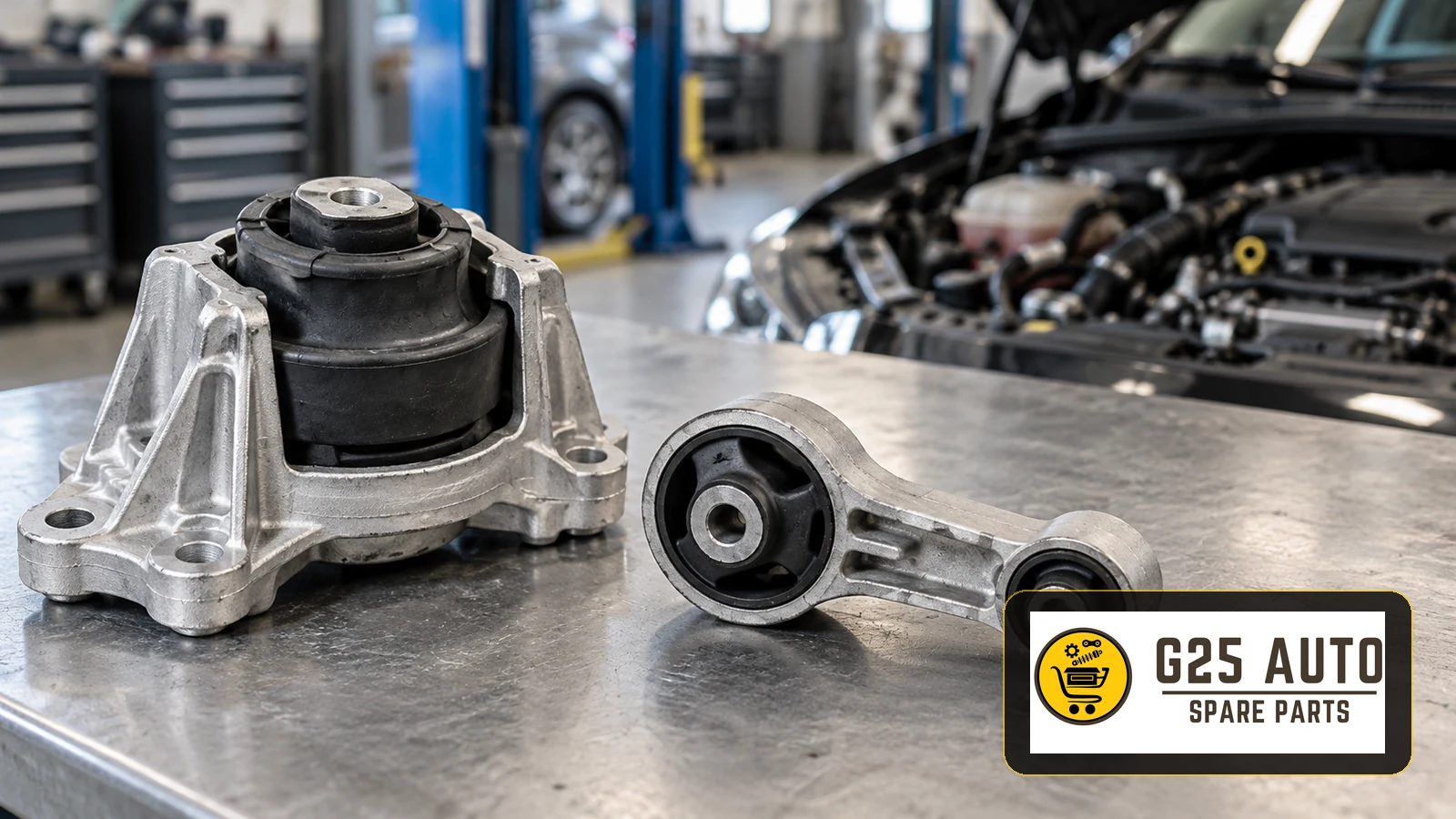
Short answer: Engine mount faults commonly show up as increased vibration at idle, jolts when pulling away or changing gear, knocking from the engine compartment and more engine movement than normal when accelerating. Since these symptoms can also result from other faults, the connections, other mounts and drivetrain should be checked together before replacing a part.
What Is an Engine Mount and What Does It Do?
An engine mount connects the engine to the vehicle body. Depending on its design, it combines a metal support with rubber or a hydraulic arrangement to damp vibration. Combustion and rotating components continually generate vibration while the engine runs. The mount reduces its direct transmission to the cabin and chassis while holding the engine in the correct position.
A vehicle may use several mounts. Depending on the engine and transmission layout, mounts can be fitted at different points. Parts described as right, left, front, rear or transmission mounts can differ in shape and function. Ordering by the term “engine mount” alone is therefore insufficient to identify the correct part.
Common Symptoms of Engine Mount Failure
Noticeable Vibration at Idle
Stronger than usual vibration through the steering wheel, seat, dashboard or gear lever while stationary is a common sign. It may become more noticeable when the air conditioning increases engine load. However, an uneven idle, ignition faults and fuel system problems can also cause vibration.
Jolts When Pulling Away or Changing Gear
Sound mounts limit engine movement as loads change. A worn engine mount may cause noticeable jolts when pulling away, lifting off and accelerating again, or shifting an automatic transmission between drive and reverse. Harsh driving can make this more pronounced.
Knocking and Thudding Sounds
If the rubber separates or a connection loosens, metal components may move closer together as the engine moves. This can cause a thud over bumps, during sudden acceleration or when switching off the engine. The suspension, exhaust hangers or transmission connections may also be the source, so locating the noise matters.
More Engine Movement Than Normal
A load test performed by a qualified technician with the bonnet open can reveal excessive forward and backward engine movement. This test carries safety risks and should not be attempted casually by the vehicle owner.
Why Do Engine Mounts Fail?
- Rubber ageing, hardening and cracking
- Engine oil or other fluids coming into contact with the rubber
- Rough roads, harsh starts and frequent stop-start driving
- Excessive vibration caused by irregular engine operation
- Incorrect installation, improper tightening or an unsuitable part
- Misalignment following an accident or engine and transmission removal
Can You Continue Driving with a Faulty Engine Mount?
Even mild symptoms should not be ignored for an extended period. Excessive engine movement can place additional strain on exhaust connections, hoses, wiring, driveshafts and other mounts. Vibration reduces comfort and may contribute to wear in surrounding components over time. The precise risk depends on the vehicle design and the severity of the fault.
How to Choose the Correct Engine Mount
- Have the VIN ready: Different engine and transmission variants of the same model may use different mounts.
- Identify the mounting position: Establish whether the part is a right, left, front, rear or transmission mount.
- Check the OEM reference: Compare the reference on the removed part with the current catalogue.
- Compare the mounting points: Check the hole pattern, bracket shape, height and orientation against the specified application.
- Confirm the mount type: Rubber, hydraulic and electronically controlled mounts must not be substituted indiscriminately.
When sourcing parts, use the part name together with its OEM reference. Request a VIN-based application check before ordering.
Choosing Between Aftermarket and Original Engine Mounts
An aftermarket product may be offered as an alternative to a stated original reference; this does not make it the vehicle manufacturer’s original part. Assess manufacturer reliability, rubber or hydraulic construction quality, dimensional accuracy, warranty and return terms alongside price. An excessively stiff mount may transmit vibration to the cabin, while an inadequately specified product may fail to limit engine movement as required.
Should All Mounts Be Replaced Together?
This is not always necessary. However, when one mount collapses, others may have carried additional loads. Inspect all engine and transmission mounts for cracks, fluid leakage, collapse and separation. If several are visibly worn, a technician may recommend replacing them together.
Frequently Asked Questions
Does an Engine Mount Increase Fuel Consumption?
A mount primarily supports the engine and damps vibration. It should not be treated as a direct cause of increased fuel consumption on its own; any accompanying engine running problems should be investigated separately.
Will Vibration Stop Immediately After Fitting a New Mount?
If the mount is the actual cause, a noticeable improvement can be expected. If vibration continues, check the ignition, idle quality, flywheel, transmission and other mounts.
Can an Engine Mount Be Repaired?
For many applications, replacement with the correctly referenced part is the appropriate lasting solution. Temporary measures that alter the component’s construction may not meet the manufacturer’s requirements.
Conclusion
Although an engine mount may look small, it plays an important role in engine positioning, cabin comfort and protecting surrounding components. Diagnose vibration and knocking before ordering a replacement, then use the VIN, mounting position and OEM reference together to verify the application.
Note: This article provides general information. Accurate diagnosis, safe testing and installation require assessment by a qualified workshop.