
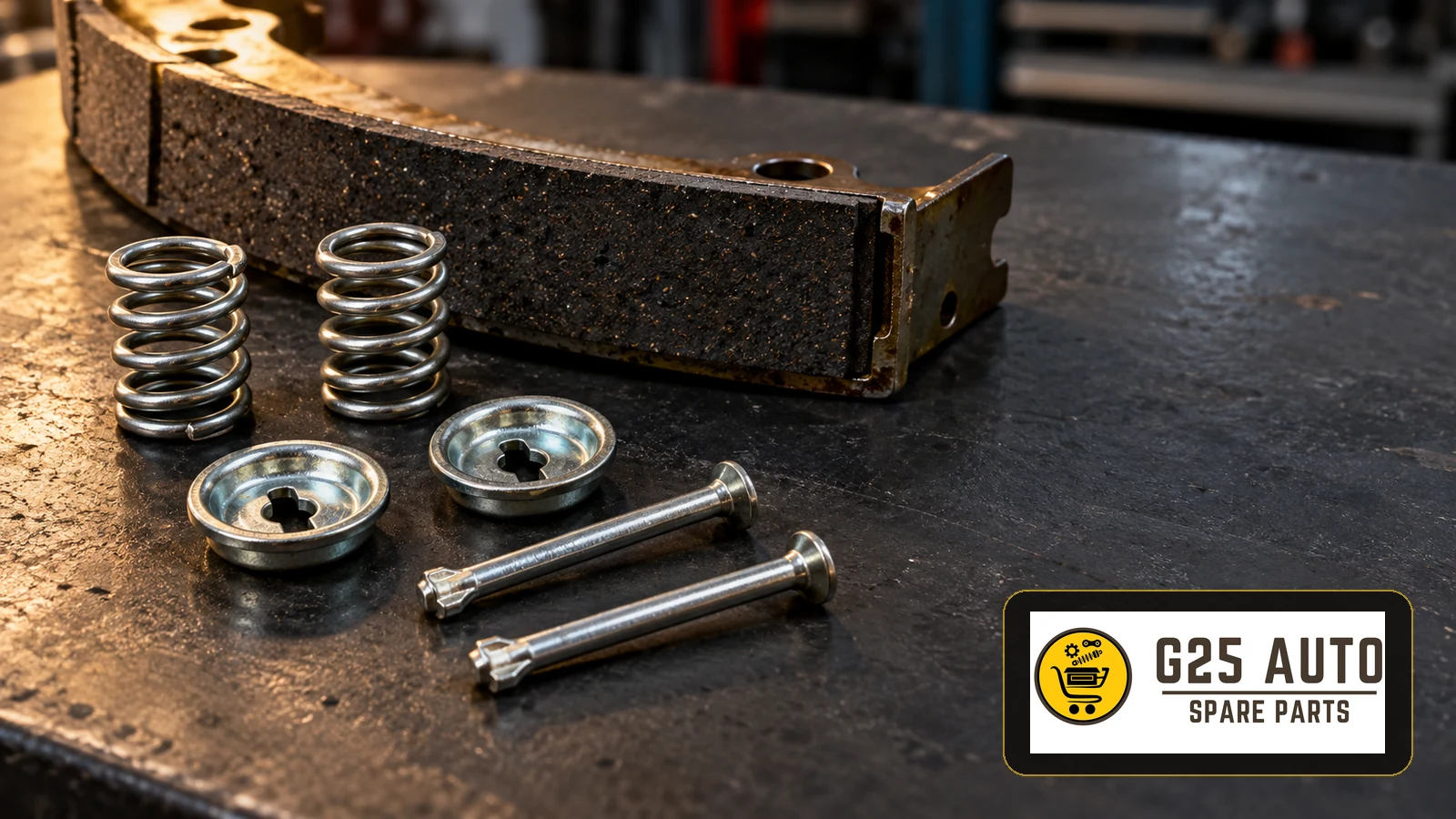
Drum brake shoe hold-down springs and pins retain the shoes against the backing plate while allowing the movement required for braking. Select replacements for the exact brake assembly, inspect the surrounding components, and follow the vehicle repair instructions. A broken or missing retainer needs professional attention before the vehicle returns to service; a similar-looking spring is not sufficient evidence of compatibility.
Understand which spring you are ordering
A conventional hold-down arrangement uses a pin, spring and retaining cup. The pin locates through the backing plate and shoe, and the spring-loaded retainer holds the shoe in its intended position. Other assemblies use different retaining designs. Identify the actual hardware rather than assuming every rear drum uses the same pin-and-cup system.
Hold-down springs and return springs have different roles
The hold-down hardware controls the shoe’s position relative to the backing plate. Return springs help retract the shoes after brake application. The adjuster and operating mechanism have their own functions. Replacing a hold-down spring does not correct a seized adjuster, a sticking wheel cylinder or a parking brake mechanism that fails to release.
Raybestos identifies springs, retaining cups and pins as the main elements of a conventional hold-down kit in its drum brake hardware bulletin. It also warns that corroded hold-down springs can break and contribute to brake drag or binding. That explains why small retaining parts belong in a complete brake inspection.
Investigate symptoms across the whole assembly
Rattling, scraping, abnormal drag, overheating or uneven braking justify investigation, but none identifies a hold-down spring fault on its own. Record when the complaint occurs and whether it followed recent brake work. Keep a vehicle with impaired braking or suspected loose internal hardware out of service until a qualified technician has assessed it.
After safe access under the applicable repair procedure, examine the retainers for missing pieces, broken coils, distortion and corrosion. Check the pins and cups together, including their seating and engagement. Inspect the backing plate around the pin locations and shoe contact areas. A new spring cannot restore a damaged mounting point.
Look beyond the visible spring
Assess shoe condition, contamination, drum wear, return springs, adjustment hardware and the operating mechanism. Where fitted, include the wheel cylinder and parking brake linkage. Record actual findings against the vehicle’s acceptance limits. Do not invent a spring tension test or judge a spring serviceable simply because it can still be compressed by hand.
Confirm the brake variant before buying
For European and Balkan workshops and distributors, a useful enquiry starts with the VIN, production information and exact rear brake position. Add the brake manufacturer or system identifier when available, together with a verified original reference or catalogue cross-reference. The VIN supports a catalogue lookup; it should not be treated as a guarantee that every installed brake component is original.
Use clear photographs of the complete assembly and individual retainers to resolve uncertainty. If requested, supply actual measurements and the specified drum or shoe information. Pin length, retaining end geometry, spring arrangement and cup design must match the documented application. Colour, approximate dimensions or a matching vehicle model name alone cannot establish fitment.
Define what the quotation includes
Confirm whether the offer covers individual retainers, a hardware set for one wheel, an axle set or a broader shoe kit. Ask for the manufacturer, part reference, supported application and itemised contents. This prevents a workshop from discovering during assembly that it has springs but no matching pins or cups.
HELLA’s brake shoe kit information illustrates the wider kit format: its described PRO package includes shoes, wheel cylinders, adjustment parts, springs, locking pins and instructions for both sides. This describes that product range, not the contents of every aftermarket kit.
Evaluate original and aftermarket offers through documented application and traceability. Confirm commercial terms for the actual order. Brand category alone establishes neither compatibility nor warranty coverage, and it does not justify assumptions about price or delivery.
Plan replacement and final verification
Raybestos recommends renewing drum brake hardware during a rear brake job. Check the relevant vehicle and kit instructions when defining the repair scope, including whether hardware is to be renewed across the axle. Inspect both sides and avoid leaving a known defect untreated. There is no universal mileage interval for this hardware that can be applied to every fleet.
Have a qualified technician follow the specified dismantling sequence, spring orientation and retaining method. Use tooling suited to the design: OTC’s hold-down spring tool description shows why engagement with the retaining cup matters. A tool intended for one style is not automatically suitable for another. Do not stretch, shorten or reshape replacement springs to make them fit.
Before release, verify retainer engagement, the correct assembly layout, adjustment and the prescribed service and parking brake checks. Where hydraulic work forms part of the repair, complete the required bleeding and leak checks. Record the checks and results rather than relying on the absence of noise during a brief drive.
Workshop and purchasing checklist
- Record the vehicle identity, brake variant and repair complaint.
- Photograph the installed hardware and complete assembly.
- Inspect pins, cups, springs, shoes and backing plate together.
- Check related causes of drag, noise and uneven braking.
- Confirm the documented replacement application and reference.
- Verify kit contents and whether the quantity covers an axle.
- Follow the specified procedure with suitable spring tools.
- Document adjustment, retention and brake function before release.
Frequently asked questions
Are drum brake hold-down springs universal?
No. Retaining designs and dimensions vary. Confirm the actual brake assembly and catalogue application before ordering.
Can a new spring repair a damaged backing plate?
No. Damage at the mounting point requires its own assessment and repair under the vehicle instructions.
Should pins and cups be checked with the springs?
Yes. They form the retaining arrangement together. Follow the prescribed replacement scope and use compatible components.
Does a rattle prove a hold-down spring has failed?
No. Inspect the complete brake assembly and other relevant causes before deciding which parts are needed.