
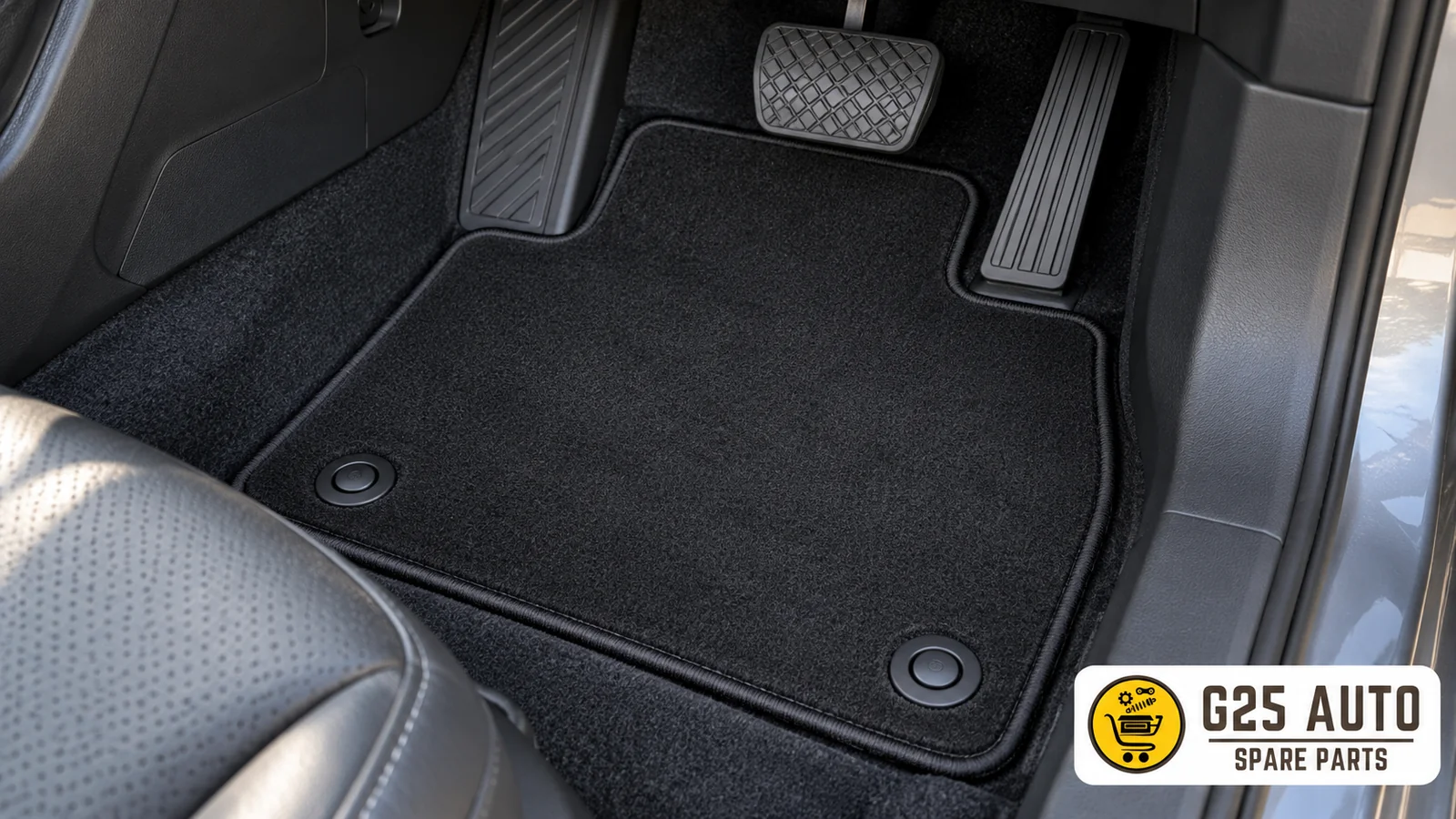
Short answer: Do not select a driver floor mat based solely on its external appearance or advertised vehicle model. Compatibility with the relevant vehicle application, retention points, and ensuring it does not obstruct pedal movement must all be verified together. Instead of improvising a broken clip with a different fastener, find the correct part identification. Do not add a second mat on top of an existing mat.
Why are mat and retention part evaluated together?
When shopping, the mat’s color, texture, and edge shape may be the first details examined. Nevertheless, how the product will be secured in the vehicle must also be explained. The presence of a fastening hole in a mat does not by itself indicate it matches the vehicle’s retention system. Read the photograph together with the product description. Instead of only asking the seller “is this for this model?” also ask which vehicle application the retention system is specified for.
Ford’s floor mat usage documentation requires the use of appropriate fasteners and that the mat does not interfere with pedal operation. Not placing an additional cover on top of an existing mat is also stated in the same document. These are not recommendations for a specific retention part for all vehicles. Refer to your own vehicle’s current documentation; do not directly transfer the number of clips or installation diagram from another application to your own vehicle.
Identify what the missing part is
In an order, the phrase “mat clip” can describe different parts. It may refer to the eyelet on the mat, the retention element on the floor, or another related component. Photograph which part is missing or damaged. Begin the conversation with a view of the entire system, then zoom in on the damaged detail. This way you can more clearly evaluate whether the product photograph from the seller shows the same part.
Photograph alone does not constitute product identification
Similar-looking fasteners may be used in different applications. Do not infer exact compatibility from the shape in the photograph and complete the order. Share the previous product reference if available, vehicle information, and the description in the relevant documentation together. If a reference cannot be read, clearly specify the missing portion. Rather than estimating the dimensions of a broken part by eye, reaching the correct application record is a more reliable starting point.
Checklist usable before ordering
| Heading | Information to verify |
|---|---|
| Vehicle application | Does the product description match the correct vehicle and version? |
| Location | Is it requested for the driver section or another location? |
| Part identification | Is the mat eyelet or floor fastener missing? |
| Package contents | Which parts shown in the image are actually delivered? |
| Documentation | Can retention and inspection instructions be accessed? |
When converting this table into an order message, instead of leaving unknown fields blank, specify “not yet verified.” For example, if you do not know from which vehicle a mat was removed, do not guess its model. Writing unverified information as definitive can lead the seller to make incorrect matching assumptions. The same clarity is required when transferring an accessory from a previous vehicle to a new one.
Separate package photograph from delivery contents
In an advertisement, a set of mats, several fastener parts, or different color options may be shown in the same frame. Do not assume this image means all parts are sent together. Read the quantity and content information in the product description. Ask in writing whether clips are sent with the mat. Expecting a separately sold fastener part inside the package can delay completion of installation even if the correct mat has been selected.
When purchasing replacement fasteners, also describe which parts are present. Instead of “set incomplete,” distinguish the intact remaining part from the requested part. Request that the description on the packaging match the description on the order line. Do not name a part the manufacturer has not specified solely from its placement in a photograph. If necessary, request the seller show on a numbered product diagram which item will be sent.
What to check during fitment inspection?
Inspection should be performed with the vehicle stationary and according to the relevant operating instructions. Proper mat placement and appropriate securing of its fasteners are evaluated. Do not accept as normal a placement that obstructs pedal movement. This article does not provide instructions for adapting by cutting the mat, drilling new holes in the floor, or replacing the fastener with another material. For a product of uncertain suitability, the correct application must first be researched.
If the mat is noticed to have shifted from position, do not identify this as merely a cosmetic issue. Show the service which section has moved and the condition of the retention parts. Placing a heavy object on top or adding a second mat to solve the problem is not a proper fitment verification. The existing product and retention should be inspected together in accordance with the vehicle’s own instructions. Do not conclude “no problem now” before completing the inspection.
Record after cleaning or service
When a mat is removed from the vehicle, reinstallation is also an inspection step. When receiving the vehicle, evaluate that the correct product has been placed in the correct location and retention has been completed. If different mats were cleaned together, do not rely solely on color similarity. A record distinguishing the product identification and location belonging to the vehicle can be helpful, especially for people using multiple vehicles. Make sure you are referring to the same part as the person performing the work.
If a damaged fastener has been replaced, note the reference of the product used. In the next purchase, you can discuss based on this reference instead of saying “the black clip bought last time.” The record may include photograph, product description, and which vehicle it was purchased for. This information does not by itself prove installation was correct; however, it makes it easier to explain which product a subsequently arising uncertainty relates to.
Sample message to send to seller
A clear message such as “I am looking for a replacement part for the driver floor mat retention fastener. Vehicle information and photographs of the existing part are attached. Can you confirm which is sent—the portion on the mat or the portion on the floor—its exact reference, and the package quantity?” can be used. Specify that the photograph belongs to the old product. If the brief reply from the seller is not sufficiently explanatory, ask separately about the remaining field.
When multiple alternatives are suggested, do not rank them by price alone. Learn for which application each is defined and which parts it covers. If there are different product options under a common image, check the selected variant. If the product name is abbreviated in the order confirmation, save the matching correspondence. This way, any possible difference between the delivered product and the ordered product can be discussed more easily.
Frequently asked questions
Can a mat labeled universal be used in every vehicle?
Do not interpret the general statement in the advertisement as definitive vehicle suitability. Application verification including retention and placement must be performed. Follow your own vehicle’s operating instructions.
Can I install any fastener in place of a broken clip?
Do not substitute an improvised fastener for correct product selection. Find the identification of the missing part and the correct reference for the application. Do not accept use as normal without verifying retention suitability.
Why should a mat not be placed on top of a second mat?
Ford’s relevant documentation explicitly prohibits this placement. Follow the relevant instructions for your own vehicle as well; do not use an additional layer as a solution to a retention problem.
Source and scope
Ford floor mat usage documentation reviewed October 30, 2026. The article does not claim a specific clip fits all vehicles; it is a general verification guide for purchasing and service communication.