
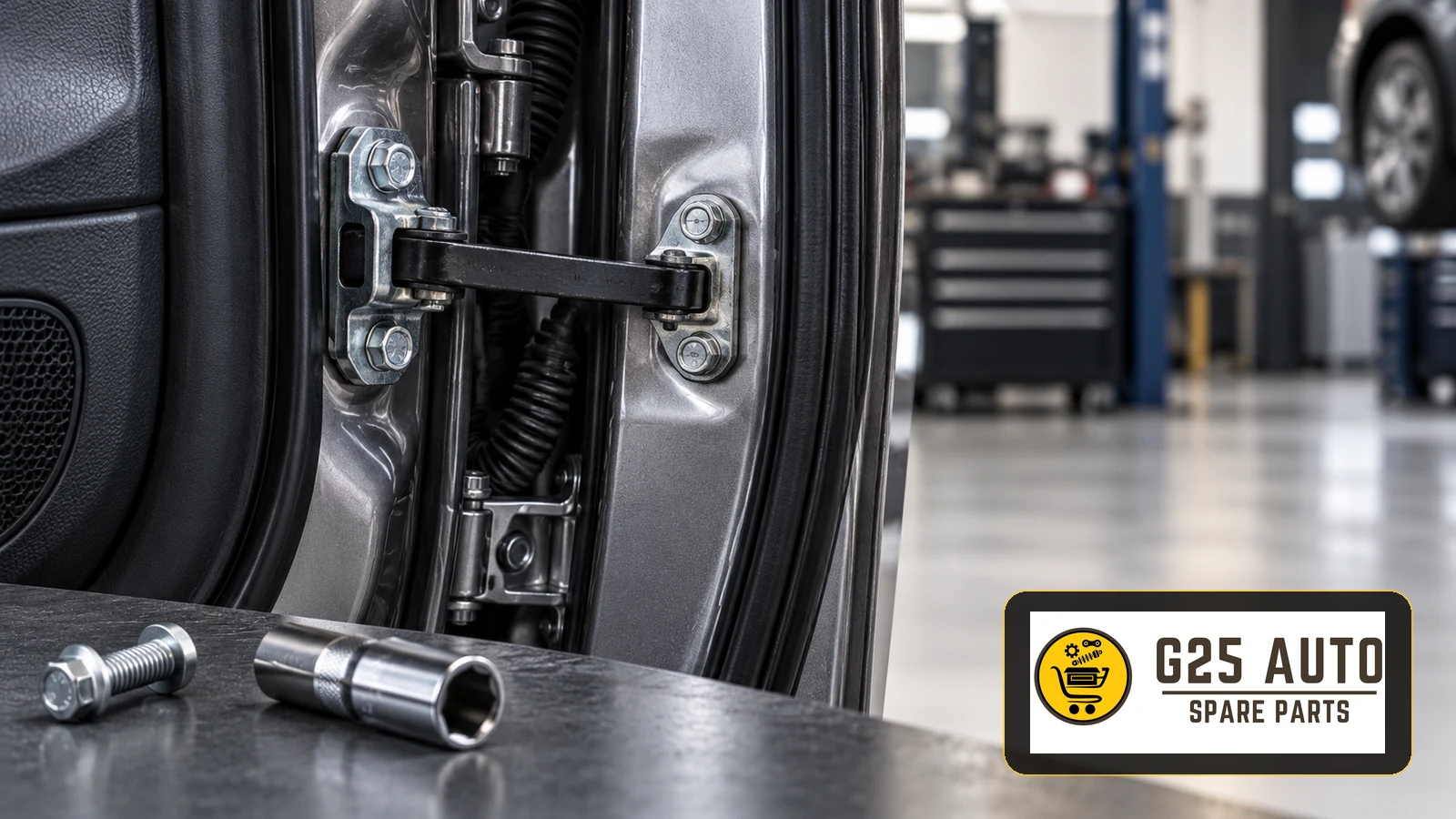
Door mechanism linkage bolts are small fasteners that help keep the relevant door components securely connected. A loose or damaged fastening can contribute to unusual noises, unwanted movement or difficulty operating the door. Correct diagnosis and selection of the appropriate replacement are essential.
What Is a Door Mechanism Linkage Bolt, and What Does It Do?
The function of a linkage bolt depends on the assembly it secures. Identify the actual component and connection before ordering: symptoms involving the handle, locking mechanism or door movement do not establish which fastening is faulty. A loose or damaged bolt can weaken the connection in the affected assembly.
The fastener’s head, position and access requirements vary with the vehicle and mechanism. Door assembly fastenings experience mechanical loads during repeated use. Their condition should be assessed rather than assuming a particular number of opening and closing cycles.
Fault Symptoms: When Is There a Problem?
Problems with door mechanism fastenings can appear through several symptoms. Recognising these signs helps arrange an inspection before further damage develops.
Common Fault Symptoms
- Loose door handle: More movement or free play than usual warrants inspection of the handle and its connections.
- Rattling or clicking: Metallic sounds when the door opens or closes.
- Difficulty opening: The door fails to open, or opens only with difficulty when the handle is pulled.
- Changes in handle resistance: The handle sometimes feels stiff and sometimes unusually light.
- Visible damage: Cracks or broken areas around a fastening when the relevant assembly is exposed.
- Shifting handle position: The handle gradually moves out of its normal position.
Checks Needed for Diagnosis
When these symptoms appear, a professional inspection should establish the cause. A workshop should consider the following checks, as appropriate to the assembly:
- Remove the door trim where necessary and visually inspect the internal mechanism.
- Check the fastening with suitable tools and the relevant service instructions.
- Confirm that the bolt head is undamaged.
- Inspect connection points for wear or breakage.
- Test the operation of the door locking mechanism.
- Assess the condition of adjacent plastic and metal components.
Important: Door handle problems are not always caused by a bolt. The fault may involve the lock, cables or the handle mechanism itself. Diagnosis should precede replacement.
Original and Aftermarket Parts Compared
Replacement options may include original parts and aftermarket alternatives. Both require checks against the particular vehicle and assembly, with attention to the product’s documented specifications.
| Feature | Original Part | Aftermarket Part |
|---|---|---|
| Compatibility | Verify the exact vehicle application and reference. | Verify the application and documented cross-reference. |
| Supply Time | Confirm current availability with the supplier. | Confirm current availability with the supplier. |
| Quality Standards | Check the specified requirements for the application. | Check product specifications and the scope of any claimed certification. |
| Warranty Coverage | Review the applicable manufacturer or seller terms. | Review the applicable supplier terms. |
| Cost | Request a quotation for the correct reference. | Compare quotations for suitable documented alternatives. |
| Range | Check the original references offered for the assembly. | Compare the relevant references offered by different manufacturers. |
Checklist for Selecting the Correct Part
Use the following checklist when ordering a door mechanism linkage bolt to help identify the correct application.
Pre-Purchase Checklist
- Record the exact vehicle make and model, such as Renault Megane or Volkswagen Passat.
- Check the body code using the available vehicle information.
- Identify the engine code if required by the parts catalogue.
- Establish the production year and month, as designs can change within a model range.
- Have the Vehicle Identification Number (VIN) available for application checks.
- Establish the OEM part reference from reliable catalogue or workshop information.
- Identify which door is involved: driver, passenger, rear right or rear left.
- Confirm the specific assembly, including whether an inner or outer handle connection is involved.
- Check the supplier’s reliability and references.
- Ensure the product description provides detailed application information.
- Read and understand the warranty terms.
- Review the returns policy.
Why Does This Information Matter?
Different equipment versions or production dates within the same model range may use different fastenings. Dimensions and specifications should be checked for the particular vehicle. The VIN is a useful identifier for catalogue checks, but the intended part and assembly must still be confirmed.
The OEM part reference is the manufacturer’s identifier for the component. It can support searches for original and aftermarket replacements. Check any aftermarket cross-reference against the actual application rather than treating it as an automatic guarantee of fit.
Replacement Procedure and Points to Watch
Replacing a door mechanism linkage bolt requires suitable mechanical knowledge and tools. Some repairs involve removing the door trim and accessing internal components. Professional assistance is recommended where the procedure is unfamiliar.
General Replacement Steps
The steps below describe the general sequence where trim removal is required; use the instructions for the particular vehicle and assembly.
- Release the inner door panel clips and screws as specified.
- Carefully disconnect any relevant wiring connections while removing the panel.
- Gain access to the affected mechanism and connection.
- Remove the old bolt with the appropriate tool.
- Fit the correct replacement and tighten it to the specified torque.
- Check the operation of the mechanism.
- Refit the panel and connections, then confirm correct operation.
Points Requiring Care
- Overtightening can damage surrounding components, including plastic parts.
- Leaving the fastening loose can allow the problem to recur.
- Work carefully around fragile panel clips.
- Do not pull forcibly on wiring connections.
- Test all affected door functions after the work.
What Should You Check When Buying Aftermarket Parts?
When choosing an aftermarket replacement, assess the particular product and supplier. Equivalent performance should be established from relevant specifications rather than assumed from the part category or price.
Quality Indicators
- Certification: Check the validity and scope of any claimed certification. A management-system certificate alone does not establish the performance or suitability of a particular bolt.
- Material quality: Check that the documented material and strength specification suit the application.
- Manufacturer information: The manufacturer’s name, address and contact details should be clearly identified.
- Packaging: Check identification and condition; attractive packaging alone does not prove product quality.
- Warranty: Review the actual terms rather than using a fixed warranty period as a measure of reliability.
- Application table: Look for detailed vehicle and assembly application information.
For G25Auto B2B parts enquiries across Europe and the Balkans, provide the vehicle details, relevant reference and exact door assembly so that the supplier can assess the required component.
Frequently Asked Questions
How Long Does a Door Mechanism Linkage Bolt Last?
Service life depends on the application, use, environment and condition of the surrounding assembly. Heavy use or accident damage may make replacement necessary. There is no universal replacement interval.
Can I Replace the Bolt Myself?
A suitably skilled person with the correct tools and instructions may be able to perform the repair. Removing door trim requires care: incorrect handling can break clips or damage wiring. Seek professional assistance if you lack experience.
Is Only the Bolt Replaced, or the Whole Mechanism?
An individually serviceable damaged bolt may be replaced on its own. If adjacent plastic retainers or connection points are also damaged, additional components may be required. Decide after a detailed inspection and check the available service parts.
Can an Aftermarket Bolt Be as Durable as an Original Part?
Durability depends on the individual product’s specifications, manufacturing quality and suitability for the application. Neither certification nor price alone establishes equivalence. Use a reliable supplier and assess the available product documentation.
Which Door Is More Likely to Show Wear?
A frequently used door, often the driver’s door, may experience more operating cycles. Actual wear depends on use and the condition of the assembly, so inspect the affected door rather than assuming a fixed failure pattern.
Can a Faulty Bolt Create a Safety Risk?
The consequences depend on the fastening and assembly involved. If a door does not operate, close or latch reliably, arrange prompt professional inspection and repair. A symptom alone does not establish that a particular bolt is the cause.
Conclusion and Recommendations
Door mechanism linkage bolts are small components whose condition can affect the connected assembly. Recognise abnormal movement, noises or difficulty opening the door, and have the cause checked instead of ignoring the symptoms.
When replacement is necessary, use the vehicle’s technical information to compare original and aftermarket options. The VIN, OEM reference, production details and any further catalogue requirements help identify the correct part. Ordering without these checks increases the risk of an unsuitable replacement and wasted time.
Assess aftermarket products through reliable manufacturer information and relevant specifications. A low price or a certification claim should not replace an application and quality check.
Correct installation matters as much as correct selection. An experienced technician can assess the fault and carry out the repair using the appropriate instructions, particularly where door operation or latching is affected.
Routine vehicle inspections can help identify developing door mechanism problems. Include the condition and operation of the affected connections in those checks.