
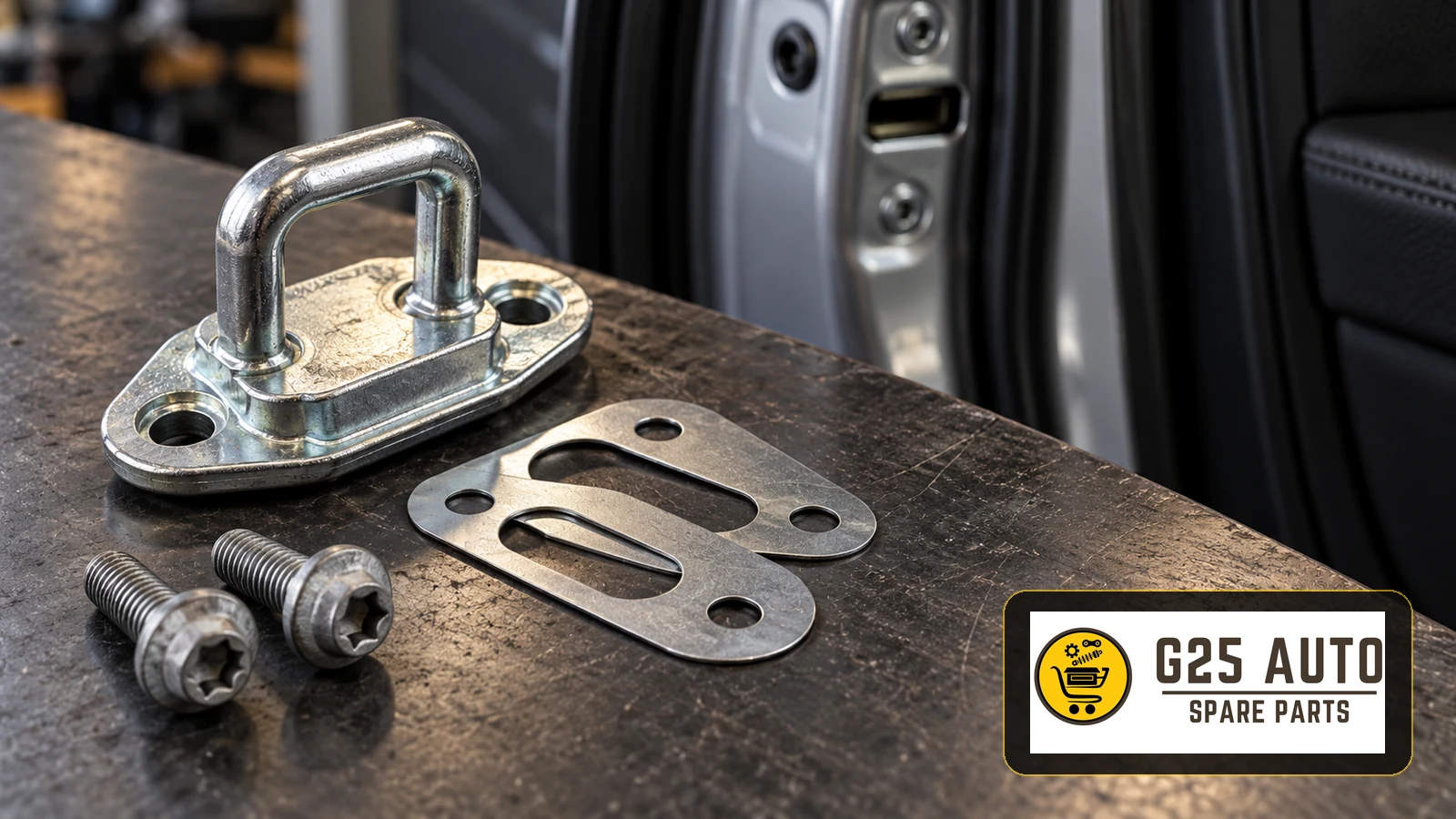
The door lock striker and adjustment plate are important components in a vehicle’s door latching system. The striker is the metal part engaged by the door latch, while the adjustment plate provides a mounting or spacing surface that helps position it correctly. Together, correctly fitted components support secure door closure, reduced unwanted noise and proper door operation.
What Are a Door Lock Striker and Adjustment Plate?
The door lock striker is one of the main parts involved in opening and closing a vehicle door. It engages with the latch inside the door to hold the door closed. Depending on the design, an adjustment or shim plate sits between the striker and its mounting surface, with the specified thickness helping establish its position.
The assembly may include the following components:
- Striker: a metal loop or hook-shaped component.
- Adjustment plate: a mounting or spacer plate in an application-specific thickness.
- Mounting bolts: fasteners securing the striker and plate to the body.
- Seals or washers: intermediate components used where specified by the design.
When Might Replacement Be Necessary?
It is important to distinguish possible fault symptoms from the checks needed to establish whether the striker or adjustment plate actually needs replacement.
Fault Symptoms That Warrant Inspection
- The door does not close fully on the first attempt.
- An unusual sound occurs when closing the door.
- Excessive movement is felt in the closed door.
- Air leakage or wind noise comes from the door while driving.
- Opening or closing the door requires unusual force.
- The latch does not engage fully or engages reluctantly.
- The door seal shows uneven wear marks.
- Rust or deformation is visible around the striker.
Diagnostic Checks
These symptoms do not necessarily mean that parts need replacement. To establish the cause:
- Visually inspect the striker for distortion or movement from its intended position.
- Check the adjustment plate for breaks, cracks or excessive corrosion.
- Check how the door latch engages with the striker.
- Inspect the striker fasteners for looseness.
- Inspect the hinges to identify other door alignment problems.
- Have a professional technician assess and measure door alignment.
Genuine and Aftermarket Parts Compared
| Feature | Genuine Part | Aftermarket Part |
|---|---|---|
| Warranty | Check the applicable vehicle brand or parts warranty terms. | Check the component manufacturer’s stated terms. |
| Fitment | Select the reference specified for the vehicle and door. | Verify the application and cross-reference information. |
| Availability | Confirm availability for the required reference. | Confirm availability with the supplier. |
| Quality control | Check the documented vehicle manufacturer specification. | Documentation and controls vary by manufacturer and supplier. |
| Cost | Compare the quotation for the specified part. | Compare suitable alternatives against the same requirements. |
| Packaging and identification | Vehicle brand packaging and identification. | Packaging and identification vary by manufacturer. |
Checklist for Choosing the Correct Part
Follow these checks when selecting a door striker and adjustment plate:
Verify the Vehicle Details
- Have the vehicle identification number (VIN) ready.
- Check the engine code where required for catalogue identification.
- Note the production date, since revisions can occur within a model year.
- Identify the exact model and trim level.
- Specify the door: front right, front left, rear right or rear left.
Check the Part Reference
- Read any OEM or part reference marked on the existing component.
- Consult the vehicle’s parts documentation or relevant catalogue.
- Have an authorised service centre or reliable parts supplier confirm the reference.
- Check cross-references when selecting an aftermarket part.
Checks Before Ordering
- Confirm that the product application information lists the relevant vehicle.
- Verify the striker type and dimensions against the required specification.
- Check that the adjustment plate thickness matches the specified arrangement.
- Establish whether mounting bolts are included.
- Read the applicable return and warranty terms.
Why Do the OEM Reference and VIN Matter?
Even a seemingly simple door striker can vary with the vehicle model, production date or trim level. These identifiers help narrow down the correct application:
OEM Part Reference
An OEM reference identifies a component within the manufacturer’s parts system. Checking it against the relevant catalogue can help:
- Identify the component required for the application.
- Distinguish revisions within a model year.
- Find relevant aftermarket cross-references for further verification.
- Reduce wasted time and expense caused by ordering an incorrect part.
Vehicle Identification Number (VIN)
The VIN is an important starting point for looking up vehicle records and catalogue data. Depending on the information available, that lookup can help establish:
- The relevant production date or production range.
- The engine and transmission configuration.
- The fitted equipment or option package.
- The vehicle’s intended market specification.
Engine Code and Production Date
The same model may be supplied with different specifications in different markets. Engine and production details, where relevant to the catalogue, help distinguish:
- Differences before and after a model update.
- Market-specific production variants.
- Changes introduced during a production series.
Installation and Adjustment Tips
Once the correct components have been selected, careful installation and adjustment are equally important:
Preparation Before Installation
- Clean the working area and prepare the necessary tools.
- Mark the existing striker position before removing it and the plate.
- Clean the mounting surface and assess any corrosion.
- Check that the new parts are complete and undamaged.
Selecting the Adjustment Plate
Where the design uses adjustment plates, their thickness affects the striker position and how the door sits against the body:
- If the door closes too tightly, check the specified spacing arrangement before changing plate thickness.
- If the closed door has excessive movement, check the plate specification and latch alignment.
- Adjustment may require an approved alternative plate thickness for that application.
- Assess seal compression against vehicle-specific guidance; there is no universal clearance or compression value.
Adjusting the Striker Position
- Follow the repair procedure for positioning the striker before final tightening.
- Adjust the horizontal and vertical position carefully.
- Check opening and closing through several cycles once the assembly is secured as specified.
- Make further small adjustments if needed.
- Use the vehicle manufacturer’s specified torque for final tightening.
Common Problems and Solutions
Incorrect Adjustment Plate Thickness
Symptom: the door closes too tightly or sits loosely when closed.
Solution: compare the fitted plates with the vehicle specification. Change the spacing arrangement only as permitted by the repair procedure rather than adding or removing arbitrary plates.
Incorrect Striker Position
Symptom: the latch does not engage fully, or the closing sound is unusual.
Solution: adjust the striker gradually in the permitted directions until it aligns correctly with the latch, following the vehicle-specific procedure.
Loose Mounting Bolts
Symptom: excessive door movement returns over time.
Solution: inspect the fasteners and mounting points, then tighten to the specified torque. Use threadlocker only where specified by the manufacturer and check the assembly again as appropriate.
What Should You Check When Choosing Aftermarket Parts?
An aftermarket component may be a purchasing option, but its quality and suitability require careful verification:
Features to Look For
- Relevant quality documentation that can be checked, rather than relying on unsupported certification claims.
- Dimensions and mounting geometry matching the required application.
- A suitable protective finish for corrosion resistance.
- Clear material information from the manufacturer.
- Written warranty terms and conditions.
Choosing a Reliable Supplier
Working with a reliable supplier is an important part of selecting an aftermarket component. For G25Auto B2B purchasing across Europe and the Balkans, compare documented application details and manufacturer information before ordering.
Useful supplier information includes:
- Detailed vehicle application information in product descriptions.
- Part references and cross-references that can be verified.
- Clear return and exchange terms.
- Access to technical support where available.
- Transparent, traceable customer feedback where available.
Frequently Asked Questions
Must the Striker and Adjustment Plate Be Replaced Together?
Not necessarily, but inspect the plate when replacing the striker. A cracked, heavily corroded or distorted plate may also need replacement. A serviceable plate may be reused where the vehicle repair procedure permits it.
Can the Same Part Be Used for Every Door?
Do not assume so. References may differ between left and right or front and rear doors. Always specify the door position and verify the part reference.
How Do I Choose the Adjustment Plate Thickness?
Start by checking the existing arrangement against the vehicle specification. If the door is too tight or loose, use the approved adjustment procedure and plate options. Correct adjustment should provide the specified seal contact without excessive closing force.
How Long Does Striker Replacement Take?
The time depends on access, condition and the adjustment required. Experience also affects the work involved. Allow enough time to establish the correct position and verify operation rather than relying on a fixed duration.
What if the Problem Continues After Replacement?
Recheck the striker position and adjustment plate arrangement. If the problem remains, the hinges or latch mechanism may be responsible. Professional diagnosis is appropriate in that situation.
Is an Aftermarket Warranty as Reliable as a Genuine Parts Warranty?
This depends on the manufacturer and the applicable terms. Compare written coverage and conditions before ordering rather than assuming equivalent protection from the part category alone.
Conclusion and Recommendations
The door striker and adjustment plate play an important role in everyday door operation, comfort and noise control. They can wear, corrode or suffer damage. Recognising symptoms early and identifying suitable replacements helps maintain proper operation.
The key points when selecting parts are:
- Verify application using the VIN, part reference and production details.
- Observe symptoms, but obtain professional inspection to establish the cause.
- Compare genuine and aftermarket options against purchasing needs and documented suitability.
- Choose reliable manufacturers and suppliers when considering aftermarket parts.
- Test the door after installation and make further adjustments if required.
There is no single answer to the choice between genuine and aftermarket components. Check any applicable vehicle warranty conditions. For either option, the correct reference, documented suitability and verified fitment remain essential.
Reliable sourcing can reduce wasted time and expense. In B2B purchasing, look for clear product descriptions, application information and identifiable manufacturer options when comparing parts.
Do not overlook a door latching problem. Misalignment can contribute to seal wear, air leakage and unreliable closure. Inspection and timely correction help maintain proper door function.