
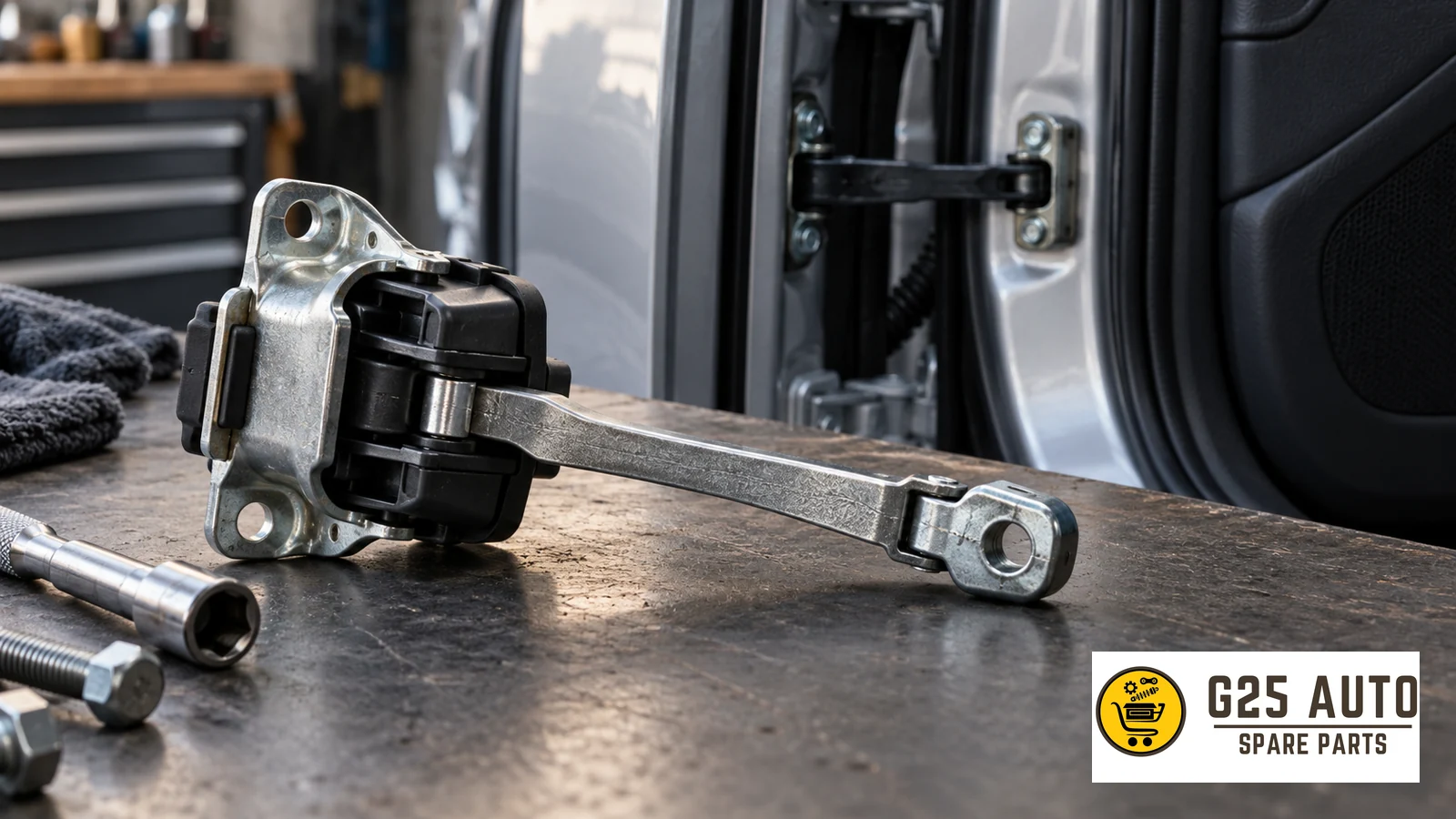
Door check straps and door stopper mechanisms help control how a vehicle door opens and closes. They hold the door at designated opening positions and resist unwanted movement, although wind and slopes can still move the door. A faulty mechanism can make door operation difficult or allow the door to swing unexpectedly, creating a safety concern as well as reducing comfort.
What Are Door Check Straps and Stopper Mechanisms?
A door check mechanism limits the opening angle and helps hold the door at particular positions. Many designs have several detent positions. The assembly connects the door to the body near the hinge area, with its arrangement depending on the vehicle.
Depending on its design, the mechanism may include the following components:
- A holding plate or detent element
- A spring-loaded retaining arm
- A stop pin or check arm
- Lubricated contact points, where specified
- A mounting bracket
These parts work together to control opening movement and hold the door at its designed positions. Their role is especially noticeable when parking on a slope or opening a door in windy conditions; the door should still be held by the user.
Symptoms of a Faulty Door Check Mechanism
Problems with a door check strap or stopper mechanism often produce noticeable symptoms:
Common Fault Symptoms
- Poor holding ability: The open door no longer stays at its designated positions and tends to close or open further.
- Squeaking and noise: Unusual squeaks, clicks or rubbing sounds occur as the door moves.
- Increased resistance: Opening or closing the door requires more force than usual.
- Loss of detent positions: The distinct stopping points disappear and movement becomes less controlled.
- Loose movement: The open door moves excessively or swings in the wind.
- Sudden closing: An unexpectedly closing door presents a safety risk and calls for inspection of the check mechanism and related parts.
Checks Needed for Diagnosis
When these symptoms appear, a professional inspection is needed to establish the cause. A qualified workshop will typically check the following:
- Visible cracks, breakage or wear in the mechanism
- The door’s ability to hold at its intended opening positions
- Play around the hinges
- The condition of any specified lubrication
- Loose or deformed mounting points
- Door and body alignment
Important: A technical inspection is needed to determine the fault and identify which component requires replacement. Visible symptoms alone can be misleading.
Verifying OEM References and Vehicle Application
Selecting the correct replacement is a key part of door check mechanism repair. Designs can differ between vehicle models and even between production versions of the same model.
Information Needed for Verification
The following information helps identify a suitable part:
- Vehicle identification number (VIN): Use the vehicle’s identification number to check the catalogue application.
- Engine code: Include it where the parts catalogue uses it to distinguish vehicle variants.
- Production date: The production month and year can help identify design changes.
- OEM part reference: Record the reference on the existing component, where legible.
- Equipment specification: Certain equipment versions may use a different mechanism.
- Door position: Identify front or rear and left or right.
Ordering without checking these details can result in an incorrect part, lost workshop time and additional costs. The VIN is a useful reference for catalogue checks, alongside the original part and relevant vehicle information.
Why Does the OEM Reference Matter?
An OEM reference identifies a component in the original equipment parts system. It is useful when comparing replacement options and checking aftermarket cross-references. A matching reference alone does not prove a replacement’s quality or suitability; the stated application and component details must also be checked.
Comparing Original Equipment and Aftermarket Parts
Original equipment and aftermarket options may be available for replacing a door check mechanism. Their suitability depends on the particular product and application.
| Feature | Original equipment part | Aftermarket part |
|---|---|---|
| Application checks | Check the current catalogue reference and vehicle specification. | Check the supplier’s application data and cross-reference. |
| Cost | Compare the quotation for the required reference. | Compare quotations for products with a verified application. |
| Warranty terms | Check the terms supplied for the particular product. | Check the manufacturer’s and supplier’s stated terms. |
| Availability | Confirm current availability with the supplier. | Confirm current availability with the supplier. |
| Quality requirements | Check the specified product and supporting documentation. | Review the manufacturer’s specification and documentation. |
| Range of options | Use the reference applicable to the vehicle. | Compare available manufacturers and product specifications. |
Which Option Suits the Requirement?
Consider the following factors when selecting a replacement:
- Vehicle age: Review the vehicle’s condition and any applicable warranty requirements.
- Budget: Compare suitable products within the available repair budget.
- Usage: Consider how frequently the door operates and assess the product specification.
- Availability: Confirm the supply position for each suitable option before ordering.
A documented aftermarket product from a reliable supplier may be an appropriate replacement. Assess the particular manufacturer, application information and product quality rather than assuming that all alternatives perform identically.
Door Check Mechanism Replacement Checklist
Check the following points before and after replacement:
Before Replacement
- ☐ Verify the VIN and vehicle details.
- ☐ Record the OEM reference from the existing component.
- ☐ Identify which door or doors are affected.
- ☐ Check for deformation around the hinges and body mounting area.
- ☐ Verify the proposed replacement against the vehicle application.
- ☐ Establish whether special fitting tools are required.
- ☐ Review any applicable warranty terms.
After Replacement
- ☐ Test holding action at all designed opening positions.
- ☐ Check for unusual noise or squeaking.
- ☐ Check that opening movement is free of abnormal resistance.
- ☐ Verify mounting fasteners against the specified fitting procedure.
- ☐ Test that the door closes fully and the latch operates correctly.
- ☐ Lubricate only where required by the mechanism’s service instructions.
- ☐ Retain the fitting records and invoice.
Maintenance and Service Life
The following practices can help maintain the condition and operation of the door check mechanism:
Routine Maintenance Recommendations
- Inspect and clean the hinge and check mechanism area as required by the vehicle’s maintenance guidance and operating conditions.
- Use only the lubricant and application method specified for that mechanism; some designs do not require added lubrication.
- Check for accumulated dirt, dust and moisture.
- Avoid forcing the door open or closed.
- Take extra care when opening a door on a slope.
- Hold the door in windy conditions to prevent uncontrolled opening.
Usage Habits That Can Cause Problems
- Forcing the door beyond its maximum opening position
- Hanging excessive weight on an open door
- Allowing the door to slam shut
- Neglecting specified lubrication and maintenance
- Ignoring early signs of a fault
Selecting Door Check Mechanisms for B2B Supply
Choosing the correct component matters for safe, dependable door operation. For G25Auto trade enquiries serving Europe and the Balkans, provide the vehicle details, door position and existing part reference.
Compare original equipment and aftermarket options using their documented applications and specifications. Confirm the proposed reference and commercial terms with the supplier before placing a B2B order.
Frequently Asked Questions
How long does replacement take?
The required workshop time depends on the vehicle model, access to the mechanism and the condition of its mountings. A workshop can assess the work for the particular vehicle.
Must all door check mechanisms be replaced if only one fails?
Usually, only the faulty mechanism needs replacement. On an older vehicle, inspect the other doors if they show similar symptoms and base any additional replacement on their condition.
Can a faulty check mechanism affect safety?
Yes. A door that suddenly swings shut can cause injury, particularly when entering or leaving the vehicle on a slope. If the door also fails to close or latch correctly, the latch, hinges and alignment need separate inspection.
Does an aftermarket replacement affect the vehicle warranty?
This depends on the applicable warranty terms and the work performed. Check those terms before repair. After the warranty period, an aftermarket option still needs to be suitable for the application and correctly fitted.
Are a door check strap and a door stopper mechanism the same thing?
These terms commonly describe the mechanism that controls door opening and helps hold it at designated positions. Terminology and component arrangements vary between vehicles.
Can I replace it myself?
The work requires the relevant mechanical knowledge, tools and vehicle-specific fitting instructions. Incorrect installation can affect door operation and safety, so professional fitting is advisable. Powered door systems require appropriate specialist expertise.
Conclusion
Door check straps and stopper mechanisms contribute to comfortable and safe door operation. Faults can create inconvenience and a risk of unexpected movement. Prompt inspection when symptoms appear can help prevent further damage.
The key replacement task is to verify the component against the vehicle. Check the VIN, OEM reference and other relevant details. When comparing original equipment and aftermarket options, consider the repair budget, vehicle age and usage.
A suitable aftermarket product can be considered alongside an original equipment option, using reliable supplier information and documented specifications. Correct use and the prescribed maintenance can help preserve the mechanism’s condition.
Door hardware deserves attention even when the components seem small. Checking its condition and addressing faults supports safe use of the vehicle and helps protect the door and surrounding bodywork.