
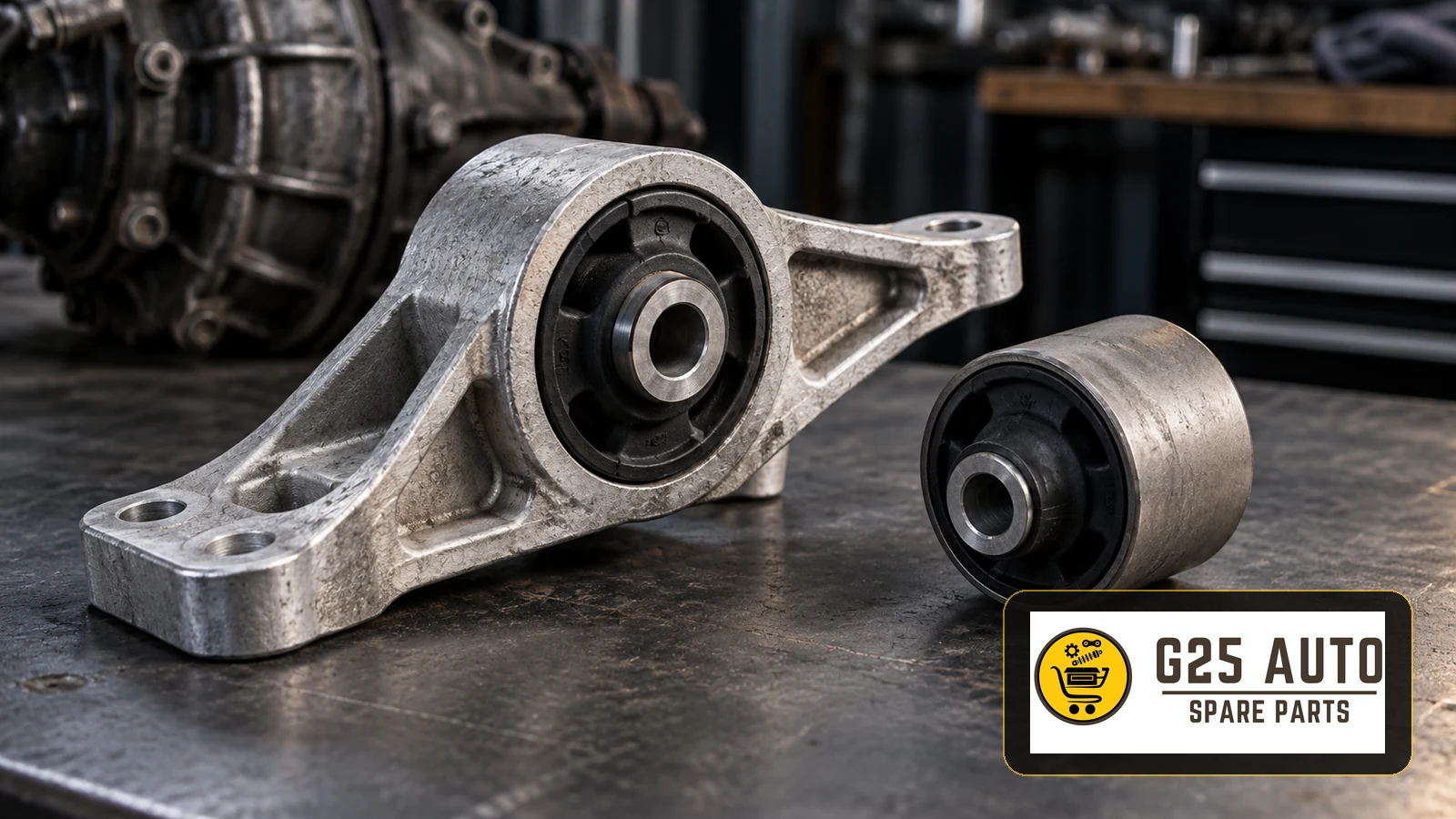
Differential mounts and bushings support the differential at its attachment points and help isolate vibration. A reported clunk or vibration needs a workshop diagnosis before parts are ordered: it does not identify a failed bushing by itself. For European and Balkan B2B buyers, the practical route is to document the complaint, identify the installed mounting arrangement and obtain application confirmation for the exact replacement reference.
Identify the mounting, not just the component name
A differential mounting is not the coupling that transfers drive between a propeller shaft and the differential input flange. Keep support brackets, mounting bushings and driveline couplings distinct on the job card and purchase order.
Rubber-to-metal mounts combine a resilient element with metal components. MEYLE’s suspension and axle mount overview describes their vibration and force absorption role. Its discussion of different mount designs also shows why a general product description cannot establish the construction of a particular differential bushing.
Ask the workshop to name the exact mounting location and show it in a photograph. State whether the enquiry concerns a bushing, a bracket assembly containing a bushing or another support component. Use this description consistently when communicating across languages and supplier catalogues.
Separate the reported symptom from the diagnosis
Record when the customer notices the complaint: taking up drive, changing gear, accelerating, slowing down or travelling over an uneven surface. Include whether it occurs cold or warm and whether earlier repairs changed it. Treat these as observations for the technician, rather than a ready-made replacement decision.
Request a written inspection finding that identifies the affected component and the evidence for replacement. Useful records can include photographs of the rubber, its bond to the surrounding metal, the bracket and nearby attachment points. Ask which checks were completed and which alternative causes remain unresolved.
Do not treat every visible crack alike
BMW’s July 2015 rear differential mount bushing bulletin distinguishes slight surface cracking from a crack extending through the bushing on the listed F10, F01 and F02 models. It does not call for replacement for the former condition, but does for the latter.
That is a model-specific assessment, not a universal acceptance standard for every mount. Ask the workshop to consult the current information applicable to the actual vehicle. A photograph showing a mark in the rubber needs interpretation in context; the purchasing team should not assign a failure threshold from a general article.
Build an enquiry that a supplier can verify
Provide the VIN, available production details, drivetrain configuration and the installed differential identification where available. Add the mounting position, legible existing references and photographs showing the complete component. Ask the workshop to flag previous axle, subframe or mounting changes.
Request confirmation for the offered manufacturer’s exact article reference against this information. Record catalogue restrictions, installation notes and any supersession. A familiar shape or a cross-reference can support the enquiry, but should not replace the supplier’s application check.
If identification remains uncertain, keep the quotation provisional and agree who will resolve it. For repeat orders, retain the evidence with the vehicle record rather than assuming a previous order for a similar vehicle settles the new application.
Compare offers on documented scope
Ask whether the offer includes a separate bushing, a complete bracket or a kit. Confirm quantities and package contents. Compare genuine and aftermarket proposals using the same application record and stated scope; neither a brand category nor a visual resemblance establishes equivalent durability or fitment.
For a proposed alternative construction, request the product manufacturer’s application and installation information before approving substitution. Obtain current price, availability and supply terms for the actual order. Record the accepted reference so that a later substitution returns for review.
Plan the repair around the actual procedure
Service access and tooling can be specific to the installation. For example, Mitsubishi’s 2010 differential carrier service procedure specifies differential removal and dedicated tools for a rear suspension crossmember bushing, including a defined tool insertion direction. This example does not describe the procedure for other vehicles.
Before releasing the parts order, ask the workshop to confirm its required tooling, support equipment and access plan against the applicable instructions. Request any specified pressing orientation, installation depth, fastening requirements and tightening sequence. This guide supplies no universal torque, pressing force or replacement method.
Inspecting related mounts can help define the job, but do not turn one confirmed defect into an automatic order for every nearby bushing. Base replacement scope on the actual findings and applicable service instructions. Confirm any required replacement hardware separately from what the bushing package contains.
Keep a useful completion record
Ask the technician to record the fitted references, work completed and results of the prescribed final checks. Where an appropriate verification drive forms part of the workshop’s process, compare the result with the originally recorded complaint. Keep unresolved symptoms visible on the handover.
Agree any further inspection according to the vehicle’s service requirements and the findings. Avoid promising a fixed service life, standard labour duration or automatic follow-up retightening interval. For recurring complaints, review the earlier diagnosis and installation record before authorising another identical order.
Workshop and purchasing checklist
- Record the complaint and the conditions in which it occurs.
- Obtain an identified fault and supporting workshop findings.
- Distinguish the mounting bushing from brackets and shaft couplings.
- Collect vehicle details, mounting location and installed-part evidence.
- Confirm the exact offered reference and catalogue restrictions.
- Clarify quantities, package contents and proposed substitutions.
- Confirm the applicable repair instructions and required equipment.
- Retain fitted references, completion checks and unresolved concerns.
Frequently asked questions
Does a clunk prove the differential bushing has failed?
No. Obtain a workshop diagnosis that identifies the cause before ordering the replacement.
Does every surface crack require replacement?
No universal rule applies. The BMW example distinguishes conditions on specified models; consult the information for the actual vehicle.
Must all differential mounts be replaced together?
Confirm the scope from inspection findings and applicable instructions rather than assuming an automatic complete set.
Can a bushing be ordered by appearance alone?
Use photographs as supporting evidence, with vehicle and mounting identification and application confirmation for the offered reference.